


Delhi’s worsening summer air linked to degraded Aravallis, rising desert dust: Experts
With Delhi’s AQI remaining in the low-to-mid 200s even during peak summer, experts warn that weakening natural barriers in Aravalli range are allowing desert dust to sweep into the capital unchecked


Delhi’s air quality index (AQI) continuing to hover in the low-to-mid 200s during peak summer months has alarmed environmental experts, who say such pollution levels were once largely associated with winter smog rather than hot-weather conditions.
On some days, the AQI has also touched the 300 mark, prompting concerns over what experts describe as an unusual and worrying shift in Delhi’s pollution pattern.
Meteorological and environmental experts attribute the trend largely to dust storms originating in the deserts and semi-arid regions of Rajasthan, carried by strong hot winds across northwest India. According to experts, the impact of these dust-laden winds was historically mitigated by the Aravalli mountain range, which acted as a natural barrier for centuries.
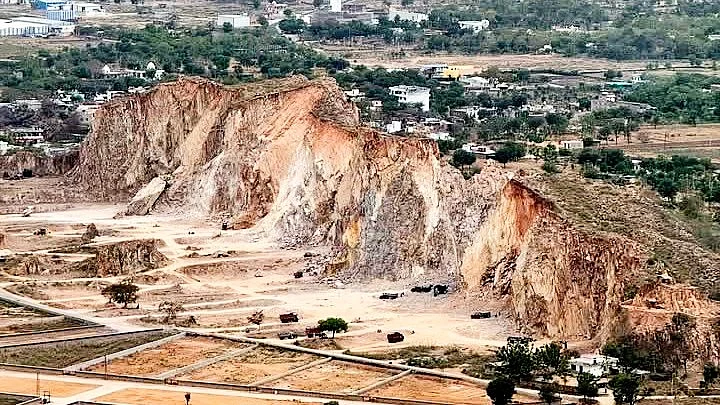
However, decades of mining, quarrying, deforestation and encroachment have weakened the Aravallis significantly, allowing desert dust to move towards the National Capital Region with far less obstruction.
“The Aravalli hills — both the long continuous ranges as well as the hundreds of smaller hills — play a critical role in controlling the spread of sand from the western Thar desert,” forest analyst Chetan Agarwal told Hindustan Times.
“The hills typically slow down winds from the west, which shed their sandy loads on the western flanks and these sands form sandy obstacle dunes,” he said.
Experts say the degradation of the Aravalli ecosystem has accelerated in recent years due to rapid urbanisation and extractive activities.
A recent study conducted jointly by researchers from the Jindal School of Environment and Sustainability (JSES) and the Indian Institute of Technology (IIT) Kharagpur found that built-up areas in the Aravalli region expanded by 53 per cent between 2017 and 2024 — an increase of nearly 2,644 square kilometres.
The study noted that much of this expansion came at the expense of croplands and rangelands, altering the ecological balance of the region.
When the findings were published in March, the dean of JSES at OP Jindal Global University had warned that mining activities — particularly those involving lead-zinc, marble, sandstone and industrial minerals — were exerting significant pressure on the Aravalli landscape.
The report highlighted the large number of active mining leases in the region and said these operations were causing “geomorphic disturbance”, weakening the hills’ ability to function as natural barriers against desertification and dust movement.
Environmentalists have long argued that unchecked degradation of the Aravallis could intensify dust pollution, reduce groundwater recharge and worsen heat conditions across northern India.
The current summer pollution levels, experts say, may now be an early indication of those long-feared consequences becoming visible in Delhi’s atmosphere.
Join our official telegram channel (@nationalherald) and stay updated with the latest headlines