


Explained: Why heavy rain repeatedly triggers landslides in Kerala
Experts say the Western Ghats' fragile geology, intense monsoon spells and decades of human intervention have made Kerala one of India's most landslide-prone states
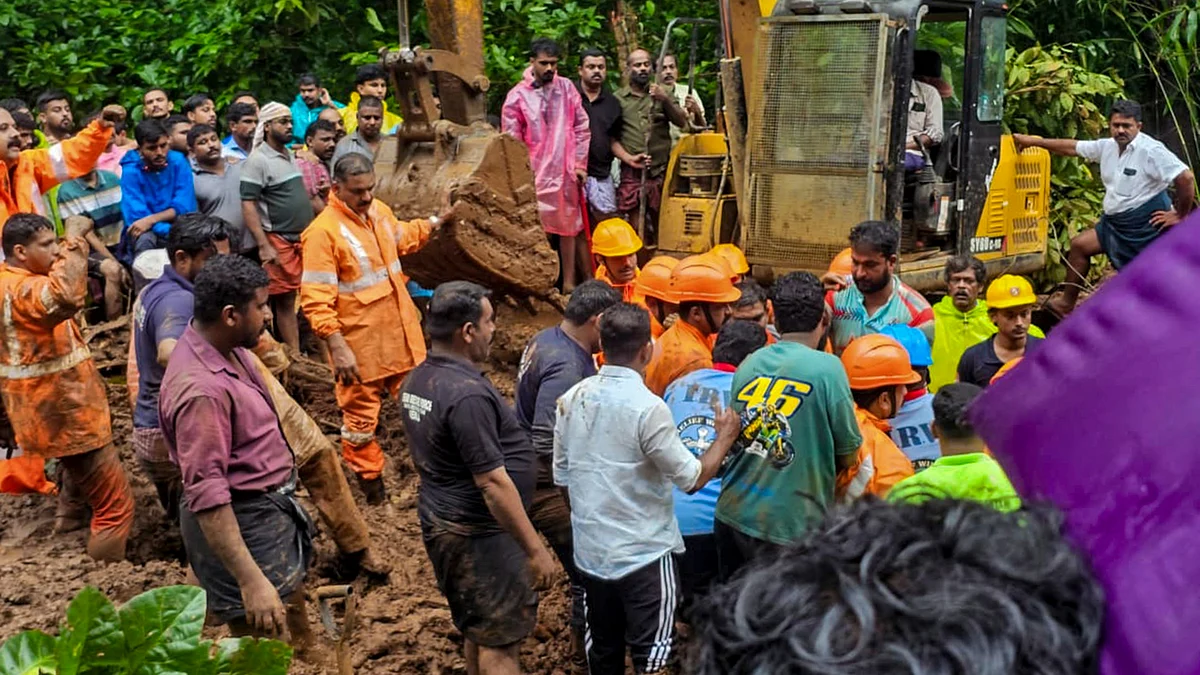


Fresh landslides, mudslides and flash floods triggered by exceptionally heavy rainfall in Kerala have once again highlighted the state's vulnerability to slope failures, with experts pointing to a combination of fragile geology, intense monsoon conditions and growing human intervention as the key reasons behind recurring disasters.
The latest spell of heavy rain, which killed at least six people and left several others missing, came almost two years after the devastating Wayanad landslides. In response, the India Meteorological Department (IMD) issued a red alert for Idukki, Kottayam, Pathanamthitta, Thrissur, Malappuram, Kozhikode, Wayanad, Kannur and Kasaragod districts, warning of heavy to extremely heavy rainfall, thunderstorms and gusty winds. The weather office also forecast strong winds of 40-50 kmph in isolated parts of the state.
Kerala Chief Minister V D Satheesan directed district administrations in Idukki, Kottayam and Pathanamthitta to undertake emergency preparations and coordinate rescue operations.
According to Neetha K Gopal, head of the IMD's Meteorological Centre in Thiruvananthapuram, the intense rainfall was caused by a combination of an offshore trough stretching from the south Gujarat coast to Kerala, strong southwesterly winds over the Arabian Sea and a pronounced north-south pressure gradient along the west coast.
Together, these weather systems strengthened the southwest monsoon, resulting in widespread heavy rainfall across Kerala rather than isolated showers.
Of the 109 IMD weather stations that recorded rainfall on Saturday, 53 received more than seven centimetres in 24 hours, while several stations recorded rainfall exceeding 20.4 cm, classified by the IMD as "extremely heavy rainfall".
Gopal said the landslides were not caused by a single spell of rain.
"It was the cumulative effect of the preceding rainfall, combined with today's intense and widespread rainfall activity," she said, explaining that large volumes of rain fell within a short period, leaving little time for water to drain.
Why do landslides occur?
Landslides are the sudden movement of rock, soil, earth or debris down a slope. They occur mainly in mountainous regions where the terrain, geology and slope conditions make the land inherently unstable.
Experts broadly classify the causes into two categories.
The first comprises conditioning factors—such as soil type, geology, geomorphology, slope angle and topography—which determine whether a region is naturally vulnerable to landslides.
The second includes triggering factors, which actually set the process in motion. These include intense or prolonged rainfall, earthquakes, snowmelt, flooding that undercuts slopes and human activities such as hill cutting, excavation, quarrying, unscientific construction, deforestation and overgrazing.
In India, most landslides are triggered by heavy rainfall.
Why Kerala is especially vulnerable
Kerala's landslide hotspots lie along the Western Ghats, particularly in districts such as Idukki, Wayanad, Kozhikode, Malappuram, Pathanamthitta and Kottayam.
According to geologists, the region's distinctive geological structure makes it particularly susceptible to slope failures during prolonged rainfall.
Professor K S Sajinkumar of the University of Kerala has explained that much of the Western Ghats consists of a layer of loose soil resting on hard bedrock. During prolonged rainfall, water gradually seeps through the soil until it reaches the interface between the soil and the underlying rock.
The water then flows along this boundary, weakening the bond that holds the soil to the rock beneath. Once that bond weakens sufficiently, the entire mass of soil can suddenly slide downhill.
Scientists say this process is especially dangerous when prolonged rainfall first saturates the ground and is then followed by a short period of extremely heavy rainfall, which rapidly increases runoff and slope instability.
Human activities worsening the risk
Experts say natural vulnerability alone does not explain Kerala's repeated landslides.
Large-scale changes in land use, quarrying, road construction and expansion of plantations have altered the stability of slopes and disrupted natural drainage systems across the Western Ghats.
Researchers have also highlighted the role of agricultural practices.
S Abhilash, Director of the Advanced Centre for Atmospheric Radar Research at Cochin University of Science and Technology, has pointed out that many recent landslides have occurred around plantation areas.
He said native forests, whose deep-rooted trees anchor the topsoil firmly to the bedrock, have increasingly been replaced by plantation crops such as tea and coffee, whose comparatively shallow root systems provide much less slope stability during periods of heavy rain.
The Indian Space Research Organisation's National Remote Sensing Centre released a national landslide atlas in 2023 based on landslide events recorded between 1998 and 2022.
The study found that while the Himalayan region experiences more landslides overall, Kerala accounts for a disproportionately high number of landslide-related deaths within the Western Ghats, underlining the state's exceptional vulnerability.
The debate over development
The recurring disasters have repeatedly revived the debate over balancing development with ecological protection in the Western Ghats.
The 2011 Western Ghats Ecology Expert Panel, headed by ecologist Madhav Gadgil, recommended strict regulation of mining, quarrying, polluting industries and major construction projects in ecologically sensitive areas.
However, after several states opposed the report, the Centre appointed another panel under space scientist K Kasturirangan.
The Kasturirangan Committee proposed a smaller Ecologically Sensitive Area and a less stringent regulatory framework than the Gadgil panel.
Successive landslides, including the devastating Wayanad disaster and the latest incidents across Kerala, have repeatedly brought the recommendations of both committees back into focus, with experts arguing that scientific land-use planning and ecological conservation are essential to reducing future landslide risks.
Join our official telegram channel (@nationalherald) and stay updated with the latest headlines