


Of vanishing lakes, concrete jungles and thirsty cities
From Mumbai’s tanker strike to Bengaluru’s drying lakes, urban water woes escalate amid a population explosion
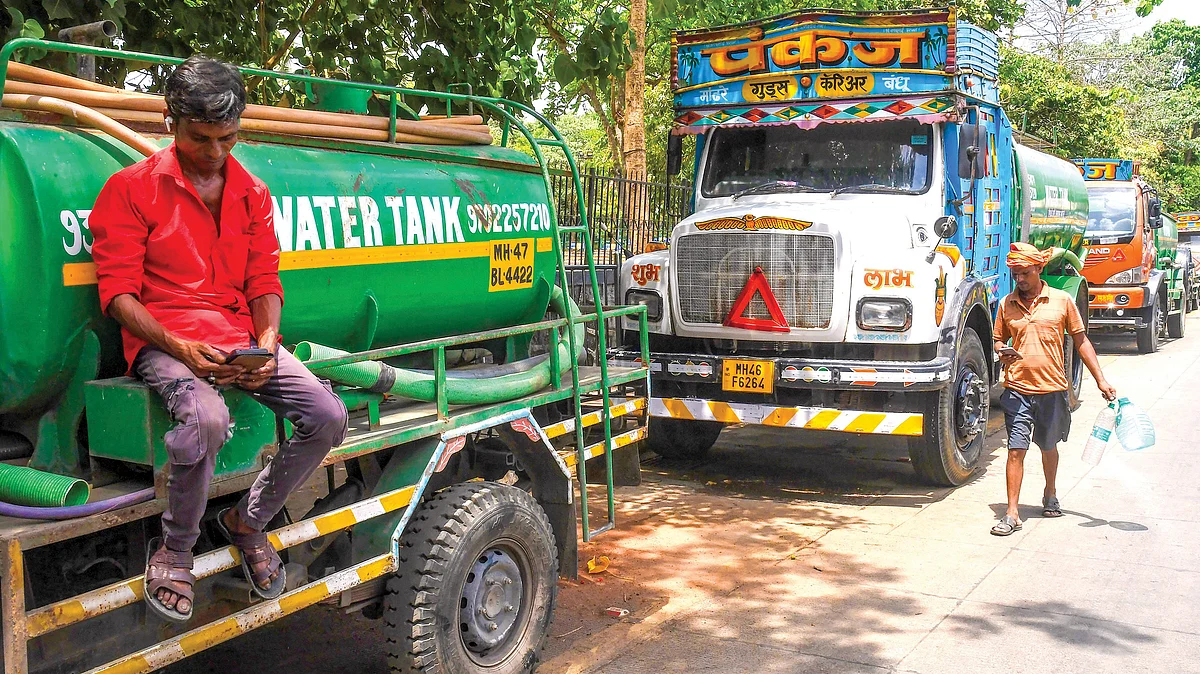


On 7 May, private water tanker operators halted services in India’s commercial capital, Mumbai. The strike was triggered by action initiated by the Central Ground Water Authority over groundwater extraction and regulatory compliance. Operators were to obtain a No Objection Certificate (NOC), prove ownership of at least 200 sq. m of land where the well is located, and ensure compliance with water quality standards set by the Bureau of Indian Standards.
Operators said the regulations threatened both their livelihoods and the water supply of millions reliant on tankers. Mumbai’s seven lakes, which supply the city’s water, are nearly empty and residents of housing societies face growing water shortages caused by this impasse.
This is the story across urban India. Lakhs of residents across Delhi’s colonies face erratic water supplies. Water levels in the Yamuna have dropped, leaving Delhi with a shortage of almost 80 million gallons per day. According to a senior Delhi Jal Board official, “The Yamuna is 6.5 ft below usual levels and the Haryana irrigation department says only 352 cusecs of water can be released. We are forced to rely on borewells and canned water.”
In nearby Gurgaon, residents of premium luxury apartments worth crores are frustrated as water rationing persists. Despite paying as much as Rs 10,000 per tanker, supply is insufficient. The Gurugram Metropolitan Development Authority attributes this to shortage of raw water, with demand far outstripping current infrastructure capacity.
Take Pune, 150 km southeast of Mumbai. Despite having four dams on the Mutha river, water shortages worsen every summer. The Pune Municipal Corporation has sought permission to draw water from the Bhama Askhed dam to meet rising demand. In just four decades, the city’s area has quadrupled — from 125 sq. km in 1987 to 508 sq. km today — and the population is up from 70 lakh in 2021 to an estimated 77.8 lakh in 2025-26.
In the south, Hyderabad faces acute shortages, with more than 20,000 tanker bookings a day. A delayed monsoon and growing dependence on tankers has forced the city’s water board to operate in three shifts, adding night deliveries.
Hyderabad-based expert Satyanarayana Bolisetty says, “Eighty per cent of Hyderabad’s lakes have been encroached upon. Earlier, the green spaces in Jubilee and Banjara Hills helped recharge groundwater. These hills have been built over, so the rain water runs off, causing localised flooding.”
India’s rapid urban population growth has compounded water stress. Metro cities — home to more than 50 crore people — face declining groundwater, erratic rain and polluted rivers. Poor planning, unchecked construction and outdated infrastructure make matters worse.
Water inequality deepens social disparities. A Greenpeace survey of 500 households in 12 of Delhi’s informal settlements found that 34 per cent buy water from private suppliers, often spending up to 15 per cent of their monthly income. The government promised 3,000 water ATMs, but has managed to instal 20 between April and June.
According to the 2023 Aqueduct Water Risk Atlas released by the World Resources Institute, India ranks #24 out of 25 nations facing ‘extremely high’ water stress. This means the country is using at least 80 per cent of its available supply.
Prof. T.V. Ramachandran of the Indian Institute of Science points out how urban planning failures have destroyed natural water recharge zones: “Bengaluru’s green cover, at 68 per cent in the 1970s, is down to four per cent. Groundwater once available at 100 ft is now 800–8,000 ft deep. In some cases, reviving green cover around the remaining lakes has helped raise groundwater to 320 feet.” He suggests adopting a ‘Green GDP’ metric that factors in environmental impact and promotes sustainable development.
Bengaluru, which had over 250 lakes in the 1970s, now has only 180, many degraded by sewage mismanagement.
Bolisetty says, “Seventy years ago, Vishakhapatnam had 104 natural tanks. Today, there are two.”
He is horrified by chief minister Chandrababu Naidu’s decision to allocate hundreds of acres, at prices way below market rates, to set up AI data centres knowing full well they need millions of gallons of water to function. “For a water-scarce state like us, where will all this water come from?” he asks.
Dehradun, once known as the ‘Venice of the East’ — with 100 canals and 40 rivers that kept the city cool and provided ample water for its famous tea gardens, orchards and basmati rice fields — has been concretised beyond recognition.
“Our rivers have been reduced to dirty nallahs. We have become a water-scarce city. Our city planners forget that urban waterbodies play a vital role in maintaining ecological balance and supporting bio-diversity,” says city-based environmentalist Renu Paul.
The World Wide Fund for Nature listed 100 cities, including 30 in India, that face ‘grave water risk’ by 2050. The list includes Delhi, Mumbai, Kolkata, Bengaluru, Lucknow and Bhopal. A 2019 Niti Aayog report had warned that 21 Indian cities risk running dry by 2020.
Prime Minister Modi’s Jal Jeevan Mission had promised household taps for 191 million homes by 2024. Claims of 60 per cent coverage are marred by corruption and unreliable data. Often, the taps are installed but there’s no water, making the scheme a washout.
The quality of water remains a serious concern. Although India possesses four per cent of the planet’s freshwater resources, it ranks 122 out of 124 countries on the 2024 World Water Quality Index. Industrial effluents and untreated sewage contaminate rivers, while harmful metals like cadmium, lead and arsenic pollute water supply.
Rivers are drying, aquifers vanish and groundwater extraction exceeds that of the US and China combined. Groundwater is being used to provide drinking water for about 85 per cent of people in rural areas and irrigation for more than 60 per cent, indicating severe overuse.
Hill stations like Shimla haven’t been spared. In 2018, taps ran dry during the tourist season when demand is highest. This story is repeated across other popular tourist and hill stations.
Himanshu Thakkar, coordinator of the South Asia Network on Dams, Rivers and People, highlights the vital role of slow rainwater absorption through forests: “Rapid runoff caused by urbanisation leads to poor water retention. Forests, wetlands, local waterbodies, and carbon-rich agricultural fields help absorb and then gradually release rainwater, supporting year-round river flow and protecting against both flood and drought.”
On 9 June, Mumbai’s tanker strike ended after Chief Minister Devendra Fadnavis promised the withdrawal of notices to well-owners and operators. But over-dependence on tankers and other short-term fixes will end only if green cover is revived as the most cost-effective way of increasing water availability.
Join our official telegram channel (@nationalherald) and stay updated with the latest headlines