


Bangladesh would've suffered kicks from Pakistani military boots without liberation: Hasina
Ousted prime minister accuses the BNP government of mistreating freedom fighters and dismantling welfare initiatives
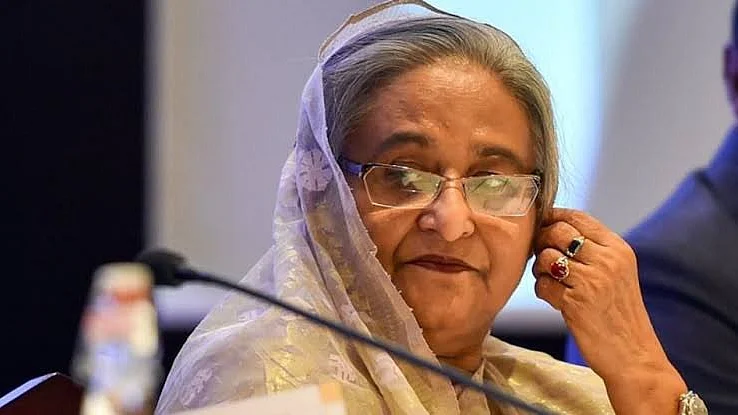


Former Bangladesh prime minister Sheikh Hasina has said the country would not have achieved independence without the sacrifices of freedom fighters, and its people would have continued to endure the brutality of the Pakistani military.
“ They would have had to suffer kicks from the boots of the Pakistani military,” Hasina said in an audio-only virtual address on Saturday, as she called on people to unite against the authorities.
Hasina was speaking through Zoom at the 98th episode of the Bangladesh Awami League's 'Dayamukti' live series. She has been living in New Delhi since fleeing Bangladesh on 5 August 2024, following a student-led uprising that brought down her 15-year government.
Her remarks come amid fresh violence in Bangladesh and days after she announced plans to return to the country on 16 December, which marks its victory over Pakistan in the 1971 Liberation War.
Calling for people to stand together, Hasina said: “We must stand together against them. If we are to live, we must live with dignity.”
She alleged that freedom fighters were being targeted and eliminated, and accused the authorities of subjecting prisoners to torture and denying them medicines and medical treatment. She also claimed that some prisoners died in custody and that their relatives were not properly informed when they were taken to hospitals.
“Today they are eliminating freedom fighters one by one,” she said, without naming any individual or group.
Hasina also alleged that a freedom fighter had been killed and his body hung from a tree, but did not provide further details.
Recalling the contribution of her father, Sheikh Mujibur Rahman, she said the “Father of the Nation” had dedicated his life to the people and given Bangladesh an independent territory and a national identity.
“He was working to change the fortunes of the people of this country, but he was not given that opportunity,” she said.
Hasina claimed that Bangladesh would have become a developed country within 10 years of independence had Mujibur Rahman been alive.
Mujibur Rahman returned from Pakistani imprisonment in January 1972 and became Bangladesh's first prime minister, having earlier served as its first president. He was assassinated along with most of his family members in a military coup at his Dhaka residence on 15 August 1975. Hasina and her sister Sheikh Rehana survived as they were in West Germany at the time.
Criticising the current administration, Hasina alleged that community clinics established during her government to provide healthcare services were being shut down. She said the clinics had offered medical assistance to mothers and expectant mothers.
She also accused those in power of wanting to keep poor people impoverished while expanding interest-based businesses. Hasina claimed that the cost of essential commodities, electricity and gas had increased, while human life had become the cheapest thing in Bangladesh.
Bangladesh is currently governed by the Bangladesh Nationalist Party (BNP), with its chairman Tarique Rahman serving as prime minister after the February elections.
The political rivalry between the Awami League and the BNP has shaped Bangladesh's politics for decades. The BNP was founded by former president Ziaur Rahman, Tarique Rahman's father, while Hasina led the Awami League following the assassination of her father.
Questioning the ban on the Awami League, Hasina said the party could not be eliminated and accused those in power of being “illegal usurpers of power”.
“How will they finish the Awami League? Is the Awami League some insignificant party? They have no right to ban the Awami League,” she said.
The party's political activities were banned in May 2025 under the interim government that succeeded Hasina's administration. The ban was upheld by the BNP government after it took office in February 2026.
Hasina was sentenced to death in absentia in November 2025 for crimes against humanity over the crackdown on protesters in 2024. She has rejected the allegations. Bangladesh has sought her extradition from India, which has said the request is being examined through a legal process.
Hasina has said she intends to return voluntarily and surrender before a court. Her lawyers had approached the Bangladesh mission in New Delhi for a fresh passport and national identity card to facilitate her return. The Bangladesh government rejected her request for fresh travel documents earlier this month.
Join our official telegram channel (@nationalherald) and stay updated with the latest headlines