


First-person account from Strait of Hormuz: Open but under Iran’s control
Canadian lawyer-journalist says he counted about 90 ships stranded on Iranian side of strait during hour-long cruise
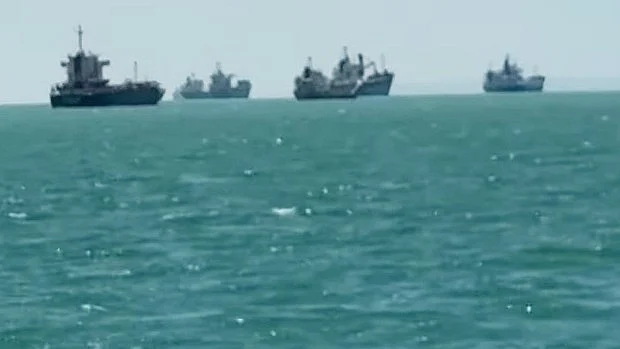


Travelling through war-ravaged Iran for the past 10 days, a group of independent ‘foreign’ journalists have been documenting the impact of the war and recording the experience of people. Dimitri Lascaris from Canada shared a video on Monday, 30 March of a cruise the group took the previous day on the Strait of Hormuz close to the Iranian coast. They were denied permission to visit the island of Hormuz because of a drone attack on the port facilities there.
The cruise lasted barely an hour, but still longer than the 20 minutes they were initially allowed. The caution was warranted partly because of the drone attacks on the group during the past few days and the deliberate killing of two journalists in Lebanon last week by Israeli attacks.
Another member of the group, asked by Lascaris in the video to describe the experience, said he was surprised to find US and Israel repeatedly bombing places they had bombed earlier in Bushehr, Minab and Bandar Abbas just after or during the group’s visit. Why would they bomb a radio station, a weather monitoring centre, a public park and a hotel which they had bombed earlier, he wondered, paranoid that the group was actually being targeted. It could not just be a coincidence surely, he asks.
The 90 ships that Lascaris counted, he says, pointed to both the north and the south, indicating that ships with Gulf countries as their destination, possibly carrying food and essential goods, as well as tankers carrying oil out of the Gulf were stranded on Sunday.
The governor of Bandar Abbas, he recalled, claimed that the strait remains open to ‘friends of Iran’ and is closed to only ships belonging to the US, Israel and their allies. Iranians insisted that contrary to Western media reports, the Strait of Hormuz remains very much open.
Meanwhile, Iran is reported to have drafted a legislation to create the 'Hormuz Law', expected create a formal toll system for the Strait of Hormuz. The law is to introduce fees on navigation and pollution in the Strait of Hormuz, creation of a 'regional fund' and formalisation of a system of long-term tolls on global shipping routes.
While the US has described these tolls on the Strait of Hormuz "illegal" and "unacceptable", Iran argues that the tolls, like the fees collected for passage through the Suez and other canals, conform to international maritime laws.
The Strait of Hormuz is one of the world's most critical oil chokepoints. It carries ~20 million barrels per day — about 20 per cent of global petroleum consumption in 2024-2025. The bulk of the oil supply — as much as 80 per cent from primarily Saudi Arabia, UAE, Iraq, Kuwait, Qatar and Iran itself —are usually headed to Asian countries. Disruption, however, would trigger severe global supply shortages and price spikes, as bypass routes are limited.
Amidst reports that the US now aims at ‘opening’ the Strait of Hormuz as its primary objective and is preparing for a ground invasion, there is growing scepticism among strategic experts on the feasibility of such plans.
John Mearsheimer pointed out that there are good reasons why all the big US Navy ships are parked far away from the Gulf today. “I don’t understand how we could possibly have a serious ground force option. Maybe with some luck we could take a small island in the Persian Gulf, but I don’t think we could hold it, and even if we did, it would hardly affect the course of the war. In the process, many Americans would die for a lost cause,” he wrote in a blog post.
Join our official telegram channel (@nationalherald) and stay updated with the latest headlines