


Iran starts to formalise chokehold on Hormuz with 'toll booth', fees in yuan
Traffic through key energy corridor collapses by 90 per cent as Tehran moves to formalise control and levy fees in yuan
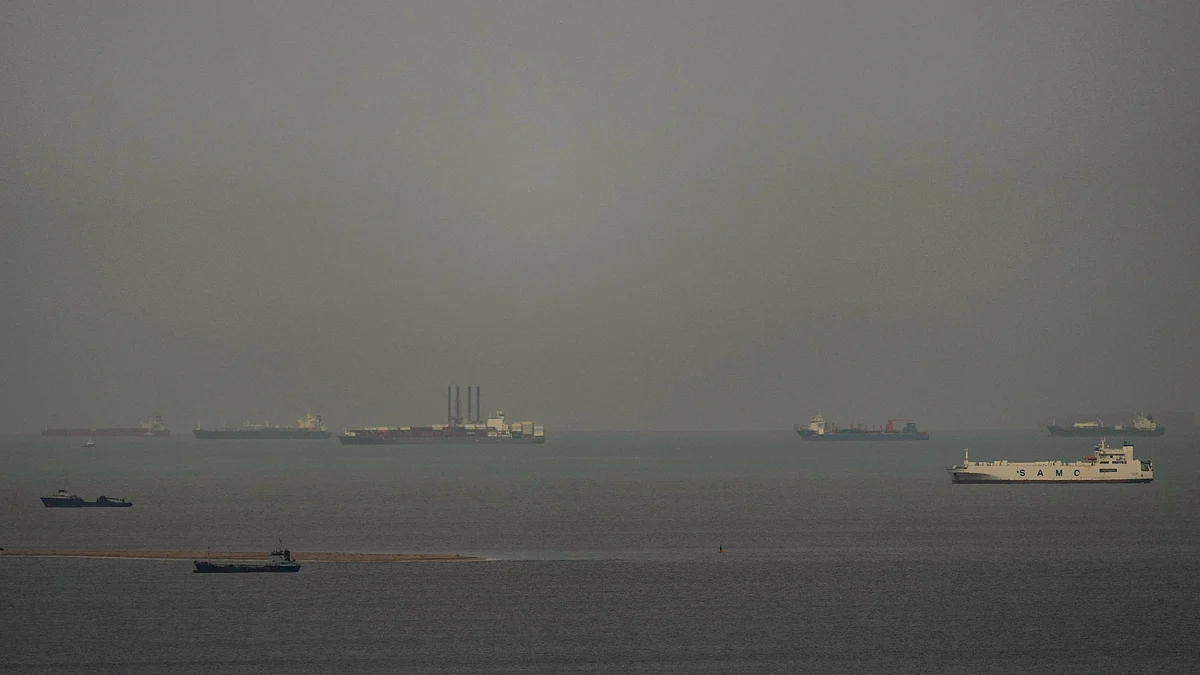


Iran appears to be positioning itself as the gatekeeper of the Strait of Hormuz — the world’s most critical artery for oil shipments — raising fears of a lasting chokehold over global energy supplies.
Shipping data, communications to the United Nations maritime authority, and vessel movements suggest Tehran is establishing what analysts describe as a de facto “toll booth” system in the narrow waterway linking the Persian Gulf to the Arabian Sea. Ships are increasingly required to enter Iranian territorial waters, submit details to intermediaries linked to the Islamic Revolutionary Guards Corps (IRGC), and undergo what has been termed “geopolitical vetting” before being allowed to pass.
At least two vessels have already paid for safe passage, with payments reportedly made in yuan, according to Lloyd’s List Intelligence.
The impact on shipping traffic has been dramatic. Since the start of the Iran war, vessel movement through the strait has plunged by about 90 per cent, intensifying pressure on global oil markets and raising concerns of supply shortages in Asian economies heavily dependent on Gulf crude.
Only about 150 ships, including tankers and container vessels, have transited the strait since 1 March — roughly equivalent to a single day’s normal traffic prior to the conflict, according to Lloyd’s List Intelligence.
Despite the disruption, Iran’s Kharg Island oil terminal loaded 1.6 million barrels in March, broadly in line with pre-war levels, with much of the crude reportedly heading to smaller independent refineries in China that are less sensitive to US sanctions pressures.
Shipping patterns show a notable shift in vessel ownership and routing behaviour. Iran-affiliated ships accounted for 24 per cent of recent transits, followed by Greece at 18 per cent and China at 10 per cent. A closer examination indicates Iran-linked vessels made up 60 per cent of early transits after the outbreak of the conflict, rising to nearly 90 per cent in recent days.
Many vessels are switching off radio identification systems before entering the strait and reappearing after crossing into the Gulf of Oman — a reflection of mounting security fears. At least 18 ships have been struck during the conflict and seven crew members killed, according to the UN’s International Maritime Organization, though responsibility for the attacks has not been specified.
Ships are increasingly avoiding the traditional two-lane shipping channel in the centre of the strait and instead taking a northern route near Larak Island, bringing them closer to Iran’s coastline and firmly within Iranian territorial waters. Entities seeking safe passage are reportedly required to submit cargo details, ownership information, destination and crew lists to approved intermediaries connected to the IRGC, after which vessels are issued clearance codes and sometimes escorted.
Oil cargo is being prioritised, underscoring Tehran’s intent to maintain its own export flows even as broader shipping traffic slows.
Iran has signalled that the current system could become permanent. In a letter to the International Maritime Organization on Tuesday, Iranian authorities said they had introduced precautionary measures aimed at ensuring maritime safety and security, maintaining that the steps are consistent with international law.
Meanwhile, Iranian lawmakers are reportedly working on legislation that would formalise fees for vessels transiting the strait, with state-linked media quoting MP Mohammadreza Rezaei Kouchi as saying parliament is pursuing a framework to codify Iran’s sovereignty and generate revenue from shipping fees.
The IMO has condemned attacks on vessels and called for coordinated international action to ensure safe navigation and uphold the principle of freedom of passage.
Criticism from Gulf states has been swift and sharp. Sultan al-Jaber, chief executive of Abu Dhabi National Oil Company, described the move as “economic terrorism”.
“Weaponising the Strait of Hormuz is not an act of aggression against one nation,” al-Jaber said at an event hosted by the Middle East Institute in Washington. “It is economic terrorism against every consumer, every family that depends on affordable energy and food. When Iran holds Hormuz hostage, every nation pays the ransom, at the gas pump, at the grocery store and at the pharmacy.”
Legal experts have also questioned the legitimacy of any transit fees. Article 19 of the United Nations Convention on the Law of the Sea guarantees “innocent passage” for civilian vessels through territorial waters.
“There’s no provision in international law anywhere to set up a toll booth and shake down shipping,” said Sal Mercogliano, a maritime historian at Campbell University. He described Iran’s actions as an attempt to leverage geographic control of the strait during a moment of geopolitical tension.
Jasem Mohamed al-Budaiwi, secretary-general of the Gulf Cooperation Council, has also termed the reported fee collection a violation of international law governing freedom of navigation.
With the Strait of Hormuz handling a substantial share of global oil shipments, any sustained disruption threatens to ripple through energy markets, trade flows and inflation worldwide — turning a regional conflict into a global economic shock.
With AP/PTI inputs
Join our official telegram channel (@nationalherald) and stay updated with the latest headlines