


Gaza children brave sniper fire to attend makeshift tent schools
Israeli bombardment destroys Gaza schools, forcing families to use makeshift tent classrooms in dangerous “yellow zones”
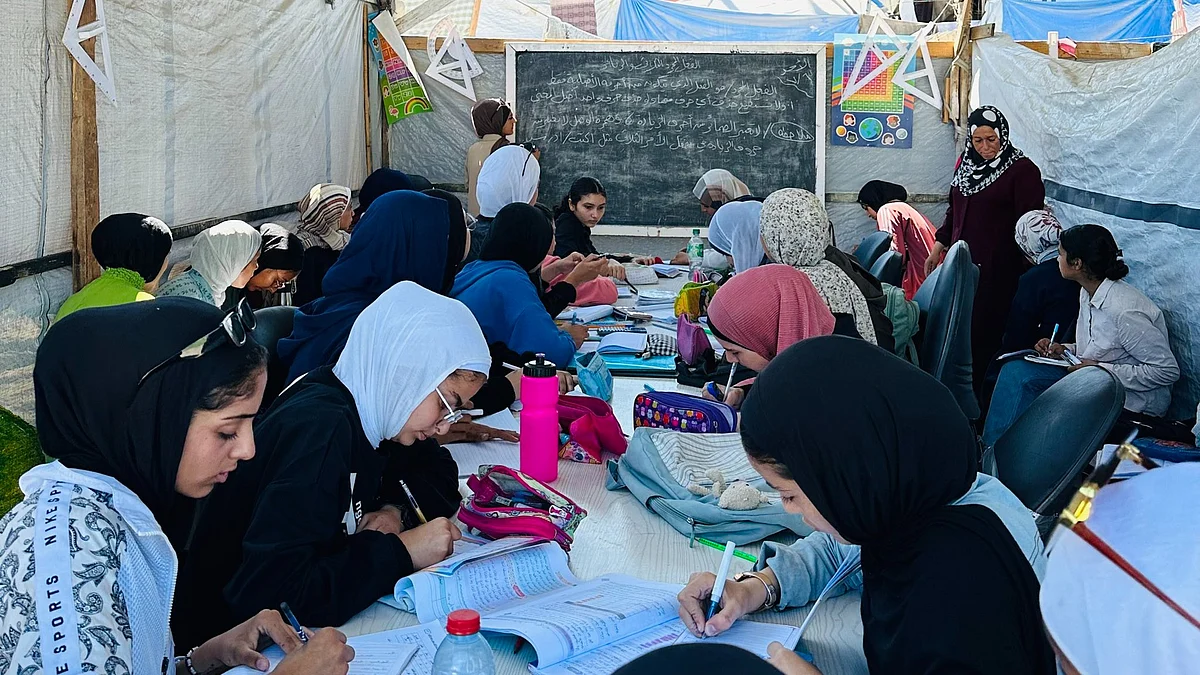


In a fragile tent overshadowed by the ominous crackle of nearby gunfire, seven-year-old Tulin readies herself for the first day of school in two long years. What would normally be a moment of joy and anticipation is instead a chapter steeped in fear for both her and her mother.
The relentless Israeli bombardment has reduced Gaza’s schools to rubble, forcing families to improvise makeshift “tent schools” in perilous zones — often mere metres from areas Israel designates as “yellow zones”, where the threat of stray bullets and sniper fire looms large.
“Until my daughter reaches school, I walk with my heart in my hand,” Tulin’s mother told Al Jazeera. “Many times, I find myself unconsciously following her. I know the danger is real, yet I want her to learn. If it weren’t for this situation, she would already be in second grade. But we are determined.”
The journey to the classroom is an ordeal. As Tulin navigates the rubble-strewn streets of Beit Lahiya, she admits to living in constant fear. “I am afraid of the shooting,” she whispered. “There is nowhere to hide. I fear the shelling or stray bullets might hit us.”
Inside the flimsy canvas walls of the tents, protection is an illusion. The walls cannot stop a bullet, yet the children sit resolute, determined to learn. Their teacher describes the daily ritual of terror: when gunfire erupts, students are instructed to lie flat, taking the “sleeping position” until the danger passes.
“The location is extremely close to the occupation forces,” the teacher told Al Jazeera. “When the shooting begins, we pray that no one gets hurt. The children lie on the ground while I whisper prayers for their safety. Despite the risks, we remain. The occupation’s policy is ignorance; ours is knowledge.”
Among the pupils is Ahmed, a young boy who has lost his father to the conflict. “We come with difficulty and leave with difficulty because of the shooting,” he said. “But I want to fulfil the dream of my martyred father — he wanted me to become a doctor.”
The desperate scenes in Beit Lahiya are but a microcosm of the broader collapse of Gaza’s education system. Speaking to Al Jazeera Arabic, Kazem Abu Khalaf, UNICEF’s spokesperson in Palestine, described the situation as “one of the greatest catastrophes.”
“Nearly 98 percent of schools in Gaza have suffered damage, some destroyed entirely,” he said. “Eighty-eight percent of these require either comprehensive rehabilitation or total reconstruction.”
The human toll is staggering. Approximately 638,000 school-aged children and 70,000 kindergarteners have lost two full academic years and are now entering a third, their education interrupted and their futures clouded.
UNICEF and partner agencies have set up 109 temporary learning centres, serving 135,000 children, but the psychological scars of war run deep. Field teams have observed alarming developmental regression, including speech difficulties affecting nearly a quarter of targeted students, underscoring the urgent need for expert intervention.
Beyond destruction and trauma, a logistical blockade compounds the crisis. Since October 2023, almost no educational materials have been permitted entry into Gaza. “The biggest challenge,” Abu Khalaf said, “is that virtually no learning materials have entered the Strip at all.”
In response, UNICEF is preparing a “Back to Learning” campaign for 200,000 children, focusing on Arabic, English, mathematics, science, and vital recreational activities aimed at repairing the psyche before anything else. Yet even these noble efforts hinge on Israel lifting restrictions to allow learning materials to flow.
“We are in constant dialogue with all parties, including Israel, to ensure children can access education,” Abu Khalaf said. “It is in no one’s interest for a child in Gaza to be denied the right to go to school.”
Amid the rubble, the fear, and the gunfire, Gaza’s children continue to cling to hope — for knowledge, for safety, and for a future that might one day be free of war.
Join our official telegram channel (@nationalherald) and stay updated with the latest headlines