


Guterres urges powerful nations to lead push for UN Security Council reform
UN chief warns outdated institutions risk losing legitimacy in a changing world
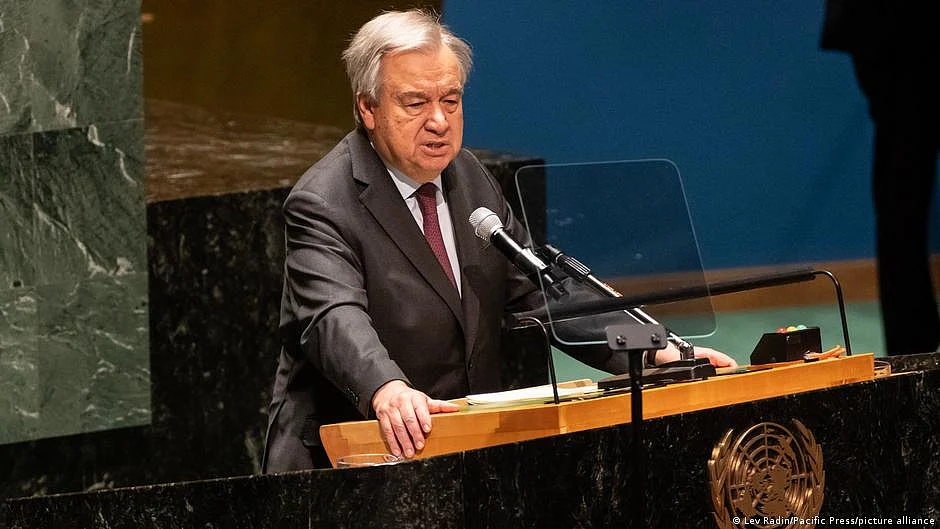


United Nations Secretary General António Guterres has called on the world’s most powerful countries to take the lead in reforming the Security Council, warning that attempts to cling to long-standing privileges could carry serious consequences in the future.
Addressing the 193-member UN General Assembly on Thursday as he set out his priorities for 2026, Guterres said global institutions must reflect contemporary political and economic realities rather than those of the post-Second World War era.
“Reform must be about institutions that reflect today’s world,” he said. “1945 problem-solving will not solve 2026 problems. If structures do not reflect our times, our world and our realities, they will lose legitimacy.”
Highlighting shifts in global economic power, Guterres noted that the share of global GDP held by advanced economies is steadily shrinking, while emerging economies continue to grow in influence. He pointed to the expansion of South-South trade, which he said is now outpacing trade among developed nations, as further evidence of the need for reform.
“Our structures must reflect this changing world,” he said, arguing that reform of international financial, trade and governance institutions was no longer optional but essential. He added that the same urgency applied to reforming the Security Council.
The UN chief stressed that it was in the direct interest of powerful states to spearhead change. “Those who try to cling to privileges today risk paying the price tomorrow,” he said, urging member states to act with courage and urgency. With his second five-year term due to end on 31 December 2026, Guterres said he was determined to make every day of his final year count.
India, which has long campaigned for reform of the Security Council, welcomed the renewed emphasis on change. New Delhi has consistently argued that the 15-member Council, established in 1945, is no longer fit for purpose and fails to reflect present-day geopolitical realities.
India has called for expansion in both permanent and non-permanent categories and maintains that it deserves a permanent seat.
India last served as a non-permanent member of the Security Council in 2021–22. Since then, deep divisions within the Council have limited its ability to respond effectively to major conflicts, including the wars in Ukraine and Gaza.
Speaking during the General Assembly debate on the Secretary General’s annual report, Eldos Mathew Punnoose, Counsellor at India’s Permanent Mission to the UN, said the organisation’s failure to act decisively in core areas was raising questions about its credibility and effectiveness.
He said these shortcomings were particularly evident in the maintenance of international peace and security, as conflicts continue to rage across multiple regions. According to Punnoose, the widening gap between global challenges and the UN’s ability to address them underlined the urgent need for structural reform.
As the United Nations approaches its 80th anniversary, India urged member states to work together towards reformed multilateralism, placing Security Council reform at its centre. Expanding the Council to better reflect current geopolitical realities, Punnoose said, was essential to ensure the UN remains capable of responding meaningfully to present and future crises.
With PTI inputs
Join our official telegram channel (@nationalherald) and stay updated with the latest headlines