


Hezbollah rejects Lebanon ceasefire as Israeli strikes kill 4
Group demands full Israeli withdrawal; truce uncertainty clouds efforts to advance broader US-Iran negotiations
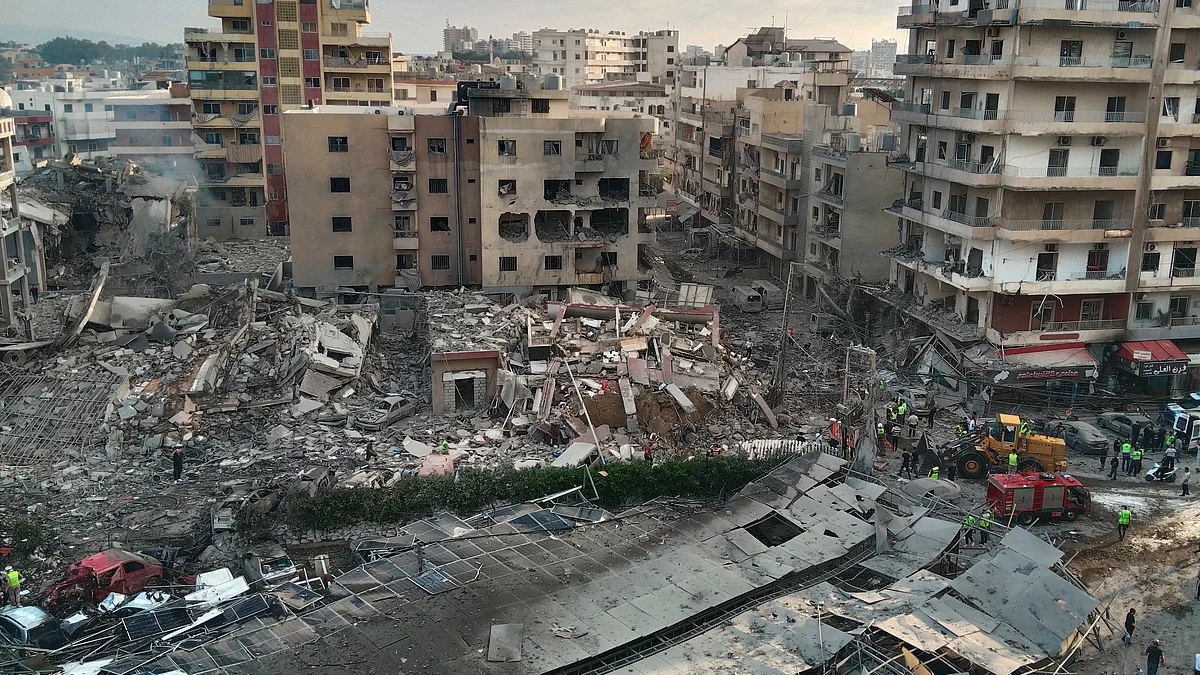


Hezbollah on Thursday rejected a newly announced ceasefire agreement between Israel and the Lebanese government, insisting that any deal must include a complete Israeli withdrawal from southern Lebanon.
The rejection came as Israeli strikes killed at least four people in Lebanon and a United Nations peacekeeper died amid ongoing hostilities, underscoring the fragility of diplomatic efforts to contain the conflict.
In a televised statement, Hezbollah chief Naim Kassem said the agreement's provision requiring the group's fighters to leave southern Lebanon while Israeli forces remain deployed amounted to "surrender" and would serve Israel's objectives.
"What we are concerned about is an end to the aggression, ceasefire and Israel's withdrawal," Kassem said.
"We did not make any commitment to any party to stop resisting as long as there is occupation," he added.
The latest setback threatens efforts to secure a broader understanding between the United States and Iran, with Tehran repeatedly linking any lasting agreement to an end to hostilities in Lebanon.
Fresh casualties
A Serbian peacekeeper serving with UNIFIL (United Nations Interim Force in Lebanon) was killed and two others were injured after a mortar struck their position near Marjayoun in southern Lebanon, according to the UN mission and Serbia's Defence Ministry.
Neither side immediately attributed responsibility for the strike.
Lebanon's state-run National News Agency reported that an Israeli drone strike killed a motorcyclist in Maaroub and wounded four others. Separate airstrikes in Sohmor in the Bekaa Valley reportedly killed three people and injured several others.
The Israeli military did not immediately comment on the reported attacks.
The latest violence came despite the announcement of a new US-brokered ceasefire arrangement between Israel and Lebanon.
Ceasefire faces uncertainty
The agreement emerged from talks between the United States, Israel and the Lebanese government and envisages the deployment of the Lebanese army in designated security zones from which Hezbollah would be excluded.
Lebanese President Joseph Aoun described the arrangement as a potential pathway towards a comprehensive ceasefire and said implementation would depend on responses from relevant Lebanese parties, including Hezbollah.
However, Israeli Defence Minister Israel Katz indicated that military operations would continue for the time being and said Israeli forces would not immediately withdraw from southern Lebanon.
The agreement does not specify a timeline for Israeli withdrawal but provides for US support to the Lebanese military as it seeks to extend state authority in areas traditionally influenced by Hezbollah.
Regional implications
The conflict in Lebanon has become closely linked to wider tensions involving Iran, Israel and the United States.
Iran has repeatedly demanded a durable ceasefire in Lebanon and the withdrawal of Israeli forces as conditions for broader negotiations.
Esmail Qaani, commander of the Quds Force of Iran's Islamic Revolutionary Guard Corps, reiterated Tehran's position on Thursday and called for Israel to pull back from Lebanese territory.
Meanwhile, hostilities have continued elsewhere in the region. Iran and the United States have exchanged attacks in and around the Strait of Hormuz, a critical global energy route that remains severely disrupted.
The latest escalation also included a strike on Kuwait International Airport on Wednesday that killed an Indian national and injured more than 60 people. Iran denied responsibility for the attack.
US President Donald Trump sought to play down concerns over repeated ceasefire violations, saying efforts to reach a broader settlement were continuing despite ongoing clashes.
The renewed fighting in Lebanon comes as diplomatic efforts intensify to prevent a wider regional conflict and secure the reopening of key shipping lanes vital to global energy supplies.
Join our official telegram channel (@nationalherald) and stay updated with the latest headlines