


‘I may be killed, but I will return’: Sheikh Hasina
Hasina urges US to support free and inclusive elections, independent courts, political reconciliation and balanced international relations
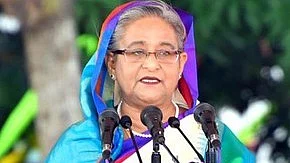


Sheikh Hasina vows to return to Bangladesh despite the risk of arrest or violence, but no date has been announced
She thanks India for providing refuge and accuses Bangladesh’s current leadership of using legal proceedings to suppress political opposition
Hasina urges the US to support free and inclusive elections, independent courts, political reconciliation and balanced international relations
Former Bangladesh prime minister Sheikh Hasina has declared that she is determined to return to Bangladesh despite the possibility of arrest, torture or death, saying she cannot remain away from her country while her supporters and ordinary citizens continue to face difficulties.
Addressing a press conference virtually from Washington, Hasina said the risks associated with her return would not deter her from going back. She has been living in India since leaving Bangladesh in August 2024, following the collapse of her government amid widespread protests.
"How risky it is, I don't care. I have to go back," Hasina said, reiterating her determination to return despite the uncertainty surrounding her political and legal future.
However, she did not announce a specific date for her return. Her son, Sajeeb Wazed Joy, subsequently told journalists that no date had been finalised and that an announcement would be made closer to the time.
During the press conference, Hasina expressed gratitude to the Indian government and people for providing her refuge after her removal from power.
"Well, thanks to Indian government, and the people, all party, they received me just like 1975," she said, referring to the period when she and her sister survived the assassination of several members of their family, including her father, Sheikh Mujibur Rahman, in August 1975.
Hasina said she understood that returning to Bangladesh could expose her to imprisonment or physical harm but maintained that her political responsibilities and commitment to her supporters remained more important than personal safety.
She also recalled previous instances when she returned to Bangladesh despite security concerns. These included her return in 1981 after years abroad following the assassination of her father and other family members, as well as her decision to return during the political emergency of 2007, when she faced criminal allegations.
By invoking these episodes, Hasina presented her latest declaration as part of a longstanding commitment to remain politically involved in Bangladesh despite personal risks.
Hasina accused Bangladesh's current political leadership of using criminal proceedings against her and members of the Awami League to suppress political opposition.
She disputed the legitimacy of the cases against her and other party figures, arguing that allegations against political leaders should be addressed through fair, transparent and impartial judicial proceedings.
Her remarks come amid continuing political uncertainty following the collapse of her government in August 2024 and the subsequent transition in Bangladesh.
Hasina's political future remains closely tied to the legal proceedings against her and the country's evolving political environment. Although she expressed a clear intention to return, she provided no timetable for doing so.
Her son, Joy, also confirmed that the timing of her return remained undecided.
Hasina used the Washington-based press conference to urge the United States to support democratic institutions and inclusive political participation in Bangladesh rather than align itself with a particular political leader or party.
"My message to Washington, I do not ask the U.S. to choose Sheik Hasina or Romani. I ask the US to choose democracy," she said, according to the conference transcript.
She called on Washington to support a political process in which Bangladeshis could determine their government through free and inclusive elections.
"I ask that Bangladeshis determine their government through free inclusive political process," she said.
Hasina also emphasised the importance of independent courts, freedom of expression, freedom of political association, minority protection and respect for due process.
She argued that excluding political parties from democratic participation could deepen political divisions and make national reconciliation more difficult.
"Equally, those who oppose my government are citizens whose rights must be respected. The future of Bangladesh must be built on reconciliation, not revenge," she said.
Her comments sought to frame Bangladesh's political crisis as a broader question of democratic participation, institutional independence and the protection of citizens' rights.
In her address, Hasina also acknowledged that her administration's record and the events surrounding the 2024 protests had raised difficult questions.
"I acknowledge the difficult questions surrounding my government, the events of 2024 and their aftermath," she said.
She maintained that allegations against any individual, including herself, should be examined through transparent and impartial legal proceedings.
Her acknowledgment comes as Bangladesh continues to grapple with the political and institutional consequences of the protests that led to the end of her government.
While Hasina challenged the legitimacy of the proceedings against her, she argued that due process and independent judicial scrutiny should apply to all political figures.
Her remarks did not resolve the legal questions surrounding her departure or establish when she might return to Bangladesh.
Hasina also addressed Bangladesh's international relations, arguing that the country should maintain constructive ties with its neighbours and major global partners, including India, the United States, China and Japan.
She cautioned against allowing Bangladesh to become a battleground for strategic competition among major powers.
According to her, maintaining balanced international partnerships would be important for the country's political stability, economic development and long-term security.
Hasina also expressed support for closer economic engagement with the United States, including greater cooperation in investment, education, technology and security.
Her remarks highlighted the importance she attaches to international partnerships at a time when Bangladesh is navigating political uncertainty and reassessing aspects of its foreign relations.
Hasina's declaration that she intends to return to Bangladesh signals her determination to remain involved in the country's political future despite the possibility of legal action and personal danger.
At the same time, the absence of a confirmed return date leaves uncertainty over when or how she might re-enter the country.
Her appeals for inclusive elections, independent courts and political reconciliation place democratic participation at the centre of her message to both Bangladeshis and international partners.
Whether those appeals translate into a change in Bangladesh's political circumstances will depend on developments within the country, the handling of legal proceedings and the willingness of political stakeholders to engage in a credible process.
For now, Hasina has made her position clear: she intends to return to Bangladesh, but the timing and circumstances of that return remain unresolved.
With IANS inputs