


Iran threatens to close Hormuz again as US maintains its blockade
Tehran signals conditional access to vital oil route even as Trump keeps pressure over nuclear deal
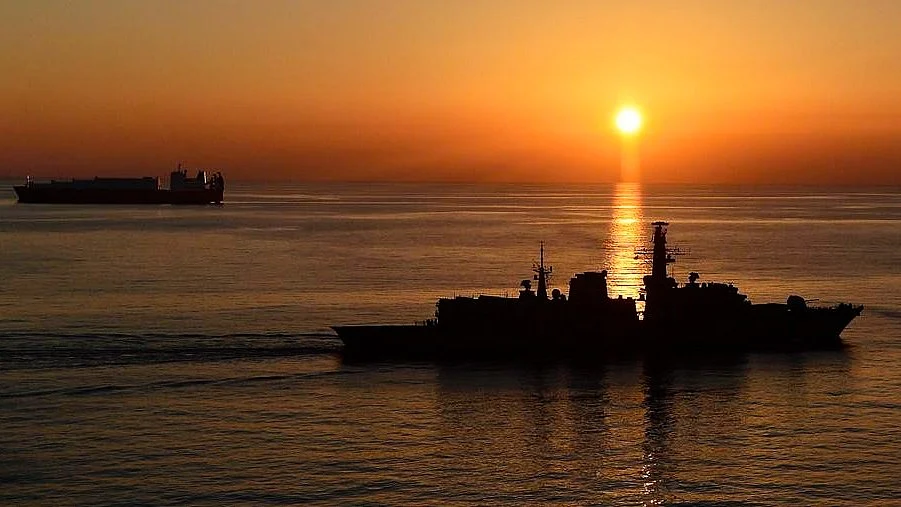


Iran said it had fully reopened the Strait of Hormuz to commercial shipping, but uncertainty remained on Saturday over how freely vessels would be able to pass through the strategic waterway as Tehran indicated it would continue to exercise control and warned it could shut the route again if the United States maintained its blockade of Iranian ships and ports.
The announcement on Friday concerning the narrow maritime corridor — through which roughly 20 per cent of global oil supply is transported — came as a 10-day truce between Israel and the Iranian-backed Hezbollah movement in Lebanon appeared to hold.
US President Donald Trump said the American blockade would remain “in full force” until Tehran reached a broader agreement with Washington, including on its nuclear programme.
Asked what would happen if no agreement was reached when the ceasefire expires next week, Trump told reporters he might not extend the truce, warning that the blockade would continue and that military action could resume. At the same time, he expressed confidence that negotiations would ultimately succeed and dismissed the possibility of Iran imposing tolls or restrictions on vessels using the Strait of Hormuz.
Trump initially welcomed Tehran’s announcement on social media, describing the waterway as “fully open and ready for full passage”. However, he later clarified that the US naval blockade would remain in place until negotiations with Iran were “100 per cent complete”.
Iranian foreign minister Abbas Araghchi said vessels would transit the strait using routes designated by the Islamic Republic in coordination with Iranian authorities, signalling that Tehran intended to retain oversight of shipping movements. It remained unclear whether ships would face additional conditions or charges.
Iranian officials argued that the blockade violated last week’s ceasefire understanding between Iran and the United States. Parliamentary speaker Mohammad Bagher Ghalibaf warned that the strait “will not remain open” if US restrictions continued.
Shipping analytics firm Kpler reported that traffic through the strait was still confined to corridors requiring Iranian approval. US Central Command said American forces had turned back 21 ships since the blockade began earlier in the week.
Trump indicates fresh talks possible
Trump imposed the blockade as part of efforts to pressure Iran into reopening the strait and accepting a Pakistan-brokered ceasefire aimed at ending nearly seven weeks of conflict involving Israel, the US and Iran.
The decision to maintain restrictions despite Tehran’s announcement appeared intended to preserve leverage as uncertainty lingered over the durability of the ceasefire.
Direct talks between US and Iranian officials last weekend ended without agreement, with differences persisting over Iran’s nuclear programme and related security concerns.
Trump suggested another round of negotiations could take place over the weekend, telling Axios that Iranian officials were keen to meet and strike a deal.
Oil prices declined on Friday amid expectations that diplomatic progress could ease pressure on global energy supplies. The head of the International Energy Agency had earlier warned that disruption to shipping through the Strait of Hormuz could deepen the global energy crisis.
Confusion within Iran’s political establishment also surfaced after two semi-official news agencies questioned the clarity of the decision to reopen the waterway.
The Fars news agency criticised what it described as a lack of transparency from the Supreme National Security Council and the negotiating team. Mehr news agency similarly said reopening the strait required further clarification and approval from Iran’s supreme leadership.
Questions have also emerged over the health of the country’s new supreme leader, Mojtaba Khamenei, who was reportedly injured early in the conflict, increasing the influence of the Supreme National Security Council as the country’s principal decision-making body.
Lebanon ceasefire may aid wider negotiations
The truce in Lebanon could remove a significant obstacle to broader negotiations between Iran, the United States and Israel, although doubts remain about whether Hezbollah will fully abide by an agreement it did not directly negotiate and that leaves Israeli troops positioned in parts of southern Lebanon.
Trump said Israel had been instructed by the United States not to carry out further offensive strikes in Lebanon, although the State Department clarified that defensive actions would still be permitted.
Israeli Prime Minister Benjamin Netanyahu said the ceasefire had been agreed at Trump’s request but emphasised that Israel’s campaign against Hezbollah was not yet complete.
Netanyahu said Israeli forces had destroyed most of Hezbollah’s missile stockpiles but indicated military operations could continue if required.
Celebrations in Beirut were marked by gunfire as displaced residents began returning to southern Lebanon and the capital’s southern suburbs despite official warnings that the situation remained uncertain.
Lebanese authorities reported sporadic shelling in parts of southern Lebanon in the hours following the ceasefire’s implementation. An Israeli strike in the Kounine area hit a car and a motorcycle, killing one person and injuring three others, according to Lebanon’s health ministry.
Israel and Hezbollah have fought repeatedly for decades, with tensions escalating again after the outbreak of the Israel-Hamas war in Gaza. A November 2024 agreement had temporarily reduced hostilities, but near-daily Israeli strikes continued amid concerns that Hezbollah was rebuilding its military capacity.
Mediators push compromise on nuclear programme
Diplomatic intermediaries are seeking agreement on three central issues: Iran’s nuclear programme, the future of the Strait of Hormuz, and compensation for wartime damage.
Trump claimed on Friday that Iran had agreed to hand over enriched uranium stockpiles — a major concession if confirmed — though neither Tehran nor mediators publicly acknowledged such a commitment.
The US president reiterated that no financial settlement would be involved in ending the conflict.
The war has resulted in thousands of deaths across the region, including at least 3,000 in Iran and more than 2,290 in Lebanon, along with casualties in Israel, Gulf states and among US service personnel.
With agency inputs
Join our official telegram channel (@nationalherald) and stay updated with the latest headlines