


Iranian tanker strikes challenge Trump’s claim of 'we won'
Fires engulf ships near Basra as attacks spread across Gulf shipping lanes and energy markets surge
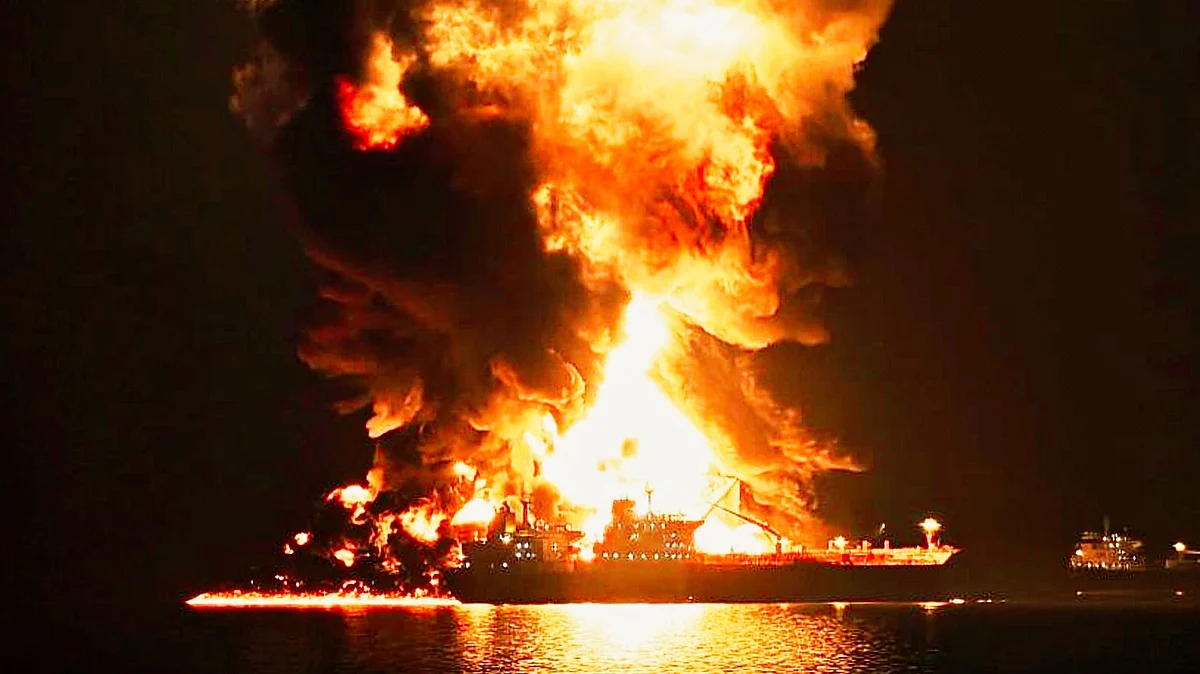


US President Donald Trump declared this week that the war against Iran had effectively been won. Events in the Gulf on Thursday appeared to challenge that claim, as a string of fresh attacks on shipping set tankers ablaze near Iraq’s southern coast and intensified disruption to global energy supplies.
According to a Reuters report, two tankers caught fire in Iraqi territorial waters near the port of Basra overnight in what authorities described as attacks by Iranian explosive boats. Images verified by Reuters and filmed from the shoreline showed the vessels engulfed in towering orange fireballs that illuminated the night sky.
At least one crew member was killed, Iraqi officials said, according to the Reuters report.
The incidents formed part of a wider wave of maritime strikes across the Gulf. Hours earlier, three other ships had been hit in the region. Iran’s Revolutionary Guards said they carried out one of those attacks, targeting a Thai bulk carrier that was set ablaze after it allegedly ignored their orders, Reuters reported.
Separately, a maritime security authority said another container vessel reported being struck by an unidentified projectile near the United Arab Emirates on Thursday.
The attacks come two weeks after the United States and Israel launched the war on Iran, a conflict that has already killed around 2,000 people and triggered the most severe disruption to global energy supplies since the oil crises of the 1970s.
Oil markets reacted sharply to the latest escalation. Prices, which had dipped earlier in the week after Trump suggested the war would soon end, surged back above $100 a barrel.
Tehran has said it will not allow oil to pass through the Strait of Hormuz — the crucial energy shipping corridor running along Iran’s coast — until US and Israeli military operations cease. It has also ruled out negotiations with Washington.
Meanwhile, more drones were reported entering airspace over Kuwait, Iraq, the United Arab Emirates, Bahrain and Oman on Thursday, undermining US and Israeli assertions that much of Iran’s long-range strike capability had been destroyed.
Financial institutions have begun responding to the heightened risks. Citibank announced it would temporarily close its branches in the UAE after Iran warned that banks were legitimate targets and advised residents to stay at least 1,000 m away from them. HSBC has already shut branches in Qatar.
The renewed spike in oil prices came even as major developed economies unveiled an unprecedented intervention in energy markets. On Wednesday, they announced plans to release 400 million barrels of crude from strategic reserves, nearly half of it from the United States.
Although the move marks the largest coordinated release of emergency oil stocks ever undertaken, analysts say it would take months to implement and would cover only around three weeks of supply normally shipped through the Strait of Hormuz.
“The only way to see oil prices trade lower on a sustained basis is by getting oil flowing through the Strait of Hormuz,” analysts at ING said. “Failing to do so means that the market highs are still ahead of us.”
Despite the growing turmoil, Trump has continued to project confidence about the outcome of the conflict. “You never like to say too early you won. We won,” Trump told a campaign-style rally in Hebron, Kentucky, on Wednesday. “In the first hour it was over.”
The United States had “virtually destroyed Iran”, he said, before adding: “We don't want to leave early do we? We got to finish the job.”
However, three sources familiar with US intelligence assessments told Reuters that Iran’s leadership structure remains largely intact and is not at immediate risk of collapse.
Tehran has signalled that it is now pursuing a strategy aimed at imposing a prolonged economic shock on global markets to force Washington to reconsider its campaign.
A spokesperson for Iran’s military command said on Wednesday that the instability caused by the conflict could push oil prices as high as $200 a barrel — far above the previous record of $147.27 set in July 2008, just before the global financial crisis.
Trump said the planned release of strategic reserves would “substantially reduce oil prices as we end this threat to America and the world”.
But analysts say the latest attacks may represent a calculated response to that move. Tony Sycamore, an analyst at IG, said the tanker strikes near Iraq appeared to be “a direct and forceful Iranian response” to the decision to release emergency oil stocks.
Iran has also targeted energy infrastructure elsewhere in the region. Fuel tanks in Bahrain were struck, while drones hit oil storage facilities at Oman’s Salalah port on Wednesday. Saudi Arabia said it intercepted several drones heading towards its Shaybah oilfield on Thursday, according to Reuters.
With agency inputs
Join our official telegram channel (@nationalherald) and stay updated with the latest headlines