


Israeli military strikes Beirut suburbs in blow to anticipated US-Iran deal
Attack on Hezbollah targets threatens delicate negotiations aimed at ending conflict and reopening the Strait of Hormuz
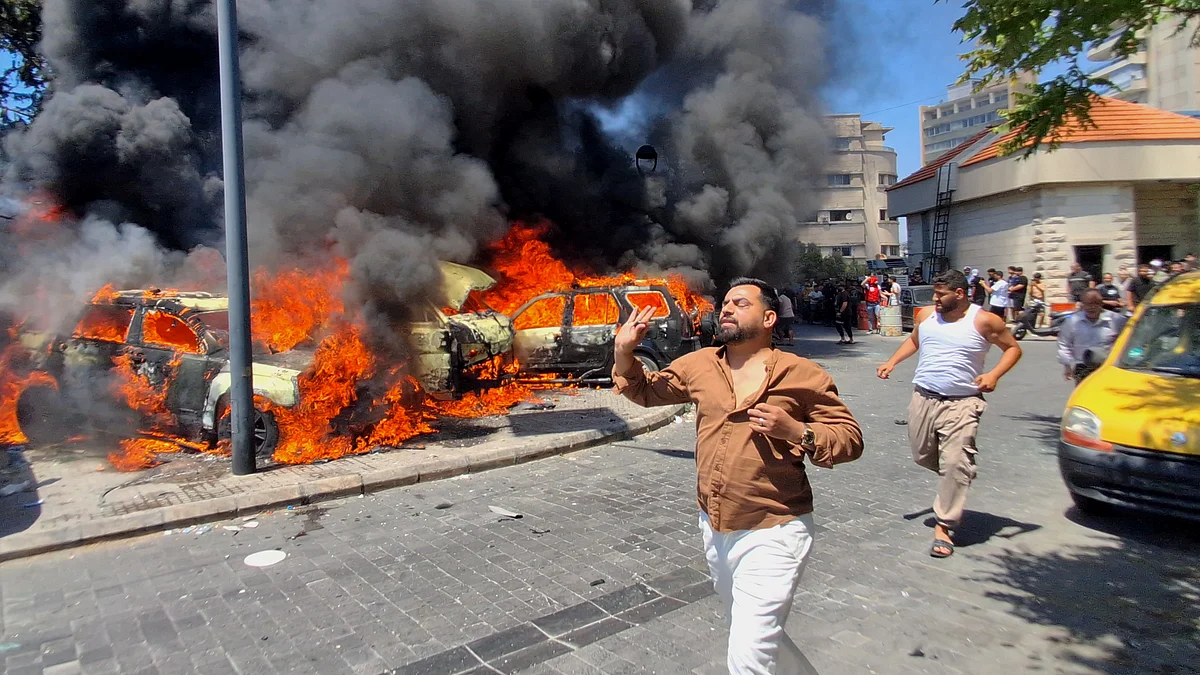


The Israeli military said it carried out strikes on Hezbollah targets in Beirut on Sunday, 14 June, despite ongoing diplomatic efforts to secure an end to the US-Iran war. Plumes of smoke were seen rising over the Lebanese capital following the attacks.
The strikes risk complicating negotiations over a ceasefire agreement that, in its current form, has already disappointed Israel's government. The last Israeli strike on Beirut's southern suburbs a week ago triggered the most serious escalation between Iran and Israel since a fragile ceasefire came into effect on 7 April.
The office of Israeli Prime Minister Benjamin Netanyahu said Sunday's strikes were carried out in response to Hezbollah attacks on northern Israel. Earlier in the day, the Israeli military said Hezbollah had fired three projectiles into northern Israel and released footage showing a loud explosion followed by a column of smoke rising above the treeline.
An Associated Press photographer in Beirut said the building targeted was a five-storey apartment block with commercial establishments on the ground floor. The two lower floors sustained the heaviest damage. There was no immediate information on casualties.
Residents of the southern suburbs, many of whom had returned to their homes after several weeks of relative calm, were seen leaving the area following the strikes.
Hezbollah began firing missiles into Israel on 2 March, two days after US and Israeli attacks on Iran sparked a broader regional conflict. Since then, Israeli forces have advanced deeper into Lebanon than at any point in more than 25 years.
Strike comes as ceasefire negotiations reach critical stage
Iran is seeking a ceasefire agreement that also addresses the fighting in Lebanon and includes the release of billions of dollars in frozen Iranian assets. However, Israel has largely been sidelined in talks being led by Pakistan and other mediators.
"Israel will not tolerate firing into its territory," a joint statement issued by Netanyahu and defence minister Israel Katz said on Sunday.
US President Donald Trump has reportedly urged Netanyahu to avoid major military action in Lebanon while negotiations remain active, but the Israeli leader has continued to authorise strikes.
Iranian Parliament speaker Mohammad Bagher Qalibaf warned on X that the attacks on Beirut's suburbs suggested that "America either lacks the will to fulfil its commitments or the ability to do so". He cautioned that the strikes could jeopardise the final phase of the negotiations.
There was no immediate response from Hezbollah.
According to two regional officials, Qatari mediators travelled to Tehran on Sunday in an effort to finalise the agreement.
The officials, speaking on condition of anonymity because they were not authorised to brief the media, expressed cautious optimism that Washington and Tehran were moving closer to a deal that could end hostilities, which have claimed thousands of lives, and reopen the Strait of Hormuz. The waterway's closure has disrupted global markets and energy supplies.
Trump and Pakistani Prime Minister Shehbaz Sharif both said on Saturday that the agreement could be signed on Sunday. Iran's foreign ministry spokesperson Esmail Baghaei, however, indicated that a deal might be concluded in the coming days. Trump also said the Strait of Hormuz would reopen immediately after the agreement was signed.
The deal is expected to be concluded electronically rather than through an in-person ceremony, although details of the signing process remain unclear.
Key nuclear issues remain unresolved
The proposed agreement does not resolve the most contentious issues between the US and Iran, including Tehran's nuclear programme and access to frozen assets. Instead, it establishes a 60-day framework for technical negotiations on those matters, according to Pakistani and regional officials familiar with the talks.
The officials described months of difficult negotiations led by Pakistan, during which mediators repeatedly worked to prevent a collapse in discussions.
Under the current framework, the US and Israel appear unlikely to achieve their original objectives of dismantling Iran's missile and nuclear capabilities and ending its support for regional proxy groups. It remains unclear whether those issues will be addressed in a final agreement.
The emerging deal has also drawn criticism from members of Trump's Republican Party, many of whom are concerned about the political costs of an unpopular conflict ahead of midterm elections.
Some critics argue that the proposed arrangement offers little improvement over the 2015 Iran nuclear agreement, which Trump withdrew from during his first term and has repeatedly described as a "bad" deal.
Trump is also expected to discuss efforts to clear mines from the Strait of Hormuz during the G7 summit beginning on Monday.
The strategic waterway is a key route for global shipments of oil, natural gas and related commodities, and its disruption has had significant economic repercussions.
Iran's nuclear programme remains at the centre of tensions with both the United States and Israel. On social media, Trump said that "when all is calm", the US would move to "downblend and destroy" Iran's stockpile of highly enriched uranium, either inside Iran or in the United States.
According to the International Atomic Energy Agency, Iran possesses 440.9 kilograms of uranium enriched to 60 per cent purity — a relatively short technical step away from the 90 per cent enrichment level generally considered weapons grade.
Iran has consistently maintained that its nuclear programme is peaceful and has not publicly indicated any willingness to surrender its enriched uranium stockpile, much of which is believed to be stored beneath three nuclear facilities heavily damaged in US strikes last year.
With AP/PTI inputs
Join our official telegram channel (@nationalherald) and stay updated with the latest headlines