


RSP’s Balendra Shah scores landslide in Nepal polls, set to become PM
New party sweeps majority of direct seats, routing established parties in major political shift
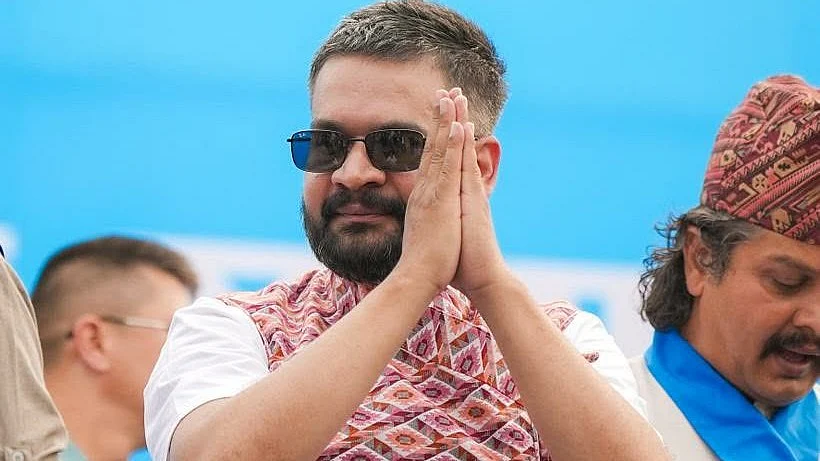


Nepal’s newly formed Rastriya Swatantra Party (RSP), led by rapper-turned-politician Balendra Shah, has secured a sweeping victory in the country’s general elections, delivering a major blow to traditional political parties in the Himalayan nation.
According to the Election Commission (EC), the RSP has already won 117 of the 165 directly elected seats in the House of Representatives and is leading in another eight constituencies. Results have been declared for 152 seats so far.
The Nepali Congress (NC) is a distant second with 17 seats, while the Communist Party of Nepal (Unified Marxist-Leninist) (CPN-UML) led by former prime minister K.P. Sharma Oli has won seven seats and is leading in three.
Other parties have secured only a handful of seats. The Nepal Communist Party has won seven seats, the Shram Sanskriti Party has won two and is leading in one, while the Rastriya Prajatantra Party (RPP) has won a single seat. One independent candidate has also been elected.
The RSP also achieved a clean sweep in all 15 constituencies of the three districts in Kathmandu Valley, EC data showed.
Balen Shah defeats Oli in major upset
Balendra Shah, popularly known as “Balen”, defeated four-time former prime minister K.P. Sharma Oli in the Jhapa-5 constituency by a large margin.
Shah secured 68,348 votes, while the 74-year-old Oli received 18,734 votes, according to the Election Commission.
Shah is widely expected to become Nepal’s next prime minister, reflecting what analysts describe as a strong public rejection of established political parties.
If he assumes office, the 35-year-old leader will become Nepal’s youngest prime minister and the first Madhesi leader to occupy the post.
The election outcome suggests voters were motivated by issues such as corruption, nepotism and the demand for generational change in the country’s political leadership.
Major defeats for established leaders
Several senior leaders from traditional parties suffered defeats in the election.
Former deputy speaker Indira Rana Magar of the RSP won from Jhapa-2, defeating Dev Raj Ghimire of the CPN-UML.
Magar received 48,742 votes, while Ghimire secured 11,368 votes.
Nepali Congress president Gagan Thapa, who had been projected as the party’s prime ministerial candidate, lost the Dhanusha-4 constituency to RSP candidate Amaresh Singh.
Singh polled 33,688 votes, while Thapa secured 22,831 votes, EC data showed.
Other prominent Nepali Congress leaders who lost included Guru Raj Ghimire, Shekhar Koirala and Bimalendra Nidhi.
The CPN-UML also suffered heavy losses. Among those defeated were the party’s general secretary Shankar Pokharel, vice presidents Bishnu Paudel, Prithvi Subba Gurung and Gokarna Bista, deputy general secretary Raghubir Mahaseth, and secretaries Sherdhan Rai, Mahesh Basnet, Rajan Bhattarai and Bhanubhakta Dhakal.
Meanwhile, Harka Rai, chairman of the Shram Sanskriti Party, won from Sunsari-1, defeating RSP candidate Goma Tamang.
RSP chairman Ravi Lamichhane also secured victory from Chitwan-2, marking his third consecutive win, with 54,402 votes against 14,564 votes for Nepali Congress candidate Mina Kumari Kharel.
Former prime minister Pushpa Kamal Dahal ‘Prachanda’ of the Nepal Communist Party won from Rukum Purba district, receiving 10,240 votes against 3,462 votes for CPN-UML candidate Lilamani Gautam.
Proportional voting and turnout
The RSP is also leading in the proportional representation voting system, receiving 18,15,857 votes so far.
The Nepali Congress has secured 6,18,630 votes, while the CPN-UML has received 5,19,353 votes.
Other parties trail behind, with the Nepal Communist Party receiving 2,45,804 votes, the RPP 1,31,277 votes, and the Shram Sanskriti Party 78,072 votes, according to the Election Commission.
Nepal recorded about 60 per cent voter turnout during the March 5 election.
Vote counting began late Thursday night and was continuing as of Sunday.
The election also saw 10 women candidates elected, including nine from the RSP and one from the Nepali Congress.
Also Read: Nepal has another date with democracy
Political upheaval and regional interest
Nepal’s parliamentary system elects 275 members, with 165 chosen through direct voting and 110 through proportional representation.
Around 3,400 candidates contested the 165 direct seats, while 3,135 candidates were competing for the 110 proportional seats.
The election followed months of political unrest. Last September, Gen Z-led protests forced the resignation of Prime Minister K.P. Sharma Oli, whose coalition government had been backed by the Nepali Congress and enjoyed nearly a two-thirds parliamentary majority.
Although Shah was widely seen as a popular choice to lead an interim administration following Oli’s removal, he declined the role, saying he preferred to seek a full mandate through parliamentary elections.
He formally joined the RSP in January and was soon declared the party’s prime ministerial candidate.
Political analyst and former MP Sunil Babu Pant said the RSP’s victory reflected widespread dissatisfaction with the traditional political order.
“The victory of the RSP in the March 5 election and the expectation that Balen Shah could emerge as Nepal's next prime minister reflect the people's deep-rooted frustration with the old political order and their hope for a new direction,” Pant said.
He added that Shah’s immediate challenge would be to demonstrate zero tolerance for corruption.
Pant also said the new government would need to carefully navigate Nepal’s complex geopolitical environment.
“He must prove that he is not a puppet of any external power, western or otherwise. Nepal's leadership must carefully balance relations with all global actors and pursue an independent foreign policy that prioritises national interest,” he said.
The election was closely watched by India, which has expressed hope that Nepal’s new government will provide political stability and continue strengthening bilateral development cooperation.
Prime Minister Narendra Modi congratulated the people of Nepal for the successful conduct of the election.
“It is heartening to see my Nepali sisters and brothers exercise their democratic rights so vibrantly. This historic milestone is a proud moment in Nepal's democratic journey,” Modi said on X.
He added that India remained committed to working with Nepal’s new government to advance shared peace, progress and prosperity.
Oli also congratulated Shah on his victory, wishing him a successful five-year tenure.
“Balen babu, congratulations for the victory. I wish your five-year tenure be trouble-free, successful and hearty congratulations,” Oli wrote in a social media post, attaching a photograph from 2022 when he had gifted a tabla to Shah after the latter won Kathmandu’s mayoral election as an independent candidate.
Join our official telegram channel (@nationalherald) and stay updated with the latest headlines