


Two Americans share Nobel Economics prize for reshaping crisis response models
Robert E. Hall and Michael Woodford are honoured for research that improved models used by governments and central banks to manage economic fluctuations
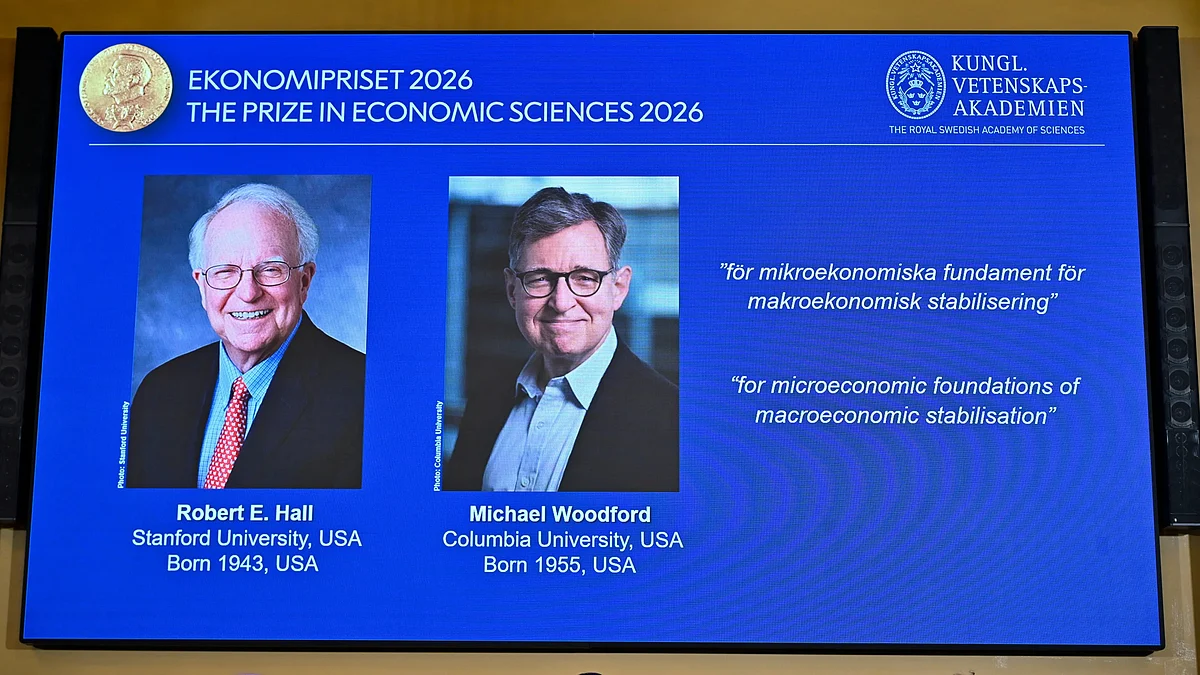


American economists Robert E. Hall and Michael Woodford won the 2026 Nobel memorial prize in economic sciences on Monday for research that has helped governments and central banks respond to economic shocks, including energy crises and inflation.
The Royal Swedish Academy of Sciences announced the award in Stockholm, saying their work had provided the theoretical foundation for economic models used by policymakers worldwide.
“The laureates' research has made it possible to manage major macroeconomic crises far more effectively than before,” the Nobel committee said, highlighting its relevance during the Covid-19 pandemic and recent energy crises.
Hall is affiliated with Stanford University in California, while Woodford is associated with Columbia University in New York. Speaking to the Nobel committee by phone, Woodford described the award as “a tremendous honour” and said it came as a surprise.
Research challenged established economic assumptions
For decades, governments responding to economic shocks drew on the ideas of British economist John Maynard Keynes, using measures such as tax cuts and increased public spending to stimulate consumption, investment and growth.
However, the stagflation of the 1970s — when high inflation coincided with high unemployment — exposed the limitations of some established assumptions about the relationship between inflation and employment.
Hall and Woodford developed separate contributions that refined economic models by examining how households and businesses make spending, investment and pricing decisions.
The Nobel committee said their work represented a shift towards understanding economic outcomes through decisions made by individual households and businesses, rather than relying solely on broad macroeconomic trends. This approach has helped shape the theory of economic stabilisation policy.
Hall examined how consumers make spending decisions
Hall studied how household spending depends on expectations about future income. Consumers who expect their incomes to rise may spend more, while those who anticipate difficult times may cut expenditure. New economic information can also change these expectations.
Also Read: Trump’s fresh bid for Nobel Peace Prize
His research also accounted for differences between households. While some can borrow or draw on savings to manage changes in income, poorer households may have to adjust their spending immediately.
In a 1982 paper with economist Frederic Mishkin, Hall found that about 80 per cent of households made spending decisions based on expectations about the future, while the remainder largely lived from hand to mouth, according to the Nobel committee.
Woodford highlighted the role of expectations in business pricing
Woodford's research examined how businesses set prices based partly on their expectations of future interest rates, costs and competitors' prices.
If businesses expect their costs and competitors' prices to rise, they may set higher prices than they would if they anticipated the opposite, the Nobel committee said.
The findings also highlighted the importance of central bank communication. Institutions such as the US Federal Reserve can influence economic decisions not only through interest-rate changes but also by clearly explaining their reasoning and likely policy direction.
Central banks have increasingly sought to communicate their decisions and plans to help businesses and households form expectations. During the call broadcast at the announcement, Woodford emphasised the importance of understanding how people in financial markets make spending decisions.
Final Nobel announcement of the year
The economics award was the last Nobel announcement for 2026. Last year's prize went to three researchers whose work explained how business innovation and new technologies contribute to economic growth and human welfare.
Formally known as the Bank of Sweden Prize in Economic Sciences in Memory of Alfred Nobel, the award was established by Sweden's central bank in 1968. It is presented alongside the other Nobel awards, although it was not one of the original prizes established by Alfred Nobel.
The 2026 prize carries an award of 12 million Swedish kronor, or about USD 1.2 million. The medicine, physics, chemistry, literature and peace prizes were announced the previous week.
Hall's award also marks the second Nobel win this year involving a Stanford University professor. Karl Deisseroth shared the 2026 medicine prize with Peter Hegemann and Georg Nagel for work that led to a light-based tool for studying brain function.