


Ukraine claims drone attack sank Russian warship at Libyan port
Zelensky praised what he called an exemplary Ukrainian operation in response to Russia's war
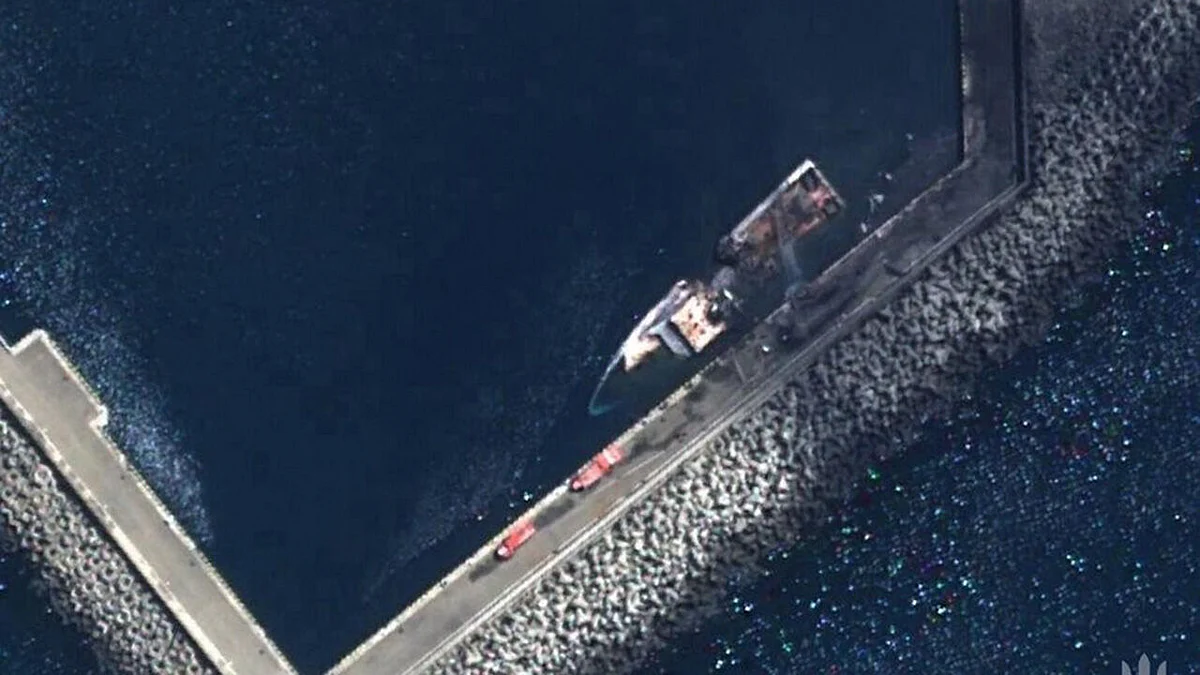


Ukraine has claimed responsibility for a drone attack that sank a Russian warship off the coast of Libya, with President Volodymyr Zelensky describing it as an operation carried out in response to Russia's war against Ukraine.
The attack also hit a second Russian vessel, a cargo ship allegedly being used to transport weapons, according to the Ukrainian prime minister.
On Sunday morning, the eastern-based Government of National Stability (GNS) said an explosion had occurred aboard a Russian warship at the port of Benghazi, where it was docked for fuel and supplies before returning to Russia.
Libya's health ministry said it had received injured people from a commercial vessel targeted off the coast of the port. It was not immediately clear whether this was the same ship that Ukraine claimed to have attacked.
Moscow had not commented on the incident at the time of reporting.
In a statement on Monday, Zelensky praised what he called an “exemplary Ukrainian operation in response to Russia's war”.
He said seven naval drones had been deployed to target and sink the corvette Merkury, one of Russia's newest warships. A Ka-27 combat helicopter was also destroyed, he added.
The Ukrainian president identified the second vessel as the MV Angara, a Russian container carrier.
The United Nations Support Mission in Libya (UNSMIL) expressed “serious concern” over the attacks and called for an “immediate, independent and transparent investigation”.
“Libya cannot afford, and must not become a battleground for foreign conflicts,” the mission said in a statement on X.
Videos posted on social media and geolocated by BBC Verify showed a ship engulfed in flames and smoke at the port on Sunday morning. Satellite imagery from Planet Labs PBC also showed a vessel on fire at Benghazi port at 05:47 GMT.
High-resolution images collected by US-based intelligence firm Vantor reportedly showed a Project 20380 Steregushchiy-class corvette, identified as the Merkury, docked at the port on Saturday. Images taken on Sunday showed most of the same vessel capsized and submerged, with only its forward bow visible.
The GNS said the Russian vessel had been using Benghazi port under an existing maritime agreement. It added that the incident was under investigation and that authorities were coordinating with their Russian counterparts to establish the source of the suspected attack and identify those responsible.
The eastern-based government condemned the attack, describing it as a violation of maritime safety and an infringement of Libyan sovereignty. It stressed that Libya was not party to the Russia-Ukraine war or any other conflict beyond its borders.
Separately, Libya's internationally recognised Government of National Unity (GNU), based in Tripoli, warned against hosting foreign forces or allowing them to use Libyan facilities.
In a statement carried by state media, the GNU said such activities raised “serious fears” about the risks of involving ports and civilian facilities in external conflicts, including threats to citizens and national infrastructure.
Libya has remained divided between rival administrations since the overthrow of former leader Muammar Gaddafi in 2011, which plunged the country into years of violence and instability.
Benghazi is more than 2,000 km from the Russian capital, Moscow.
The incident follows an earlier dispute in March, when Russia accused Ukraine of attacking the Russian tanker Arctic Metagaz in the Mediterranean Sea between Libya and Malta using uncrewed sea drones launched from the Libyan coast.
Such attacks can disrupt Russia's so-called shadow fleet of tankers used to export oil and gas, while also dealing a symbolic blow to the Kremlin.
The latest incident could also have repercussions for eastern Libya's leadership. The Russian vessel was reportedly in the region under an arrangement with the eastern-based administration, which is allied with Khalifa Haftar, commander of the Libyan National Army.
Analyst Jalel Harchaoui said Haftar could regard the attack as a personal slight and seek answers about who had allowed Ukrainian forces to operate in the area.
Join our official telegram channel (@nationalherald) and stay updated with the latest headlines