


Ukraine grapples with troop shortage as war enters 5th year
Some frontline units are operating at half strength as mobilisation problems and exhaustion limit Kyiv’s ability to sustain operations
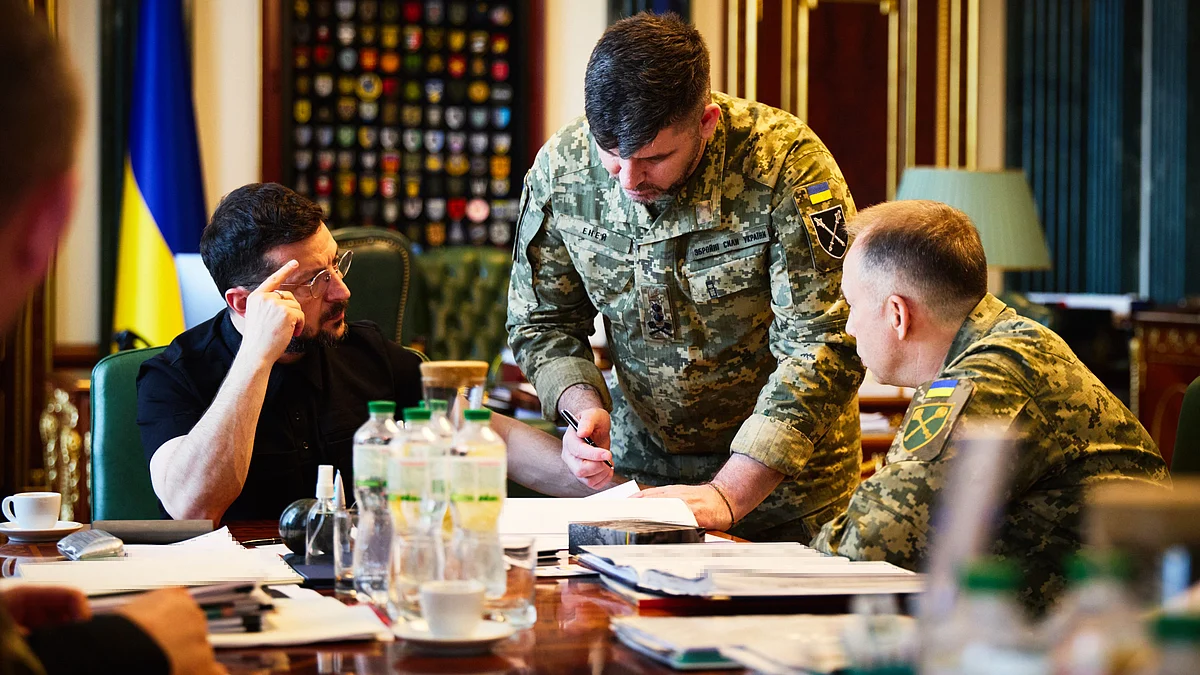


Ukraine is struggling with a shortage of combat-ready troops as its war with Russia enters its fifth year, with some frontline units operating at only half strength and commanders warning that manpower shortages are limiting the country's ability to exploit advances in drone technology.
Ukraine has been outnumbered by Russia throughout the war, but the need for personnel has become increasingly acute as the conflict drags on, according to commanders and military analysts. The shortage is limiting Kyiv's ability to rotate exhausted troops, reinforce vulnerable sectors and turn local battlefield gains into sustained operations.
“Based on the equipment and the number of people we have today, we barely have enough to hold the sector we currently have,” said a deputy commander of the Da Vinci Wolves battalion in the Pokrovsk area of eastern Ukraine, identified only as “Afer” because of military rules.
“To move forward would inevitably mean greater losses,” he said.
Ukraine's front line stretches for about 1,250 kilometres, and long-standing mobilisation problems, including draft evasion and desertion, have made it harder to build adequate reserves.
Nick Reynolds of the UK-based Royal United Services Institute said Ukraine needed to be able to commit forces quickly without withdrawing them from other parts of the front.
Without sufficient reserves, commanders have fewer options to turn temporary advantages into sustained operations, he said. Infrequent troop rotations also lead to exhaustion, which can further increase casualties.
The Ukrainian Defence Ministry, which underwent a leadership shake-up in July, is seeking to address the problem through reforms to mobilisation, training and military organisation.
A ministry official, speaking anonymously because they were not authorised to brief the media, summed up the challenge: “There just are not enough people.”
Developing a new mobilisation policy, including measures to encourage deserters to return to duty, is among the sensitive issues under consideration.
Reforms face a manpower challenge
Former defence minister Mykhailo Fedorov, who was replaced by Yevhenii Khmara during the summer reshuffle, had sought to reorganise the military around fewer but stronger units. The plan involved reinforcing formations that performed well and disbanding weaker ones.
Khmara has said he intends to continue those reforms, but lawmakers have yet to see new mobilisation initiatives, according to Yehor Cherniev, a member of parliament's defence committee.
In June, Fedorov introduced changes to military contracts aimed at making infantry service more attractive through higher salaries and fixed terms of service.
Recruiting enough soldiers remains difficult after more than four years of war, with Ukraine drawing from an estimated population of 39 million.
The pool of eligible men is relatively small after years of demographic decline, displacement and migration. There are about 6.8 million men aged 25 to 59, according to UN figures provided by Ukraine's National Health System, although that figure includes wounded veterans and others unable to serve.
Official figures put the size of Ukraine's military at about 1 million, with only a fraction deployed on the front.
Compulsory military service applies to men. Women can volunteer, while those with medical or pharmaceutical training are required to register with the military. More than 70,000 women were serving in the army, according to Defence Ministry statistics from January 2025.
In March, Fedorov said about 2 million Ukrainian men were evading military service, while around 200,000 soldiers had deserted or left their units without authorisation. Desertion can carry a prison sentence of up to 12 years.
Some men have fled the country illegally or gone into hiding. Recruiters sometimes stop men in streets and trains, while those without valid exemptions can be sent into the military. In January 2025, the government said around 950,000 men had deferments requested by businesses.
Russia also faces challenges in filling its ranks despite having an estimated population of 143 million. After launching its invasion, Moscow ordered a widely unpopular partial mobilisation of 300,000 reservists, prompting hundreds of thousands of men to flee abroad. The Kremlin has since relied heavily on volunteers attracted by relatively high pay and benefits. President Vladimir Putin has said about 700,000 Russian troops are fighting in Ukraine.
Frontline troops serving longer
Military analyst Taras Chmut, who also heads the Come Back Alive charity, said Ukraine's problem was not simply the total number of personnel but how they were managed and deployed.
Increasing the number of people in the defence forces does not necessarily make them more effective, he said.
Soldiers and analysts cited exhaustion, poor organisation, inadequate training and the absence of a clear end-of-service date as factors contributing to desertion.
The consequences are particularly acute at the front, where there are fewer troops available to replace casualties, rotate exhausted units or reinforce areas when battlefield opportunities emerge. Drones can partly compensate for the shortage but cannot replace personnel entirely.
Afer said some troops had spent up to a year at the front with little opportunity for rotation. His unit is operating at about half strength while its area of responsibility has doubled, meaning the same number of troops must defend roughly twice the territory.
He said the army would ideally need at least twice as many troops simply to hold its current positions, without accounting for the reserves required to replace casualties.
Ukraine is also struggling to find qualified specialists capable of operating increasingly sophisticated battlefield equipment, Afer said. Troops “who know how to think”, he added, are in short supply.
Small offensives remain possible
Despite the manpower shortage and continuing Russian advances in some areas, Ukraine has been able to conduct localised offensive operations, including around Lyman in the east.
Pavlo Narozhnyi, a Ukrainian military analyst, said manpower was not an insurmountable problem for simply holding the defensive line.
“We can do limited offensives,” he said, pointing to recent operations in the Dnipropetrovsk and Lyman areas, “but it's relatively small.”
According to figures cited by Ukrainian President Volodymyr Zelenskyy, Russian forces have occupied about 990 square kilometres of Ukrainian territory since the beginning of 2026, while Ukrainian forces have retaken about 820 square kilometres. Zelenskyy has said Kyiv aims to bring the figures closer to parity by the end of the year.
Reynolds of RUSI, however, said the broader battlefield balance was unlikely to fundamentally change, with the front line essentially remaining in place.
Join our official telegram channel (@nationalherald) and stay updated with the latest headlines