


UNGA: Gaza takes centre stage as leaders condemn Israel’s actions
Jordan’s Abdullah and Turkiye's Erdogan denounce Gaza and West Bank policies as Palestinian president addresses UN by video


The Gaza genocide took centre stage as the United Nations General Assembly opened its high-level debate, with Jordan’s King Abdullah II accusing Israel of pursuing policies that could make a Palestinian state impossible, while Turkish President Recep Tayyip Erdogan condemned the US decision to deny Palestinian President Mahmoud Abbas a visa to attend the session in person.
Abdullah, speaking on Tuesday, 22 September, accused Israel of pursuing an "expansionist appetite" that posed a regional threat and equated the destruction in Gaza with what he called the de facto annexation of parts of the occupied West Bank.
"The reality on the ground is being remade — Gaza through destruction, the West Bank through de facto annexation," Abdullah said, adding that "the objective is the same: to make a viable Palestinian state impossible."
He accused the Israeli government of continuing attacks and destruction of civilian infrastructure in Gaza while allowing settlement expansion, land seizures and settler violence to intensify in the West Bank. He said the international community had spent decades managing rather than resolving the Israeli-Palestinian conflict, allowing measures once considered temporary to become policy.
Erdogan, meanwhile, described the US refusal to grant Abbas a visa as an "injustice" and urged countries that have not yet recognised Palestine to do so.
"Although President Abbas is unable to be with us here in person, we will, as we did last year, continue to be the voice of a free and sovereign state of Palestine," Erdogan said.
The US denied visas to Abbas and other senior Palestinian officials for the second consecutive year, citing Washington's objections to the Palestinian Authority's conduct and legal actions against Israel. The UN General Assembly subsequently approved a resolution allowing the Palestinian delegation to participate virtually in the high-level debate. The resolution received 152 votes in favour.
Erdogan described Gaza as "the world's largest graveyard for children" and the "most shameful concentration camp of our time", while accusing the international community of failing to respond adequately to the crisis. He also called for reform of the UN system, arguing that the current structure of the Security Council had undermined the organisation's ability to respond to conflicts.
UN Secretary-General António Guterres, in his opening address, said conflicts across West Asia were "cascading" and warned that so-called ceasefires had amounted to little more than "lesser fires", with civilians continuing to pay the price. "Enough is enough," Guterres said, calling for an end to fighting and unrestricted humanitarian aid.
On Gaza, he said the scale of killing and destruction since the 7 October 2023 Hamas attacks was unlike anything he had witnessed during his years as secretary-general. He also pointed to legally binding provisional measures issued by the International Court of Justice in the genocide case brought against Israel and said all parties must comply with international law and the court's orders.
Guterres also warned that violence, displacement and settlement expansion in the occupied West Bank were "bulldozing the path to peace" and raising the spectre of ethnic cleansing.
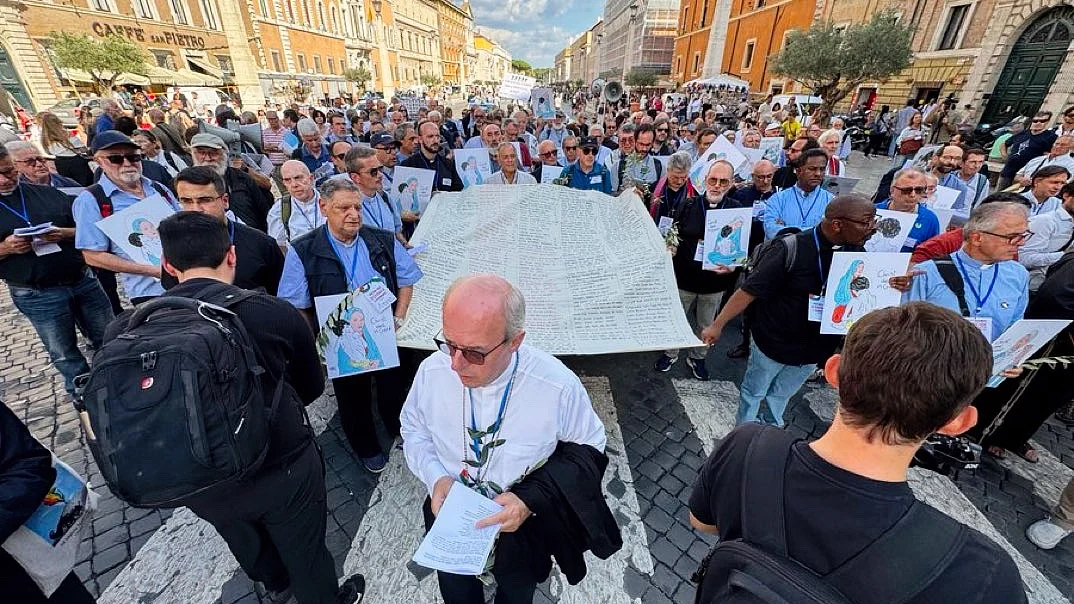
The renewed focus on Gaza at the UN came a day after an unusually large protest by Catholic clergy in Rome. Around 150 priests and friars, a bishop and nuns marched towards the Vatican on Tuesday to demand an end to what they called the "genocide" in Gaza.
The protesters carried a banner bearing the names of 300 Palestinian and Lebanese children whom organisers said had been killed during Israel's military campaign. The marchers prayed near St Peter's Basilica before proceeding to the Palestinian and Lebanese embassies and then to the Rome headquarters of defence manufacturer Leonardo.
The protest was organised by the 'Priests Against Genocide' network, founded in August 2025 and now claiming more than 2,500 priests and bishops across five continents. Organisers said Tuesday's turnout was significantly larger than the group's march last year.
The Vatican protest also reflected the growing international debate over whether Israel's conduct in Gaza amounts to genocide. UN-appointed experts have made that allegation, while Israel has repeatedly rejected it, saying its military operation is directed at Hamas and that civilian casualties are a consequence of the group's operations in densely populated areas.
Israel launched its military campaign in Gaza after the Hamas-led 7 October 2023 attack on Israel, in which about 1,200 people were killed and 251 people were taken hostage, according to Israeli figures. Gaza health authorities said on 22 September that 73,919 Palestinians had been killed since the start of the war and 174,977 injured. The figures do not distinguish between civilians and combatants.
The UN debate is unfolding against a broader regional crisis, with the war in Gaza, continuing violence in the West Bank and the conflict involving Iran and the United States adding to concerns over the UN's ability to manage multiple simultaneous crises.
Israeli Prime Minister Benjamin Netanyahu is scheduled to address the General Assembly later this week, where he is expected to defend Israel's military actions and respond to international criticism.
With AP/PTI inputs
Join our official telegram channel (@nationalherald) and stay updated with the latest headlines