


Unilateral sanctions hampering global food security, people's welfare: Iran President
BRICS must expand trade in national currencies and build a more inclusive global economic framework, Iranian President Masoud Pezeshkian said at the BRICS summit
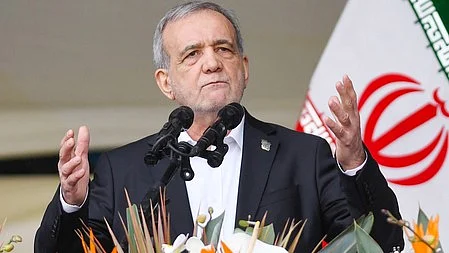


Iranian President Masoud Pezeshkian on Sunday called on BRICS countries to expand trade in national currencies and work towards a more inclusive global economic framework, saying excessive dependence on existing financial and trade systems had made emerging economies vulnerable to political shocks.
Addressing the BRICS summit, Pezeshkian criticised "unilateral sanctions", saying they directly affected global food security and people's welfare.
His remarks came weeks after the US imposed new economic sanctions on Iran, further restricting Tehran's finances amid ongoing military hostilities between the two sides.
Pezeshkian said BRICS should play a greater role in building a more balanced, inclusive and just international order, with resilience, cooperation and sustainability translated into practical measures.
He said economic resilience could not be maintained without security and referred to what he described as military aggression by the United States and Israel against Iran.
According to Pezeshkian, attacks on Iran's economic, energy and development infrastructure could have consequences beyond the country, with potential regional and global repercussions.
"The Iranian people have paid a heavy price," he said, referring to the killing of civilians and damage to infrastructure built over decades.
Pezeshkian also said the international community had a responsibility to protect civilians and prevent the "normalisation of attacks on civilian targets".
The Iranian president thanked India, its people and Prime Minister Narendra Modi for hosting the summit. He said the summit's theme, "Resilience, Cooperation and Sustainability", reflected fundamental global needs at a time when the destinies of nations were increasingly interconnected.
He said the international community should not limit itself to managing existing crises, but should work towards creating systems capable of strengthening countries against future crises and promoting a fairer global order.
On economic challenges, Pezeshkian said excessive dependence on a limited number of financial and trade systems had left economies vulnerable to political shocks.
He called for greater use of national currencies in trade between BRICS members and for strengthening the New Development Bank to improve the bloc's economic resilience.
Turning to Gaza and Lebanon, Pezeshkian said people in the region continued to face the consequences of "crimes and genocide". He urged BRICS to play a more effective role in defending national sovereignty and territorial integrity, as well as the prohibition on the use of force.
Pezeshkian said no country could tackle global challenges on its own and called for the capabilities of the Global South to be transformed into shared capabilities.
He also highlighted Iran's geopolitical location and its energy and transit potential, saying these could help develop trade and energy corridors connecting BRICS members.
On sustainability, Pezeshkian said development could not be considered sustainable if it increased inequality or shifted the costs of present-day development to future generations.
He also raised concerns about the environmental consequences of war, saying damage to energy and industrial infrastructure could affect natural resources and cause losses extending beyond the immediate economic impact.
Pezeshkian further identified knowledge and innovation as key components of the BRICS agenda. He said artificial intelligence and other emerging technologies should be used to empower nations rather than become instruments of domination.
Join our official telegram channel (@nationalherald) and stay updated with the latest headlines