


Venezuela’s acting president proposes cooperation with US after Maduro’s capture
Delcy Rodríguez strikes conciliatory tone on “shared development” even as Trump threatens further strikes and presses to open oil sector
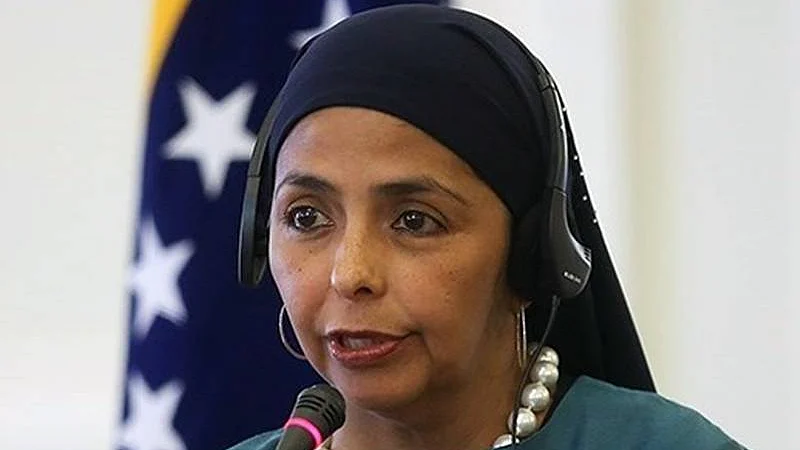


Venezuela’s acting president Delcy Rodríguez on Sunday offered to collaborate with the United States on an agenda centred on “shared development”, marking the first conciliatory overture from Caracas since US forces captured President Nicolás Maduro and his wife in a high-intensity military operation.
In a statement posted on social media, Rodríguez said her government was prioritising a shift towards respectful relations with Washington, despite having earlier condemned the US raid as an illegal act aimed at seizing Venezuela’s national resources.
“We invite the US government to collaborate with us on an agenda of cooperation oriented towards shared development within the framework of international law to strengthen lasting community coexistence,” Rodríguez said. “President Donald Trump, our peoples and our region deserve peace and dialogue, not war.”
Rodríguez, who also serves as Venezuela’s oil minister, has long been viewed as the most pragmatic figure within Maduro’s inner circle. Trump has previously said she was willing to work with the United States. Publicly, however, Rodríguez and other senior officials have continued to describe the detention of Maduro and his wife, Cilia Flores, as a “kidnapping” and have insisted that Maduro remains the country’s legitimate leader.
The statement came a day after Trump warned that the US could launch another strike if Venezuela failed to cooperate with Washington’s efforts to open up its oil industry and curb drug trafficking. Speaking to reporters, Trump also threatened military action in Colombia and Mexico, and said Cuba’s communist government appeared close to collapse. The Colombian and Mexican embassies in Washington did not immediately respond to requests for comment.
Rodríguez’s outreach came on the eve of Maduro’s scheduled appearance on Monday before a federal judge in New York. The Trump administration has portrayed his seizure as a law-enforcement action to enforce criminal charges first filed in 2020, which accuse Maduro of conspiring to engage in narco-terrorism.
US prosecutors allege that Maduro provided support to major drug trafficking organisations, including the Sinaloa Cartel and the Tren de Aragua, directed cocaine trafficking routes, used the military to protect shipments and allowed presidential facilities to be used for moving narcotics. The charges were updated on Saturday to include Flores, who is accused of ordering kidnappings and murders. Maduro has denied all allegations, and US officials have said it could take months before his trial begins.
While administration officials have framed the operation as a legal action, Trump has also acknowledged broader motivations. He has cited the flow of Venezuelan migrants to the United States and Venezuela’s past nationalisation of US oil assets as contributing factors.
“We’re taking back what they stole,” Trump said aboard Air Force One while returning to Washington from Florida. “We’re in charge.”
Trump said US oil companies would return to Venezuela to rebuild its petroleum industry. “They’re going to spend billions of dollars and they’re going to take the oil out of the ground,” he said.
The raid has drawn sharp international criticism and raised questions over the legality of capturing a sitting head of state. The United Nations Security Council is scheduled to meet on Monday to discuss the US action, which António Guterres has described as a dangerous precedent.
China reiterated its criticism, saying the US actions violated international law and calling for the release of Maduro and his wife. Several other countries have also urged Washington to respect international legal norms.
In the US, opposition Democrats have questioned the administration’s handling of Venezuela policy, saying lawmakers were misled. Secretary of State Marco Rubio is due to brief senior members of Congress later on Monday.
The crisis unfolds against the backdrop of Venezuela’s prolonged economic collapse. Once among Latin America’s most prosperous nations, the country has seen its economy deteriorate over the past two decades, driving roughly one in five Venezuelans to migrate abroad in one of the world’s largest exoduses.
Analysts warn that the removal of Maduro, a former bus driver who ruled Venezuela for more than 12 years after the death of Hugo Chávez, could trigger further instability in the country of about 28 million people, even as the region braces for the wider geopolitical fallout of Washington’s actions
Join our official telegram channel (@nationalherald) and stay updated with the latest headlines