


A matter of life and death
A 24x7 helpline offers mental health support to those struggling with agrarian distress in Maharashtra


As his cell phone starts buzzing, 20-year-old Kirit quickly settles before a desktop, slides on his headphones, picks up a pen, and flips open his diary.
“Namaskar, Shivar Helpline,” he says, in a quiet and steady voice.
On the other end is Parvati, a middle aged woman-farmer from a village in Maharashtra’s Nanded district.
“How may I help you?” Kirit asks in Marathi. A third year BA Psychology student in Pune, he is originally from a village in Parbhani.
Parvati hesitates. Her voice trembles. “Rains destroyed all our crops,” she manages to say. “Soybean, tur… the goats are gone too. There’s no work now.” She asks if Kirit can provide green-gram seeds for the upcoming rabi season. “If we get seeds, we will at least be able to see the summer through.”
Kirit diligently notes down her needs, asks about her family and village community, and tells her he will convey her family’s requirements to the head of the helpline.
“Kahi tari jarur hoil, kalji karu nak (Something will surely work out, don’t you worry),” he tells her gently. Parvati thanks him profusely, but before hanging up, she pleads: “Ya bahini kade laksha theva, dada (Keep this sister in your thoughts, brother).”
The conversation ends in 10 minutes. The pain lingers, on both sides.
A look at Shivar Helpline’s dashboard data from 23 September to 23 October 2025 tells a grim story: close to 10,000 calls were attended to. Shivar had to recruit more volunteers during that period to manage the rush. On the worst day, there were 894 calls. Among those, at least 180 people were contemplating serious self-harm.
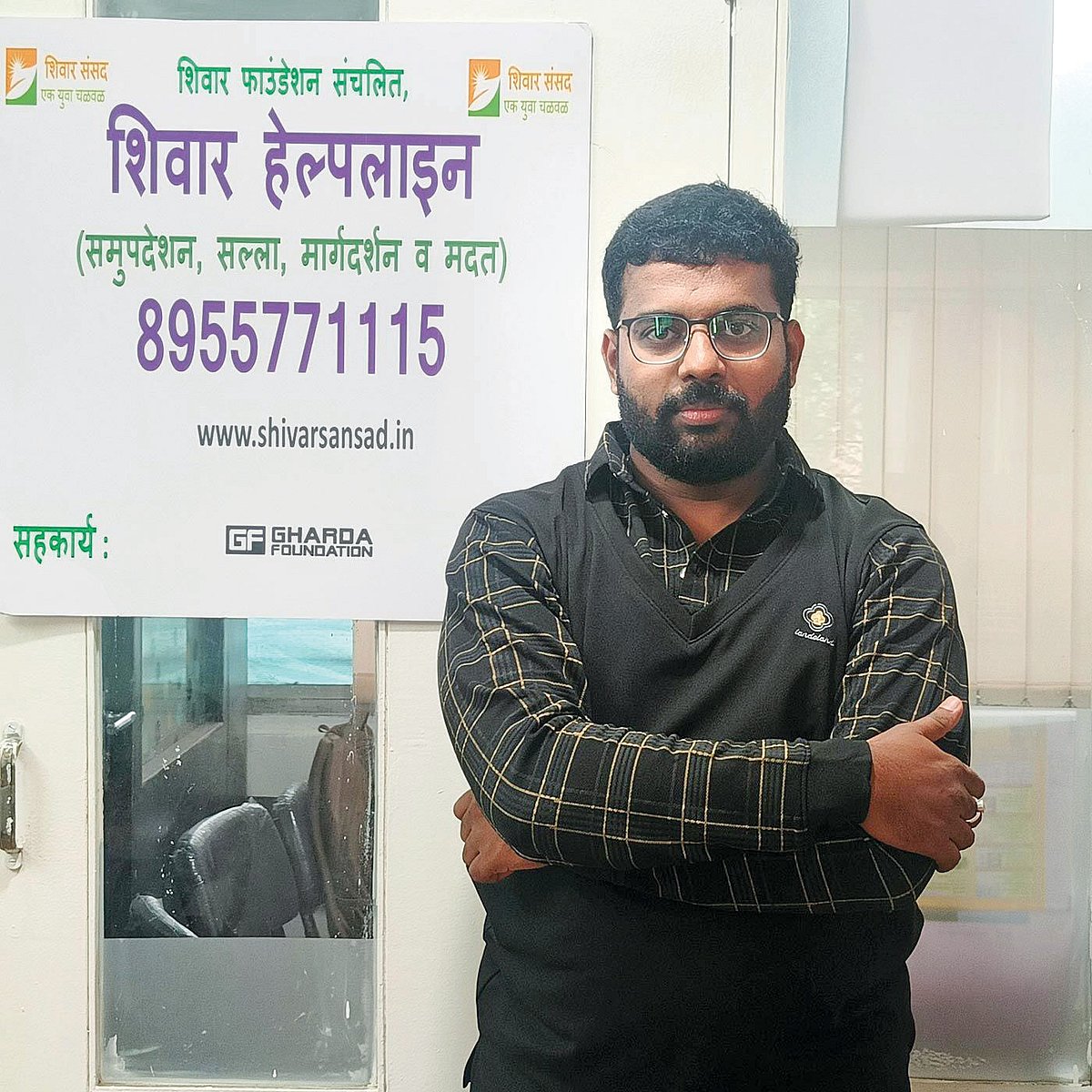
“We just crumbled under the calls,” recalls Vinayak Hegana, the 31-year-old founder and CEO of Shivar. A trained psychologist and social worker, he is an itinerant observer of rural distress.
“The calls tell us the sorry state of people all over Maharashtra,” says this 2023 Chevening Fellow. “The crisis runs deep.”
For nearly three decades, Maharashtra— particularly Vidarbha and Marathwada regions—has been in the throes of deepening agrarian distress. The fallout is the continuing saga of farmers’ suicides—over 60,000 since the National Crime Records Bureau (NCRB) started keeping a log. The flash floods of 2025 was only the latest.
“Climate disaster is not just an economic crisis,” Hegana says, “it’s also a mental health epidemic.”
On 24 September 2025, Laxman Gavsane, 42, made one last call to his wife Shivkanya from a nearby town where he had gone to buy groceries.
A marginal farmer, he doubled up as a labourer, doing any work he could get. His dream was to educate his daughter Vaishnavi (studying pharmacology in Solapur’s Barshi) and son Shivshankar (studying technical education in Dharashiv).
On 25 September, as the rain continued to pelt down, Gavsane was found dead amidst thickets of sugarcane. He left a note with an appeal to local leaders, requesting help for his children to finish their education.
Perhaps Gavsane had never heard of Shivar. If he had, might he still be alive?
The day Gavsane died, local newspapers reported four more deaths by suicide. Between 20 and 25 September, Solapur district received 365.8 mm of rain—1,253 per cent higher than the average for the month.
According to the state’s assessment, kharif crops over 44 lakh hectares—a third of the net sown area in Marathwada’s eight districts—were irreparably damaged. State wide, nearly 3,600 houses were damaged; 224 human lives and 600 livestock heads were lost in the floods.
Floods wash away riparian vegetation, degrade riverbanks and contaminate drinking water sources. They also disrupt groundwater recharge. Socially, floods deepen rural vulnerability: families lose crops, livestock, stored grain and essential documents. Repeated losses forced many into repeated cycles of debt and migration.
“Social, cultural, political and economic circumstances define the mental health of people during disasters,” says Dr Subhasis Bhadra, head of the department of psycho social support in disaster management, National Institute of Mental Health and Neuro-Sciences (NIMHANS). “How quickly people emerge from sudden shock is determined by the nature, scale and swiftness of support systems during, before and after the disaster,” he says. The stronger the community bonds, the higher the resilience, he adds.
A white paper by climate scientists, agrometeorologists and civil society groups in October 2025 argues that Marathwada’s floods—and the mental health crisis they triggered—were not merely caused by rainfall, but by a systemic failure. September recorded 305 mm of rain, 204 per cent above normal, with districts like Beed, Parbhani, Latur, Hingoli and Nanded breaking new records.
June-July rainfall deficits stressed soils, followed by sudden surges in August that filled reservoirs while leaving the land unable to absorb water. By late September, silted rivers, undersized culverts, roads blocking drainage lines and poorly synchronised dam releases turned heavy rain into what the report calls ‘a preventable amplification of the flood.’
Marathwada, the report says, is no longer a uniform drought region but a patchwork of extremes—long dry spells intertwined with sudden bursts of extreme rainfall. The Mahapur Ahval (Flood Report, November 2025), a field-based study by the National Alliance of People’s Movements (NAPM), reinforced these conclusions. Both reports suggest that unless corrective measures are taken, Marathwada would continue to oscillate between two extremes—drought and floods—in the same season.
At Shivar Helpline, the phones didn’t stop ringing. For thirty-one days, Hegana did not go home. It was, he says, “a war-like situation.”
Every caller was on the edge of self-harm. “We could not afford to turn down any call; it might have resulted in loss of life,” he recalls. “I haven’t celebrated Diwali for the last 10 years. One October night, we received 47 calls—from 10 p.m. to 6 a.m. Every caller had a suicidal thought.”
Hegana designed the Farmers’ Distress Quotient Index (FDQI) to classify callers as low-, moderate- and high-risk. The high- risk ones he attends to personally
Also Read: Farmers get the short end of the stick
Every time he gets a call, he tells himself, “Just listen, don’t sermonise, don’t lecture, hold their hand.”
That may be the most radical act of rebuilding mental and emotional health in the aftermath of a shattering climate disaster.
Hegana designed the Farmers’ Distress Quotient Index (FDQI) to classify callers as low, moderate and high-risk. The high-risk ones he attends to personally and continues to follow up on.
Since he started the helpline, his team has mapped at least 27 different reasons for people from rural Maharashtra to be mentally traumatised, reasons that are under-acknowledged in policy circles. “One reason is constant feuding with neighbouring farmers over access to farm roads, something that can be easily resolved by district revenue officials,” he says.
Hegana focuses on two verticals: mental health counselling and village-level interventions. “We have to work on the stressors and triggers,” he says.
The helpline addresses the first challenge: that of the mental health epidemic. But the stressors that push individuals into a vortex of mental health issues need a long-term fix—from field-level interventions to policy redressal. Hegana floated Shivar Foundation to collectivise farmers and youth and work on constructive interventions.
“For instance,” he says, “we have mobilised widows who need work in Dharashiv (one of Maharashtra’s most rain deficient areas). We need to create livelihoods by tapping into private and public sectors to ease their financial stress.”
Hegana aims to build an agri-psycho social model. Simultaneously, the foundation would try to build a replicable and easily accessible mental health support model for farmers. Having a phone line available round the clock helps avert extreme reactions, he says.
He liaises with respective district collectors and state line department officials wherever possible and connects farmers to the government to leverage state aid. Many officials are helpful. Yet, he says, the response is inadequate.
From 2023, as climate variability worsened, Hegana sensed that the crisis ahead would be far more complex than drought. In 2025, a generous donor helped make the move to Pune to a centralised system that will scale up for pan Maharashtra. Yet, mental-health care remains invisible in climate-policy responses. “The soil may not heal quickly,” Hegana adds, “but you may be able to save and rebuild lives.”
Courtesy: People’s Archive of Rural India (PARI)
Join our official telegram channel (@nationalherald) and stay updated with the latest headlines