


State does not hold public resources as 'private proprietor' but as trustee on people's behalf: SC
Top court flags concerns over transparency, directs preliminary enquiry into alleged favouritism linked to CM’s family
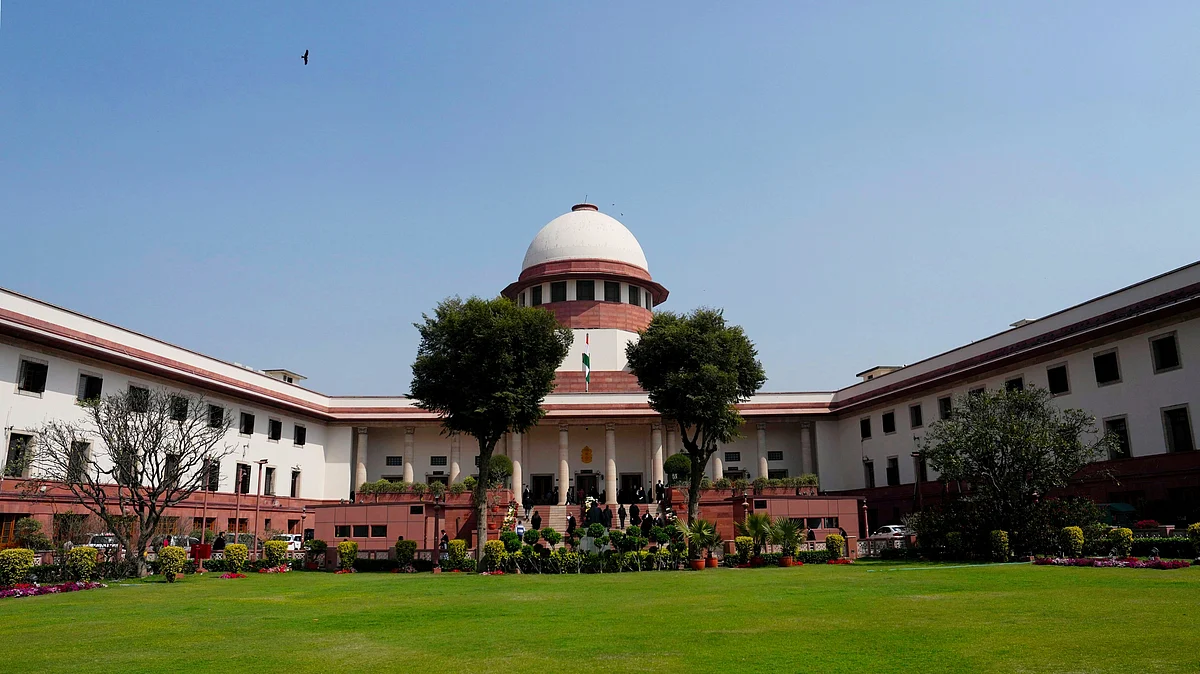


The State does not hold public resources as a "private proprietor" but as a trustee on behalf of the people, the Supreme Court said on Monday.
A bench headed by Justice Vikram Nath said whenever the State undertakes the allocation of public resources, award of public contracts or execution of public works, it is bound to act in a manner that is transparent, fair and consistent with the guarantee of equality under Article 14 of the Constitution.
The top court's observations came while directing the CBI to register within two weeks a preliminary enquiry into allegations of preferential allotment of contracts for public works in Arunachal Pradesh to firms allegedly owned or related to family members of Chief Minister Pema Khandu.
The bench, also comprising Justices Sandeep Mehta and N V Anjaria, said public confidence in governance rests upon the assurance that opportunities created by the State are administered through institutions that respect equality, integrity and accountability.
"Where the distribution of public resources is clouded by allegations of nepotism, patronage or opaque decision-making, the issue is not merely one of administrative irregularity. It raises concerns that go to the heart of the constitutional promise that State action shall be fair, impartial and guided by reason," it said.
The bench said constitutional courts, as guardians of that promise, are therefore required to ensure that the exercise of public authority remains anchored in legality, transparency and institutional accountability.
"In a constitutional democracy governed by the rule of law, the exercise of public power is always subject to constitutional discipline. The State does not hold public resources as a private proprietor, but as a trustee on behalf of the people," the bench said in its 35-page verdict.
It said the top court's jurisprudence has consistently emphasised that the power to direct an investigation by the CBI is to be exercised with restraint.
"The governing principle is that the transfer of investigation to the CBI is justified only in rare and exceptional cases where it is necessary to do justice between the parties and to instil confidence in the public mind, or where the investigation by the State police lacks credibility and it is necessary to secure a fair, honest and complete investigation," the bench said.
It said illustratively, such a transfer may be warranted where high officials of the State are involved, where the accusation is against top officials of the investigating agency, such that they may influence the course of investigation, or where the probe is prima facie found to be tainted or biased.
The bench said the court ordinarily examines whether the material placed before it discloses a prima facie case raising serious questions of legality; circumstances suggesting that a probe by ordinary State machinery may not inspire confidence where high public functionaries are implicated, and the necessity of an independent inquiry to preserve public confidence in the rule of law.
It said the award of public contracts is an exercise of public power and it involves the expenditure of public funds and the conferment of economic benefit by the State.
"Such decisions are not insulated as matters of private contract. They are subject to the discipline of Article 14 of the Constitution of India, because the State must act fairly, transparently and in a non-arbitrary manner when it distributes public resources," the bench said.
It said the apex court has repeatedly recognised that State-owned or public-owned resources cannot be dealt with at the absolute discretion of the executive and public interest is the paramount consideration.
"The State and its instrumentalities cannot confer benefits according to the whims of any political or administrative functionary," the bench said.
It said the State is the custodian of public records and it is expected to maintain them in a manner that makes public expenditure traceable and accountable.
Dealing with the petition, the bench said the petitioners' allegations were not confined to a mere grievance about the outcome of a tender and they raise issues that go to the integrity of public procurement and the traceability of public expenditure.
"The audit report, the petitioners' additional affidavit and the State's replies together disclose repeated resort to non-tender methods, repeated absence of recorded reasons for such resort and repeated non-production of vouchers and tender-related records in relation to high-value public projects," the bench noted.
It said ultimately, what emerges from the record is that the State does not deny that the work order system has been used extensively.
The bench said the audit material reflects multiple instances of non-tender execution and missing documentation.
"The petitioners allege related-party benefit and conflict of interest. In response, the State offers broad justifications, invokes percentages and disclaims comment on the audit report.
"These answers do not meet the gravity of the allegations. They do not restore the confidence that a matter of this nature requires," it said.
Join our official telegram channel (@nationalherald) and stay updated with the latest headlines