


If Ayodhya sounds like trouble, talk of Mathura
A familiar blueprint has come up — kar seva, talk of removing a dome, homes and temples marked for demolition, questionable land deals...
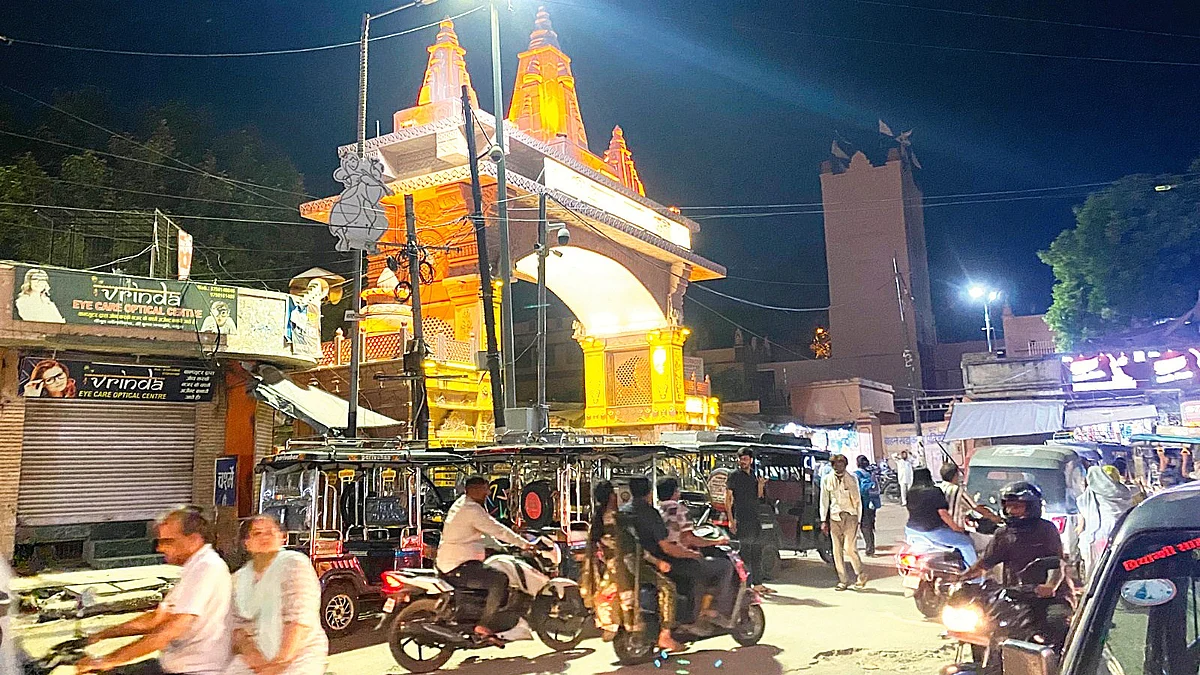


It’s a hot and humid afternoon in Mathura. Outside the Shri Krishna Janmabhoomi temple complex, ice-cream vendor Rakesh is waiting for customers. “Not enough people yet — it’s too hot. It might pick up in the evening,” he tells me. Has he heard about the kar seva called by the Akhil Bharatiya Akhara Parishad on 9 August, I ask him. He’s heard, he says, a bit disinterestedly.
It looks like just another day in Mathura, but I wonder if this is the lull before the storm. On 28 June, Uttar Pradesh chief minister Yogi Adityanath dropped the keywords ‘kar seva’ and ‘Krishna janmabhoomi’, while speaking at a public event in Hathras, 50-odd kilometres from Agra.
In the same breath, he baited his adversary and Samajwadi Party chief Akhilesh Yadav, who had taken to social media on 7 June to allege embezzlement of temple donations in Ayodhya, bringing the matter into the national spotlight and setting off a chain reaction that embarrassed the entire Sangh Parivar. Yogi, as the incumbent chief minister, and with elections round the corner, has a little more at stake, and will desperately want a new narrative.
Before long, the religious leadership in Mathura had awakened. On 4 July, Swami Sachchidanand Maharaj of the Shri Chitragupt Peeth in adjacent Vrindavan, declared that a kar seva would be organised on 9 August to remove the (Shahi Eidgah) dome adjacent to the Krishna Janmabhoomi temple, “just like the kar seva that liberated the Ram mandir”.
His call was backed by the Nirmohi Akhara and Akhil Bharatiya Akhara Parishad president Ravindra Puri, whose organisation represents 13 akharas and an estimated five lakh sadhus.
Also Read: What loot in Hindutva hotspots looks like
On 14 July, the campaign echoed at a gathering in neighbouring Vrindavan, when Swami Abhishek Brahmachari declared: “Krishna Lalla, we are coming. We will build the temple there.” Posters targeting Akhilesh and Mulayam Singh Yadav appeared across the city, while Ravindra Puri told a television channel that even Akhilesh would eventually be persuaded to join the movement.
Reacting to these calls for kar seva, Tanveer Ahmad, secretary of the Mathura Eidgah Committee, said: “Such dates have been announced earlier as well. When cases are pending in court, statements like these are only made for political gain. Mathura is a religious city, but its people believe in communal harmony. Those calling for kar seva are outsiders.”
Ahmad points out that the Mathura dispute between Shri Krishna Janmasthan Seva Sansthan and the Shahi Eidgah Trust was settled through a 1968 agreement, and subsequently implemented through a court decree in 1973. According to a report in The Hindu, the Seva Sansthan transferred a portion of the land to the Shahi Eidgah.
However, there are petitions pending in courts that challenge this agreement as ‘fraudulent’ and seek the transfer of the entire property in the name of Shri Krishna Virajman (the deity). Petitioners representing the Hindu side argue that the land on which the Shahi Eidgah mosque stands is Krishna janmasthan and the Muslim side should remove its structure. They say land for an eidgah can be provided at another location away from the janmasthan.
Also Read: Lip-reading the SAMADHAN initiative
On reports that the Supreme Court is encouraging negotiated settlements in Kashi, Mathura and Sambhal through Lok Adalats, Ahmad says notices have been issued in 23 pending cases in Mathura district, not just the Krishna Janmabhoomi–Shahi Eidgah dispute. Possibly 18 connected cases are pending before the Allahabad High Court, he said, and about ten before the Supreme Court.
Local Congress leader Aditya Tiwari sees echoes of Ayodhya in the ‘Chalo Mathura’ call. “The same atmosphere is being created in Mathura. Kashi and Mathura have always been on the BJP–RSS political agenda, but circumstances have changed. The Ram Mandir donation controversy has weakened public support. The locals are unlikely to back this campaign.”
****
Away from the political heat, Jeetu Chaudhary, a factory worker by day and motorcycle taxi driver after sundown, worries about the proposed Banke Bihari corridor in nearby Vrindavan, and how it might affect his livelihood. “If my salary were enough, I wouldn’t have had to earn extra through my bike-taxi.” He has only vaguely heard about the kar seva and doesn’t really care.
In the narrow lanes around the Banke Bihari temple in Vrindavan, 10-odd kilometres from Mathura city, some residents have gathered to watch a painter marking houses with saffron lettering: ‘Property of Shri Thakur Banke Bihari Ji Maharaj, Vrindavan’. More than 20 houses have been marked thus.
In the Jungalkatti area opposite the temple, 285 properties have been identified for demolition. “Of these 285 properties, 30-35 are temples that are 400-500 years old. The corridor is putting Vrindavan’s civilisational and cultural heritage at risk,” says social activist Deepak Parashar.
The corridor project came on the heels of the 2022 Janmashtami stampede, in which two devotees died. The Uttar Pradesh government subsequently proposed the corridor to improve crowd management and, in 2025, passed the Shri Banke Bihari Ji Temple Trust Ordinance. The Goswami community challenged it, arguing that it would strip the temple’s hereditary custodians of their rights.
The Supreme Court has, in its interim order, stayed the formation of the proposed trust pending a final verdict, but permitted conditional use of temple funds to acquire about five acres for the corridor.
Parashar alleges irregularities in the acquisition process. “Different portions of the same original property have been assigned different values,” he says. He also questions the land acquisition before the detailed project report (DPR) has been made public. “There are complaints that owners were coerced into registering sale deeds. And how can people sell what is often worth their entire lifetime savings, and that too when the project has not even been disclosed?”
Leading the resistance is Sohan Lal Mishra, a priest at the Banke Bihari temple. “No locals are demanding a corridor; only outsiders.” Mishra says Vrindavan’s congestion owes less to poor infrastructure and more to poor traffic management. “Why allow cars into crowded streets? The corridor is being created so that luxury facilities can be built for wealthy visitors. Locals are forced to take detours while affluent visitors get VIP access. Has the Kashi Vishwanath corridor eliminated congestion?”
Join our official telegram channel (@nationalherald) and stay updated with the latest headlines