


Lip-reading the SAMADHAN initiative
If attempts at reconciliation failed to resolve the Babri Masjid dispute, why might they succeed in Kashi or Mathura?
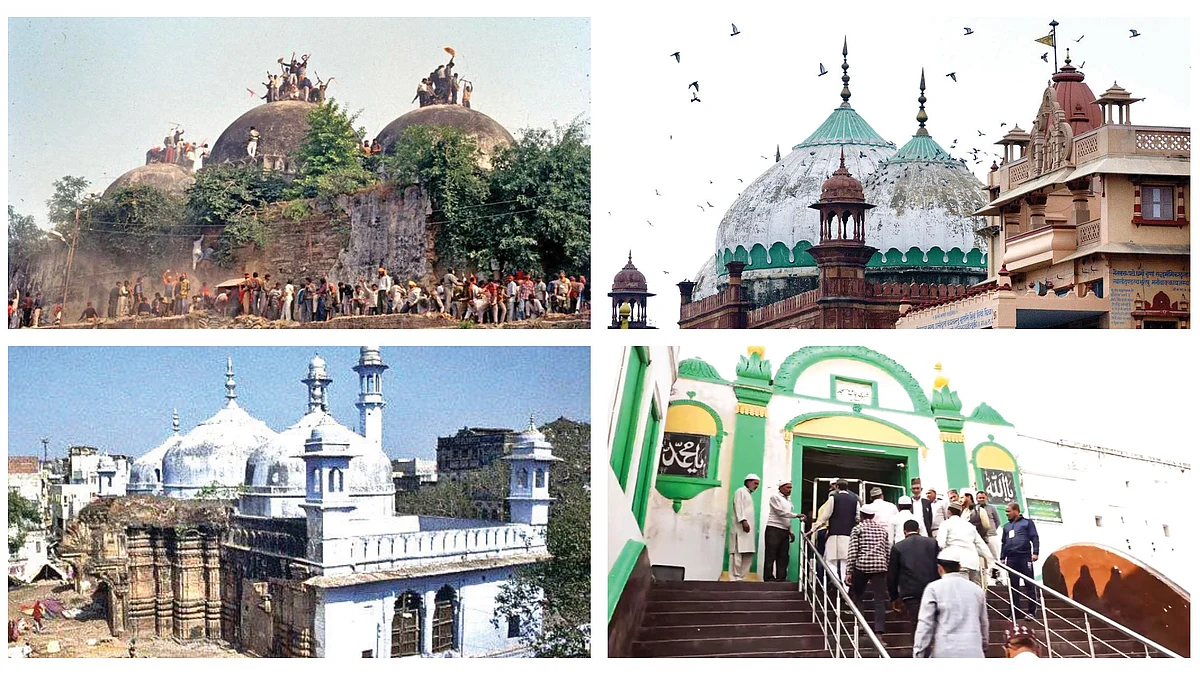


The Supreme Court deserves appreciation for its imaginative initiative christened SAMADHAN — Supreme Court Action for Mediated Adjudication and Disputes Harmonisation Across Nation. Even those who question the wisdom of the exercise will concede that the acronym is ingenious. It reflects the judiciary’s apparent desire to promote mediation and consensual settlement instead of prolonged litigation.
One cannot, however, overlook the fact that the Court seems to have been inspired by Prime Minister Narendra Modi’s well-known fascination for memorable acronyms.
The Court has announced a three-day SAMADHAN Samaroh (21–23 August) to resolve through mediation all manner of disputes, including some very contentious religious ones. The sentiment is admirable, but the question is: can goodwill and mediation dissolve disputes that have resisted resolution for decades?
History suggests otherwise.
The Ayodhya dispute witnessed numerous attempts at reconciliation. Among those who tried were the Shankaracharya of Kanchi and IPS officer-turned-scholar Kishore Kunal, renowned for his work at the Mahavir Mandir in Patna and his extensive research on the Ram Janmabhoomi issue. Many eminent citizens quietly explored formulas acceptable to both communities. None succeeded. The reason was simple.
Successful mediation requires authorised representatives capable of making binding compromises. Neither Hindus nor Muslims have a single organisation empowered to negotiate on behalf of all believers. Any individual or body claiming to represent one side would immediately be accused of conceding too much. Negotiators would have no guarantee that their own communities would hon-our the settlement. Faced with that reality, discretion became the better part of valour.
Ultimately, the Supreme Court had to decide the Ayodhya dispute.
When the judgment was delivered in November 2019, there was remarkable calm across the country. That was because both communities had prepared themselves for a judicial verdict after decades of litigation. The unanimous nature of the decision, extensive security arrangements, repeated appeals for peace and the general acceptance that the country’s highest court had spoken helped prevent widespread unrest.
The Constitution bench consisted of Chief Justice Ranjan Gogoi and Justices S.A. Bobde, D.Y. Chandrachud, Ashok Bhushan and S. Abdul Nazeer. Interestingly, the judgment acknowledged weaknesses in the Hindu side’s evidentiary claims while also recording that the demolition of the Babri Masjid in 1992 was an egregious violation of the rule of law. It also recognised that Muslims had been unlawfully deprived of their mosque.
Yet, considering the totality of historical evidence and continuous Hindu belief regarding the birthplace of Lord Ram, the judges awarded the entire disputed site for construction of a Ram temple while directing that five acres of land be allotted elsewhere for a mosque.
In other words, the Supreme Court did what courts are expected to do— it decided the dispute, whatever its merits.
It’s germane to recall at this point the Places of Worship (Special Provisions) Act, 1991, which was enacted by Parliament during the Congress government headed by P.V. Narasimha Rao. This law froze the religious character of every place of worship as it existed on 15 August 1947, with the sole exception of Ayodhya, which was a pending dispute. It prohibited conversion of à place of worship into another and barred fresh litigation seeking to alter the historical-religious status of any site.
The legislation represented Parliament’s determination that independent India should not endlessly reopen medieval history. Successive governments, including those led by Atal Bihari Vajpayee and Narendra Modi, allowed the law to remain on the statute book, presumably recognising that reopening ancient disputes would endanger communal harmony.
The wisdom of that law becomes evident if one recalls that organisations spearheading the Ayodhya movement often claimed that hundreds or even thousands of temples had been destroyed and replaced by mosques during medieval invasions. If every such claim were to become the subject of litigation, India would spend generations excavating the past, instead of building its future.
Courts would be flooded with historical controversies requiring archaeologists, historians and theologians more than judges. Every disputed structure could become a flashpoint for communal mobilisation. The energy of the nation would be diverted from improving education, healthcare, employment, infrastructure and scientific progress. Independent India cannot become a nation permanently engaged in correcting every perceived historical wrong.
Unfortunately, the 1991 settlement gradually began to unravel.
The process started in Mathura. In December 2023, the Allahabad High Court ordered a court-monitored survey of the Shahi Idgah complex; the Supreme Court stayed the directive in January 2024. All this appeared inconsistent with the spirit, if not the letter, of the 1991 Act. The Supreme Court could have clarified at an early stage that subordinate courts lacked jurisdiction to reopen issues expressly frozen by Parliament.
Similar developments occurred in the Gyanvapi litigation, where inspection of the wazukhana (ablution area) led to claims that an object discovered there was a shivling. Muslims maintained that it was part of the fountain system used for ablutions. Whatever its true character, the controversy dramatically altered the legal and political landscape and weakened the 1991 Act.
Sambhal followed a similar trajectory. A civil suit was filed questioning the status of the Shahi Jama Masjid, and almost on cue, a local court ordered a survey. The exercise immediately heightened communal tensions. Rumours spread rapidly, protests erupted and violent clashes followed, resulting in deaths and injuries. The episode demonstrated the dangers of permitting sensitive religious disputes to proceed without first addressing the threshold question of whether such litigation is barred by the Places of Worship Act.
The same tendency has surfaced even in relation to the Taj Mahal. Built during the reign of the Mughal emperor Shah Jahan in memory of Mumtaz Mahal, it is one of the Seven Wonders of the world and has long been recognised as one of the finest examples of Mughal architecture. Yet, ever so often you’ll hear that it originally housed a Hindu temple. A local court in Agra has dismissed the claims, but litigation continues nevertheless.
Recently, the Allahabad High Court directed photographic and videographic documentation in related proceedings. One cannot help wondering whether every survey will produce fresh assertions about hidden religious symbols. Such exercises risk undermining the very purpose of the 1991 Act, which sought to prevent historical speculation from becoming contemporary litigation.
Significantly, the Supreme Court itself has entertained petitions challenging the constitutional validity of the Places of Worship Act. Once the validity of the law is under judicial scrutiny, uncertainty inevitably spreads to disputes that Parliament intended to settle permanently.
Against this backdrop, expecting the Mathura, Kashi and Sambhal disputes to disappear through SAMADHAN is optimistic, to say the least. Both sides have already expressed reservations about mediation. When fundamental questions of faith, history and identity are involved, goodwill compromises are difficult.
The Supreme Court may, therefore, have no option but to do what it ultimately did in Ayodhya: hear the evidence, interpret the law and pronounce a binding judgment.
There is an old saying that the road to hell is paved with good intentions. It means that noble motives alone cannot guarantee desirable outcomes. SAMADHAN may be born of fine intentions, but where mediation is impossible, justice demands not conciliation but adjudication. The Supreme Court cannot discharge its constitutional duty by avoiding difficult decisions.
A.J. Philip is a senior journalist and commentator on national affairs. More of his writing here
Join our official telegram channel (@nationalherald) and stay updated with the latest headlines