


Between faith and statehood: Ladakh’s moment of reckoning
As Buddha’s relics reach Leh on Buddha Purnima, Ladakh’s long standing demands for statehood and constitutional safeguards return to the political spotlight
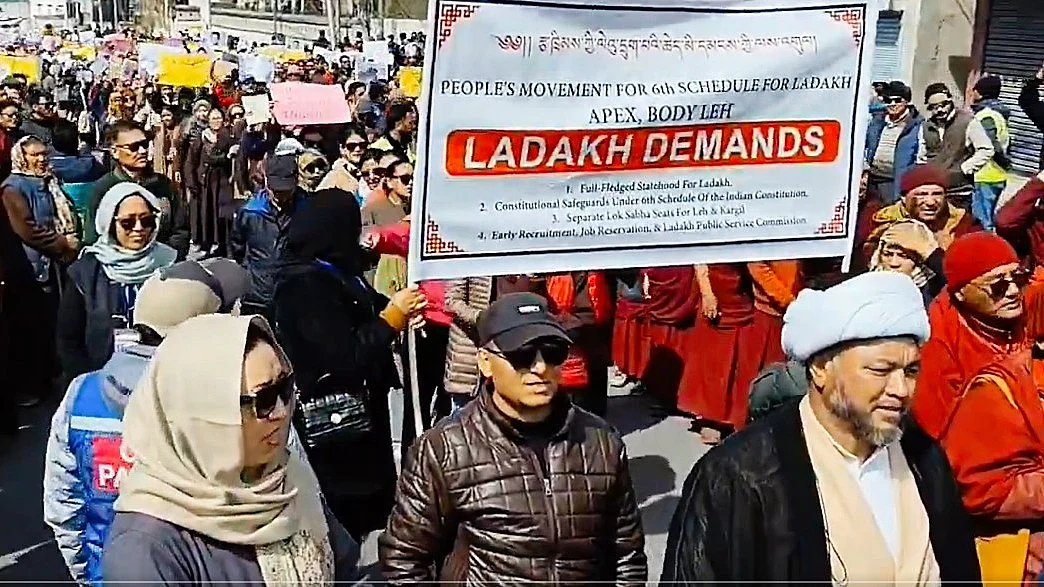


For Ladakh, April 30 promises to be more than a ceremonial date—it may become a defining political and spiritual moment.
On that day, the sacred relics of Lord Buddha, preserved in the National Museum in New Delhi, will arrive in Leh for a historic public display from May 1 to May 15—the first such exhibition of the revered relics in India. For a region where Buddhism is not merely a religion but a lived civilisational identity, the occasion carries extraordinary emotional and cultural significance.
The timing is equally symbolic. Buddha Purnima, marking the birth anniversary of Lord Buddha, will be observed on May 1. The organisers have framed the journey of the relics to Ladakh as a message of global peace, compassion and harmony at a time when West Asia remains engulfed in conflict and geopolitical violence. In a fractured world, the image of Buddha’s relics travelling to India’s high-altitude frontier offers both spiritual reassurance and diplomatic symbolism.
But in Ladakh, faith and politics rarely travel separately.
As the relics make their way to Leh, Union Home Minister Amit Shah is also expected to arrive for a two-day visit. And that is what has transformed this sacred occasion into a politically charged moment.
For Leh Apex Body (LAB) and Kargil Democratic Alliance (KDA)—the two principal platforms spearheading Ladakh’s democratic demands—Shah’s presence is more than symbolic. It is an opportunity. Since Ladakh was carved out as a Union Territory in 2019 without a legislature, the region has witnessed sustained political mobilisation over concerns of identity, land, employment and governance.
The core demands remain unchanged: full statehood for Ladakh and constitutional safeguards under the Sixth Schedule to protect tribal rights, land ownership and jobs.
Yet, despite months of agitation, negotiations and assurances, uncertainty continues to define the Centre’s approach.
In what many local leaders see as political choreography, Ladakh’s administration has recently made two major announcements. First, Lieutenant Governor V.K. Saxena declared that the high-powered committee’s sub-committee on Ladakh’s demands would meet on May 22—after a four-month gap. Then came the sudden announcement of the creation of five new districts in Ladakh, increasing the total from two—Leh and Kargil—to seven.
On paper, these decisions appear administrative. Politically, however, many in Ladakh see them not as reform, but as political signalling.
Both LAB and KDA have openly expressed dissatisfaction, arguing that secretary-level committee meetings have yielded little because bureaucrats lack the authority to take substantive political decisions. To them, these exercises risk becoming procedural distractions rather than genuine dialogue.
Their demand is clear: direct engagement with Amit Shah.
For leaders in both Leh and Kargil, only the Home Minister can provide meaningful assurances on statehood and Sixth Schedule protections. Anything less, they fear, would merely prolong uncertainty.
This has created an unusual atmosphere in Ladakh—one where spiritual reverence is accompanied by political anticipation.
Will Amit Shah use this visit only for ceremonial participation, or will he seize the moment to politically engage with Ladakh’s leadership? That remains to be seen.
For now, Ladakh stands suspended between devotion and democratic aspiration.
As Lord Buddha’s relics arrive bearing a message of peace, Ladakh’s people are also hoping for political clarity. In the monasteries, prayers may be for compassion; in the public squares, the demand is for constitutional justice.
Join our official telegram channel (@nationalherald) and stay updated with the latest headlines