


Satya Niketan collapse: Court flags DU hostel crisis, MCD suspends 5 officials
As Delhi HC holds MCD and DU accountable, basic question remains: who will keep outstation students safe?
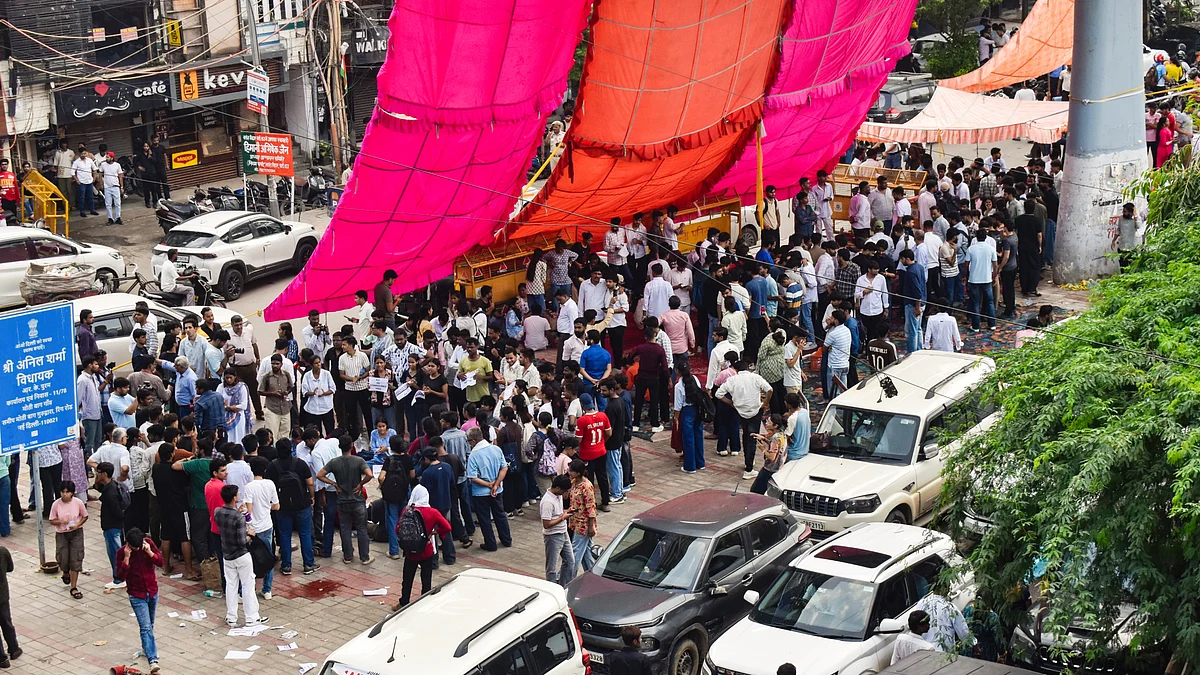


The Municipal Corporation of Delhi (MCD) on Monday, 7 September suspended South Zone deputy commissioner Rakesh Kumar and four engineers pending disciplinary proceedings following the Satya Niketan building collapse that killed seven people and injured several others.
The suspended officials are superintending engineer Ranvir Singh, executive engineer (building) Lalit Kumar Goel, assistant engineer (building) Sunil Chauhan and junior engineer (building) Ashish Kumar.
Rakesh Kumar, a Bihar Civil Service officer who was promoted to the IAS in October 2025 and allocated the Bihar cadre, was appointed South Zone DC earlier this year. Officials said the South Zone witnessed three major building-related incidents during his tenure — the Saidulajab building collapse, the Hauz Rani fire and now the Satya Niketan collapse.
Earlier, Delhi High Court called the collapse, which also left several people injured, "most unfortunate" and said responsibility for the tragedy did not rest only with the building owners. The court also held the MCD and DU responsible, pointing to the university’s failure to provide adequate accommodation for students from outside Delhi who are forced to rely on private PGs.
The court also asked authorities to file separate replies to a public interest litigation (PIL) within 10 days and listed the matter for further hearing on 25 September.
For Delhi University (DU) students often forced to make do with paying guest (PG) accommodation in cramped and congested bylanes, the Satya Niketan building collapse that killed seven people has lent urgency to a basic demand ahead of the Delhi University Students’ Union (DUSU) polls: a safe place to stay.
The decades-old boys' PG accommodation near Delhi University’s south campus collapsed on Sunday while repair work was under way. Twelve people were pulled out of the debris, seven of whom died.
As the rescue operation entered its second day, students who visited the site said the collapse had exposed concerns extending well beyond the individual building to the safety of the accommodation on which thousands of students depend.
In Satya Niketan, tall buildings crowd the sky while narrow lanes leave little room for sunlight, pedestrians or emergency vehicles. Students said most buildings in the inner lanes are used as PGs and alleged that several have been constructed or modified without the required papers or approvals.
A group of students pointed to one building which, according to them, has a gym in the basement and five floors above it, with the owners occupying one floor and PGs occupying the others.
The physical layout of the neighbourhood is itself a source of concern in an emergency. The passages become progressively narrower deeper inside the area, with buildings standing almost wall to wall. In some stretches, there is barely enough room for one person to walk through. Thick bundles of electrical and communication wires hang overhead, while air-conditioning units, pipes and makeshift shades further crowd the passageways.
"An ambulance cannot reach this area," a student said. "Just imagine if there is a fire or a building falls down, where will the students go?" another asked. "If one building falls on the other, the other will fall on the next. It is going to be like a stack of cards just falling down."
Also Read: What Delhi owes its urban villages
Students said they knew the DUSU could not solve Delhi’s accommodation crisis on its own, but argued that student representatives could help identify safer alternatives and push the issue into the political spotlight. "If accommodation cannot be given immediately, at least give us a list of places that have been checked for safety and recommend where we can stay," said Kashish, a B.Com (honours) student.
Students suggested that government institutions, including colleges and universities, could help students identify hostels and other accommodation after proper safety checks. They stressed that they were not blaming the DUSU or other student unions for the collapse. "The DUSU and student unions have nothing to do with this," said Parth, a sociology student.
But they said student unions could still work towards helping students find safer alternatives near their colleges. Moving farther from the university is not always practical because of longer commutes, higher travel costs and the time lost travelling to and from classes. "We have to go so far away to find a place to stay and then commute for so long. If we go to the outer parts of the city, the problem will become even bigger," another student said.
Jashan Kumar, a biochemistry student from Punjab who has lived in the area for the past three to four years, said he was among the first students to reach the site after the collapse. "It was an extremely loud sound. We immediately went there and called the ambulances," Kumar said. For students who come to Delhi from other states, he said, the incident highlighted the difficult choices they face in finding accommodation. "All of us are from outside Delhi. When we want to stay here, this is our only option."
Another student said the collapse had made students look more closely at the buildings around them and the conditions in which they are accommodated.
Students also said the number of students arriving from outside Delhi after the introduction of the Common University Entrance Test (CUET) had increased pressure on the already limited supply of affordable accommodation around university campuses.
With DUSU elections scheduled for 18 September and counting and results expected on 19 September, students want candidates to make accommodation and safety a poll issue.
With PTI inputs
Join our official telegram channel (@nationalherald) and stay updated with the latest headlines