


Dharmendra Pradhan's 'Mahakal time' pitch triggers fact-checks, basic geog. lessons
Remarks on 3 April revive scrutiny of scientific claims and India’s unresolved two-time-zone debate
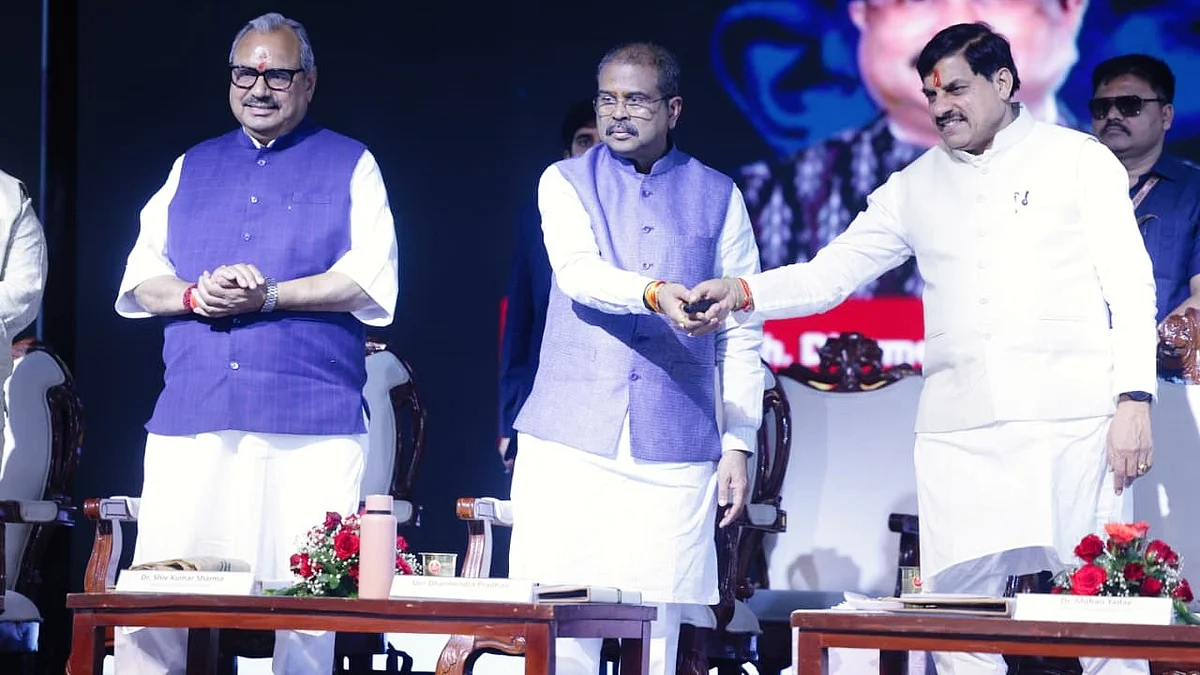


When the country’s education minister proposes resetting the world’s clocks, the least one expects is that the underlying geography survives contact with a school atlas.
Speaking on Friday, 3 April at the inauguration of the three-day 'Mahakal: The Master of Time' international conference at the planetarium complex in Ujjain, Dharmendra Pradhan proposed replacing Greenwich Mean Time (GMT) with a so-called 'Mahakal Standard Time' (MST), arguing that the ancient city should serve as the global reference point for time.
“Ujjain is the place where the Equator and the Tropic of Cancer meet and ancient world time calculations were made,” Pradhan said, according to PTI. “Therefore, the time has come to logically establish Mahakal Standard Time (MST) in place of Greenwich Mean Time (GMT).”
There is, however, a small cartographic difficulty: the Equator and the Tropic of Cancer do not meet anywhere on Earth.
The Equator lies at 0° latitude and passes through nations including Ecuador, Kenya and Indonesia. The Tropic of Cancer lies at approximately 23.5° north latitude and passes through India, including areas near Ujjain. The two lines remain parallel — an arrangement unlikely to be altered by ministerial enthusiasm.
Ujjain does occupy an important place in the history of Indian astronomy. Classical texts such as the Surya Siddhanta treated the city as a reference meridian for astronomical calculations, and observatories were later established there under royal patronage.
Modern global timekeeping, however, is governed less by symbolic geography than by atomic clocks synchronised across laboratories worldwide. Coordinated Universal Time (UTC), not GMT, is the primary global standard today.
Altering internationally recognised time standards would require multilateral scientific consensus and diplomatic coordination — a process typically involving somewhat more than a conference declaration.
Pradhan also called for discarding what he described as the 'Macaulay mindset' within the next decade, arguing that strengthening institutions such as the Ujjain Science Centre would help restore India’s scientific legacy. “Ujjain is a place where the distance between spirituality and science disappears and a new vision is born,” he said.
The reference to Macaulay follows a well-worn script in BJP rhetoric. The phrase alludes to Thomas Babington Macaulay, the British official whose 1835 Minute on Education advocated English-language instruction in colonial India.
Party leaders have repeatedly invoked the term to frame contemporary policy debates as efforts to shed colonial intellectual influence. Critics argue the trope is often deployed as a rhetorical workhorse — useful for signalling civilisational confidence, if not always accompanied by demonstrable improvements in scientific or educational outcomes.
Congress spokesperson Rashid Alvi dismissed the proposal as symbolic politics. “BJP’s idea of development is changing names of roads and cities built by others,” Alvi said. “They want to change the time standard now because to them, that’s all there is to Indian civilisation. But why stop there? Throw away your mobile phones, ban telephones, light diyas instead of using electricity.”
Also Read: The freedom to think critically
But of course, Madhya Pradesh chief minister Mohan Yadav endorsed Pradhan's proposal, stating that traditional Indian methods of time calculation based on planetary motion were “more accurate than GMT”.
Modern timekeeping, meanwhile, relies on atomic clocks and measurements of Earth’s rotation coordinated through international scientific bodies — techniques generally considered difficult to outperform using sunrise charts.
The episode has also revived a more grounded question closer to home: if India has struggled for decades to adopt even a second domestic time zone, resetting the global clock may be an ambitious escalation.
India follows a single time zone, Indian Standard Time (IST), despite spanning nearly 30 degrees of longitude. This results in stark variations in daylight hours across regions, with several northeastern states experiencing sunrise well before 5.00 am during summer.
Tea gardens in Assam have long followed an informal 'bagan (garden) time', typically about an hour ahead of IST, allowing work schedules to better match daylight rather than waiting for official time to catch up.
Researchers have argued that the mismatch between daylight and official working hours leads to energy inefficiencies and reduced productivity. Studies by bodies including the Council of Scientific and Industrial Research (CSIR) have examined the potential benefits of introducing a second time zone for the Northeast.
Even this relatively modest adjustment has remained under discussion for years due to concerns about logistical complexity and possible confusion across railway timetables, aviation schedules, broadcast timings and digital infrastructure.
Establishing a new time zone in India would require technical evaluation by agencies such as the National Physical Laboratory, followed by Union government approval and extensive coordination across sectors ranging from telecommunications to financial markets.
Against that backdrop, persuading the rest of the world to realign its clocks may prove a longer-term project.
Ujjain’s historical association with astronomical study remains well documented. But as modern timekeeping continues to rely on globally synchronised atomic clocks rather than intersecting latitudes, the more immediate task — some scientists suggest — may be ensuring that public discussions of science remain broadly aligned with it.
Join our official telegram channel (@nationalherald) and stay updated with the latest headlines
Published: 06 Apr 2026, 5:29 PM