


Eleven-armed Durga: When Bengal’s guardians of tradition forget to count
As BJP leaders and Hindu groups lecture Bengal on Puja traditions, a government ad gives Durga an eleventh arm — and then blames a designer
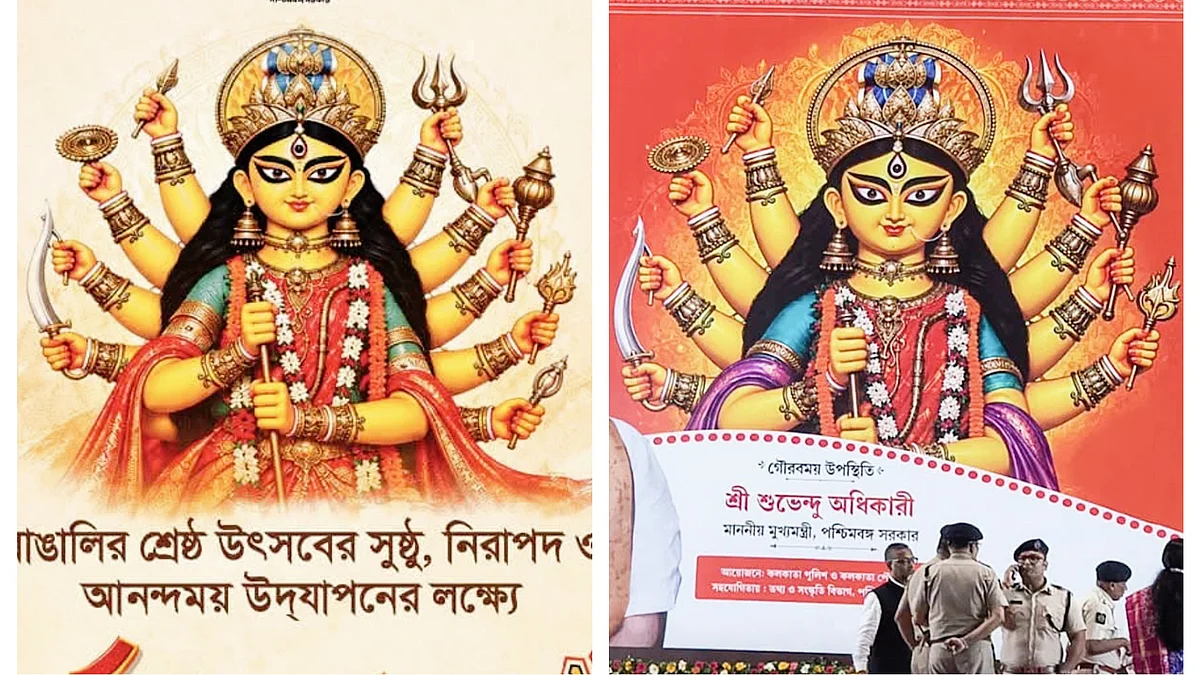


If goddess Durga has always arrived in Bengal as 'dashabhuja', or the 10-armed one, the state's new BJP government has apparently decided that 2026 deserves a little extra firepower.
A government advertisement released on Monday, 7 September for a government meeting with Durga Puja committees showed the goddess with eleven arms, complete with a strange additional weapon. In a state where Durga Puja is not merely a festival but practically an annual emotional audit of Bengali identity, this was never going to pass quietly.
The advertisement was issued by the information and cultural affairs department for chief minister Suvendu Adhikari’s meeting with puja committees at Milan Mela. Prime Minister Narendra Modi appeared on one side of the artwork and Adhikari on the other, with the eleven-armed Durga presiding above them.
And just like that, Bengal had a new theological question to debate: who authorised the eleventh hand?
Trinamool Congress (TMC) MLA Kunal Ghosh was quick to ask. 'No themes, no distortions... we saw heaps of threats and talk of codes of conduct. But how did ‘Ma’ end up with 11 arms in a government advertisement?' he wrote, following up with the question that was almost impossible to resist: 'According to which scripture did the ten-armed goddess (dashabhuja) transform into an eleven-armed one (ekadashbhuja) in 2026?'
CPI(M) leader Shatarup Ghosh joined the fun, suggesting that the government had effectively donated an additional weapon to the goddess. The 'rebel' TMC unit, meanwhile, accused the government of becoming "increasingly alienated from Bengali culture".
The BJP’s first response was almost too perfect for the joke. State president Samik Bhattacharya said, "Mother has become even more powerful." He then supplied the decidedly less divine explanation: "It was a mistake by the advertising agency. This error can be rectified. There is no politics involved in this."
Perhaps not. But Bengal has never been a particularly forgiving place when it comes to political theology — especially when the people doing the explaining have spent so much time explaining how everyone else should practise their religion.
Because this year, Hindu organisations including the VHP, have already urged puja organisers to return to "traditional" practices and keep non-vegetarian food away from puja pandals. The VHP has stressed that it is not demanding a blanket ban on non-vegetarian food. But the advisory nevertheless opened a very large — and very Bengali — can of fish curry.
There have also been demands and political discussions around restrictions on theme-based puja celebrations and how committees should conduct themselves. So, before Durga had even arrived, Bengal had already accumulated instructions on what could be eaten, what could be displayed and how puja should look.
Then came Bageshwar Baba, or Dhirendra Krishna Shastri. During a recent visit to Bengal, Shastri appealed to people not to sell non-vegetarian food around Durga idols and urged Bengali Hindus to observe Navratri. His comments triggered another controversy, particularly because fish and meat during Durga Puja are hardly some recent Bengali rebellion against tradition.
The debate soon became less about faith and more about who gets to write the puja menu. And there was an amusing complication for those trying to prescribe it. Even Bhattacharya did not appear particularly enthusiastic about telling Bengalis what they should put on their plates.
Which brings us back to the eleventh arm. For a political establishment that presents itself as the guardian of Hindu tradition and religious culture, the sight of a government advertisement giving Durga an extra arm is almost too good a piece of political comedy to waste.
The message, after all, has been consistent: respect tradition, preserve tradition, do not distort tradition.
And then the official artwork apparently went: One, two, three... eight, nine, ten... Hang on. Who invited the eleventh hand?
The government did move quickly to correct the advertisement. But even the correction created its own visual problem: removing the extra arm took away the symmetry of the image. Neither was there room for an important element that she traditionally carries — a conch shell.
Join our official telegram channel (@nationalherald) and stay updated with the latest headlines