


Spotlight on foreign travel by judges and a badminton tournament in London
The storm in a teacup over a badminton event in England for 150 Indian judges and lawyers may have died down, but troubling questions remain
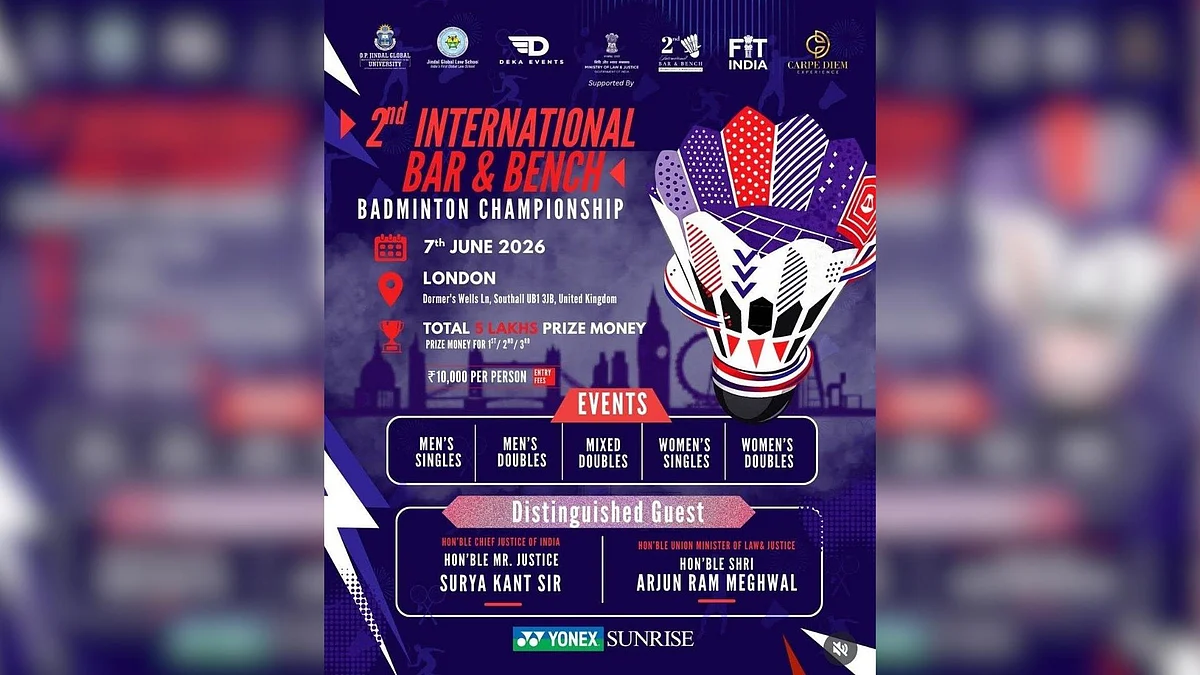


Badminton is the flavour of the season and has been for a while in judicial circles in Delhi — and now in London. The recent controversy of judges attending, at tax payers' expense, a badminton match in London organised by a private entity has brought the sport centre stage.
But the controversy first. An 'international' badminton tournament was organised on 7 June at London's Southall for members of the bar and bench from India and the UK. As questions began arise on the propriety of judges attending a private event, or on whether some of the sponsors could be litigants in the Supreme Court or various high courts, the 'distinguished guest', CJI Surya Kant, who was in London at the time, distanced himself from the tournament. The other guest, law minister Arjun Ram Meghwal, did not travel to London.
Contrary to the social media storm, it was not 75 judges who went to London. Several members of the judiciary National Herald spoke to confirmed that two judges travelled to London for the event (the CJI apart). The two are from the Lucknow bench of Allahabad High Court and avid badminton players. This was confirmed by a Facebook post by another lawyer who was present.
Law ministry sources confirmed that the main event to which the CJI was invited was the Indian Council of Arbitration conference and the badminton tournament was a side event. Indeed, the CJI was scheduled to attend nine events in London, while sources say Meghwal was scheduled to travel to London for the tournament.
A lawyer who attended the tournament said, “If there were 75 judges, would they not have attended the ICA event as well? I saw two judges at the tournament and both play badminton. But there were at least 100 lawyers for the event organised at Westminster, including members of the ICA.”
A law ministry spokesperson told National Herald, “The law minister is in India and has not visited London.” He refused to provide details of the other judges who travelled to London.
The organiser of the ticketed event, ex-national badminton player Abantika Deka, posted a picture with Meghwal on social media on 1 June and wrote, 'The championship is being organised by Deka events with the support of the Ministry of Law and Justice.' She did not specify the members of 'Team India' for the tournament, the entry fee for which was Rs 10,000.
But coming back to badminton replacing cricket as the flavour of the season. Lawyers and friends of Deka say she has been organising badminton tournaments for Delhi High Court and Supreme Court judges for the past four-odd years. “She’s organised two events for DHCBA in 2022 and 2023 and at least two for the SCBA including the one in London,” said a lawyer.
Deka also arranged a 'Premier Law Badminton League' match in February 2025, which too was organised by the ministry of law and justice. Minister Anurag Thakur was chief guest, per Deka's social media post. The reigning passion until recently was cricket, with the bar associations of the Supreme Court and high court holding an annual match each for members of the bar and bench. When contacted, Deka said she was busy and refused to answer questions.
In 2008, the Manmohan Singh government had read out the riot act to judges. The then law minister had in a letter to the then CJI said, 'Invitation extended to a judge by non-governmental institutions, organisation, private parties should be politely refused.'
That government oversight is required to sanction foreign travel by judges has been the rule, but is no longer the norm, sources say. In fact, in order to perhaps also facilitate judges travelling abroad, the Supreme Court has created a post of registrar (judges admin and international relations), headed by a retired official. This office also facilitates visiting foreign dignitaries.
In the past, judges travelling abroad had to seek permission from the department of justice, ministry of law. The financial implications of the trip, the protocol to be extended by the embassy concerned, and even the appropriateness of the function for which the judge wished to travel were all mooted by the foreign office and law ministry, signed off by the prime minister on what was called the 'foreign travel order' and sanctioned by the President. Private events were never allowed and even seminars and conferences had to have the backing of the foreign government.
A Restatement of Values of Judicial Life, aka, the code of conduct adopted by judges in 1999 is an illustrative guide for how judges should conduct themselves, and several members of the bar told National Herald the dividing line is thin.
Also Read: An apology may be in order, your lordship
Until a few years ago, it was not just what event the judge could go to, it was also what s/he said that was vetted by New Delhi. Says another lawyer, “A few years ago, a chief justice of India at a seminar rattled off figures showing huge pendency of cases, and how he helped reduce the case load. This was picked up by the Washington Post that did a scathing story on India losing its place in the sun, its inability to attract FDI and its inability to get its act together where litigation and red tape was concerned. It led to several red faces in Delhi. In the past, such requests would be denied at the level of the law minister.”
Referring to the controversy, a senior lawyer said, “The problem with private meetings (where government functionaries are present) are that they are not minuted. Such meetings raise suspicion from the point of view of transparency. The law ministry should not be supporting such events and adding credence to them.”
The practice of attending private events has picked up in the past 15 years, sources say. “Now judges think nothing of attending events of private entities. A few years ago, we were agog when a CJI visited a private university. Now these universities, for instance, print brochures with the judges’ photographs displayed prominently. The judges do not realise they are the product being marketed.”
Senior advocate Tanvir Ahmed Mir, however, says, “The burqa age of judges is over. We have to make the transit from judges being aloof, dispassionate. Judges too should be allowed to attend private dinners, raise a toast. A judge should follow a conscientious morality while donning the robe. If judges decide on evidence and not public perception, they are good to go.”
In 2008, this reporter managed to obtain the foreign travel orders of judges of the Supreme Court and various high courts after an eight-month RTI battle with the department of justice. The Supreme Court, then headed by CJI K.G. Balakrishnan, reportedly refused to allow the details to be made public on the ground that the judiciary was not under the RTI.
For the UPA government, the reporter’s query was a test also of the robustness of the newly minted RTI Act 2005 and Hansraj Bhardwaj as law minister and Shivraj Patil, home minister, managed to override the CJI’s objections, paving the way for hundreds of FTOs to be shared by March 2008.
The longest official trips, coincidentally, were during the summer breaks. Then CJI, the late Y.K. Sabharwal, was out of the country for two months on official work from 31 May-1 July 2006 to attend a conference in Montreal and another at Edinburgh, travelling first class with his spouse. The visit included a trip to Niagara falls and Lake Louise. The previous year, too, he was busy attending conferences, coincidentally also during the summer break, between 25 May and 3 July 2005, travelling first class to London, Washington, Edinburgh, and Paris.
Edinburgh was a favourite destination of Balakrishnan, who later became CJI. He was away for a month beginning June 2006 for work to Toronto, Edinburgh, Amsterdam and Zurich.
The UPA regime cracked the whip, with the law minister telling the CJI that judges should avoid foreign visits on work days. In August 2008, he wrote to the CJI, 'In case you feel the high court should be represented in any event abroad, then you may like to restrict the size of the official delegation to one only'. More importantly, the clearance would henceforth be given by the PMO, he said.
The law ministry refused to answer questions on who vets the proposals for a judge’s foreign travel in the present context.