


“It’s strange to apply to be alive”
K.A. Shaji on Tamil Nadu’s vanishing voters and the bumpy road to the elections later this year
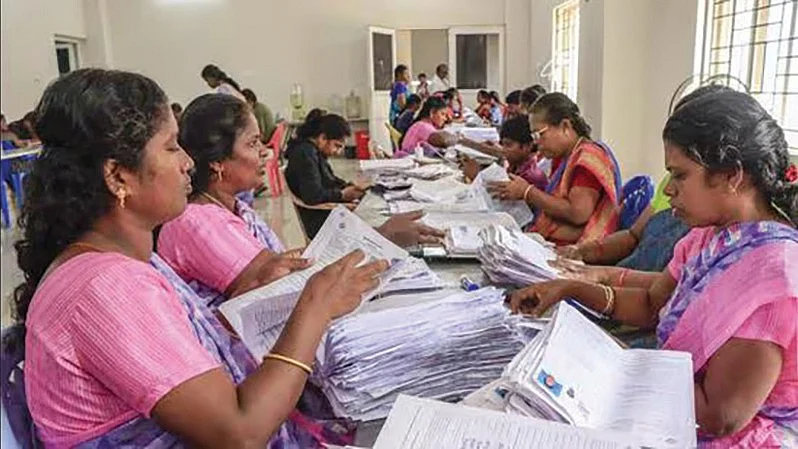


When V. Lokpriya was looking through the draft electoral roll published on 19 December, she was more curious than anxious. She had always voted from the same address in Mogappair, Chennai, since she turned 18. She had a voter ID and her life, by all ordinary measures, was stable. But her name was missing. Lokpriya is 37.
She has a private sector job and lives in a densely populated neighbourhood, where people move in and out frequently, though she has stayed rooted. “At first, I thought it was a mistake on the website,” Lokpriya told National Herald. “I kept refreshing the page. Then I searched by EPIC number. Still nothing.” That’s when fear set in, bringing back memories of Lok Sabha 2024, when she was told her name was not on the list.
“I put it aside then as a one off error. But it has happened again. How many times must I prove that I exist?” Lokpriya is not alone. More than 97 lakh names have been deleted in the draft rolls, and Tamil Nadu’s electorate is now down to 5.43 crore from 6.41 crore before the exercise got under way in the state. The Election Commission maintains that these deletions too, like everywhere else where the SIR exercise is ongoing, are of people dead or permanently migrated or duplicate enrolments.
It insists that no eligible voter will be denied the right to vote, that the exercise includes revisions based on objections. But even those who know the official ECI line are not really comforted by the assurance. For many, the deletion has crept up on them—a neighbour may mention it, a party worker will check, a child may search online, and suddenly, a long-term voter may find his/her name has been struck off.
Venkat Baskar, a senior IT professional, lives with his family at Alwarthirunagar on the outskirts of Chennai. He, his wife and elderly parents have all been marked ‘dead’. “When I saw this, I first laughed,” Baskar told National Herald. “According to the ECI, my entire family is dead. We pay taxes, we have Aadhaar and ration cards—alive in all other ways except the right to vote.”
Even if the deletion is just a mistake, it exposes the fragility of the entire exercise. K. Ragu is a daily wage worker from Alamathi village near Madhavaram in north Chennai, another victim of the SIR, who has also been marked dead.
“I stood in front of the officials and said: ‘Look, I’m alive! You see me; I’m speaking to you.’ But they asked me to fill a form. It’s strange to apply to be alive.” Nowhere is this tension more palpable than in Chennai. The city accounts for over 14 lakh deletions, nearly a third of its electorate. In several assembly constituencies, the deletions have crossed 40 per cent.
These are not just migrant workers living in the city’s slum clusters. The deletions have also hit middle-class localities, resettlement colonies, apartment clusters and the rapidly urbanising fringes of the city. “Cities defeat enumeration,” said one election official in Chennai, requesting anonymity. “Houses are locked. People leave before we arrive. Tenancies change without paperwork. And we are expected to finish verification within tight deadlines.
Possibly the most error-prone deletions are those marked ‘shifted’ or ‘absent’. In Tamil Nadu’s cities and industrial belts, the voter may be absent at a given address because they have left for work, not because they have migrated. A woman working as a domestic worker may leave at dawn and return late.
A factory worker may be on shift. Sometimes a tenant may have moved two streets away. The anxiety is not limited to Chennai. In Muttharasanallur near Tiruchirappalli, hundreds of families received notices asking them to appear for document verification. Many are Muslims. “We are not against verification,” said Syed Mustafa.
“But when notices come to house after house in the same area, people feel targeted, like we are being asked to justify who we are.” Election officials have denied any communal bias and said the notices are routine. But when said verification clusters around communities, distrust is natural. Another layer of exclusion is digital. The ECI has been encouraging electronic submission of forms. For many, this may even be easier but for the urban poor and the elderly, it is an impenetrable wall.
In Pudupet near Egmore, Janaki, a street vendor in her late 50s, said she’d never used a smartphone. “Voting was always simple. Now they say check online. If somebody doesn’t tell us, we won’t even know if we are missing.” Civil society groups have raised this concern repeatedly.
Jayaram Venkatesan of Arappor Iyakkam told National Herald that the revision of rolls cannot be a ‘preferably digital’ exercise. “The rolls must be displayed physically in ward offices and panchayats. There must be announcements, camps, handholding. Otherwise, the poorest voters will quietly drop out,” he said.
The SIR has also triggered a political storm.
Chief Minister M.K. Stalin has called the exercise hurried and confusing. Speaking to party workers, Stalin said the DMK was not opposing deletion of the names of dead or duplicate voters but warning against a process that shifts the burden of proof onto citizens.
“The right to vote cannot depend on whether a BLO found your door open or shut,” he said, announcing legal and political action against this “flawed exercise”. The DMK has moved the Supreme Court, arguing that the ongoing SIR creates scope for arbitrary deletions and mass disenfranchisement. Predictably, the AIADMK has a diametrically opposite view.
Accusing the DMK of deliberately spreading panic for political gain, leader of the opposition in the state assembly Edappadi Palaniswami says the deletions are proof that the voter rolls needed a clean-up. ‘People should not panic… Those whose names are missing can apply again. Our party workers will help genuine voters,’ he asserts in a statement.
The Election Commission maintains that the draft roll is provisional and that the claims and objections window is open till 18 January, allows corrections. The final roll will be published on 17 February, after which we’ll know how many genuine voters fell by the wayside and how many made it to the list in this most harrowing exercise.
Join our official telegram channel (@nationalherald) and stay updated with the latest headlines