


PMCH redevelopment threatens last façade of historic Bankipore Hospital
PMCH redevelopment has already razed historic wards and adjoining structures in Patna
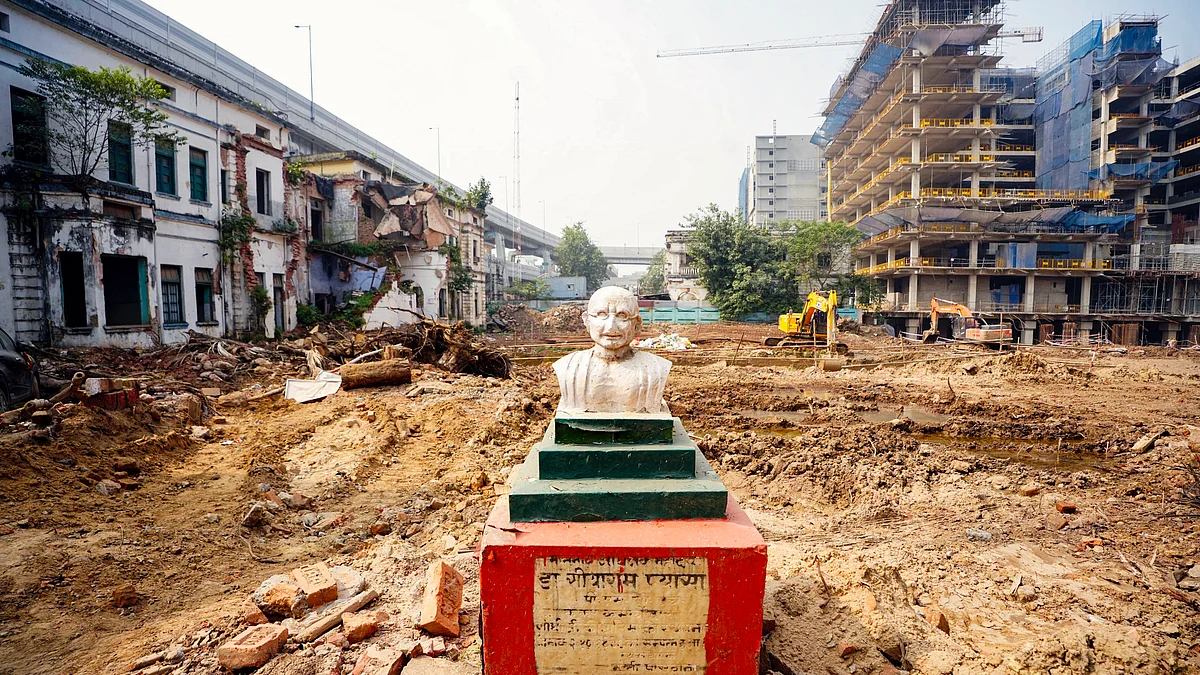


Gandhi Sangrahalaya appeals to culture ministry to save the surviving façade of Bankipore General Hospital
Historic wards, staircase lobby and connecting bridge have already been demolished under PMCH redevelopment
Hospital building is linked to Gandhi's 1947 visit when he stayed through Manu Gandhi's appendicitis surgery
The famed Gandhi Sanghralaya in Patna has urged the Union culture ministry to intervene urgently to save the surviving façade of the old Bankipore General Hospital building on the Patna Medical College and Hospital (PMCH) campus, warning that the heritage structure associated with Mahatma Gandhi faces imminent demolition.
The appeal, dated 19 November, was sent by 87-year-old Razi Ahmad, a noted Gandhian and long-serving secretary of the museum established in 1967. It comes during World Heritage Week, observed from 19 to 25 November in India and across the world.
The Sanghralaya's appeal adds to mounting calls by heritage conservation body INTACH, the alumni association of the century-old PMCH, Gandhians, scholars and heritage enthusiasts to spare the structure.
The old Bankipore General Hospital building, nearly 120 years old, has a history closely associated with Gandhi's visits to Patna. In a letter to the culture ministry, Ahmad expressed concern that the building was being threatened in the name of urban development.
'With heavy hearts, we inform you that the historic building of the Bankipore General Hospital (of the PMCH), nearly 120 years old, which has a glorious past history in itself of the undivided Bihar associated with Mahatma Gandhi in Patna, is facing a threat of demolition, in the name of development of Patna,' the letter said.
The hospital's historic medicine wards — Hathwa Ward and Guzri Ward, located in its north and south wings and until recently flanking the main façade — have already been demolished over the past two months as part of the PMCH redevelopment project.
The old staircase lobby between the two heritage wings, which housed a defunct British-era lift, was also razed recently, along with the bridge connecting the wings to the main frontage. The surviving façade is now under threat.
The Bihar government has faced growing criticism from historians, scholars, heritage activists and organisations, including the Delhi-based Indian National Trust for Art and Cultural Heritage (INTACH), over the demolition of historic structures by local authorities.
Flagging the destruction of several old PMCH buildings, the Gandhi Sangrahalaya criticised the state government for failing to incorporate heritage conservation into its redevelopment plans.
'We are pained to say that the state government has not yet shown any interest in preserving this heritage building (old Bankipore General Hospital) despite several appeals for preservation by heritage lovers and civil society,' the letter said.
'Most of the old buildings of the PMCH have already been demolished, as the entire campus is being renovated. Therefore, we earnestly request to initiate suitable steps to protect this portion of the present building (the remnant of the old Bankipore General Hospital building) from demolition,' it added.
The surviving façade is an architecturally distinctive structure, featuring graceful two-storey Doric columns on its eastern and southern sides. It previously housed the hospital's medical superintendent's office.
The PMCH redevelopment project, whose foundation stone was laid by then chief minister Nitish Kumar in February 2021, began with the demolition of several old campus structures later that year.
The entire front portion of the PMCH Women Hospital was demolished in March 2024 to make way for a nearly 2-km double-decker flyover along Ashok Rajpath. More recently, the remaining Women Hospital structures, dating back to around 1930, were dismantled, except for a small section facing the main road. A bust of Gandhi installed in the hospital courtyard decades ago now stands amid the ruins.
'We are marching towards our aim of becoming a "Viksit Bharat", but can we make a developed India or a smart city by destroying the heritage building associated with Bapu in Bihar, his "karmabhoomi",' Ahmad asked in his letter.
The Sangrahalaya also recalled Gandhi's visit to Patna in May 1947, following communal violence in Calcutta (now Kolkata) and surrounding areas, including Noakhali. Gandhi had visited Calcutta and riot-affected areas on 14 May and held prayer meetings.
According to the letter, Gandhi arrived in Patna from Calcutta on 15 May 1947 and addressed a prayer meeting. On the same day, Manu Gandhi was taken to PMCH for an appendicitis operation and remained there for over a week recovering. Gandhi stayed with her during the surgery in the operation theatre, the letter said.
Gandhi himself recorded the operation in his diary, while PMCH also recounts the episode on its official website.
The surgery was performed by Col Dwarka Prasad Bhargava, a prominent surgeon who headed the department of surgery at Prince of Wales Medical College and Hospital — established in 1925 and later renamed Patna Medical College and Hospital — from 1936 to 1947, according to archival records.
Photographs of the operation, including one showing Gandhi seated inside the operating theatre, are preserved in archival collections.
The PMCH's centenary celebrations were held at Patna's Bapu Sabhagar on 25 February 2025, with President Droupadi Murmu attending alongside former chief minister Kumar. The President was presented with a framed archival photograph of Gandhi watching Manu's operation from inside the operating theatre, the letter said.
The Gandhi Sangrahalaya cited the Sassoon General Hospital in Pune, where Gandhi underwent an appendicitis operation in 1924 and which has preserved a memorial to him, as an example of how the Bankipore hospital remnant could also be conserved.
'In the same way the remnant of the old Bankipore General Hospital should be preserved, and it can carry the name of Gandhiji or Manu Gandhi,' the letter said.
The medical college traces its origins to the Temple Medical School, established in Patna in 1874, when Bihar was part of the Bengal Presidency.
With PTI inputs
Join our official telegram channel (@nationalherald) and stay updated with the latest headlines