


MGNREGA: Far worse than trying to erase Mahatma Gandhi
In trying to wash its hands off MGNREGA’s employment guarantee, the Union government is also planning to kill the right to demand work
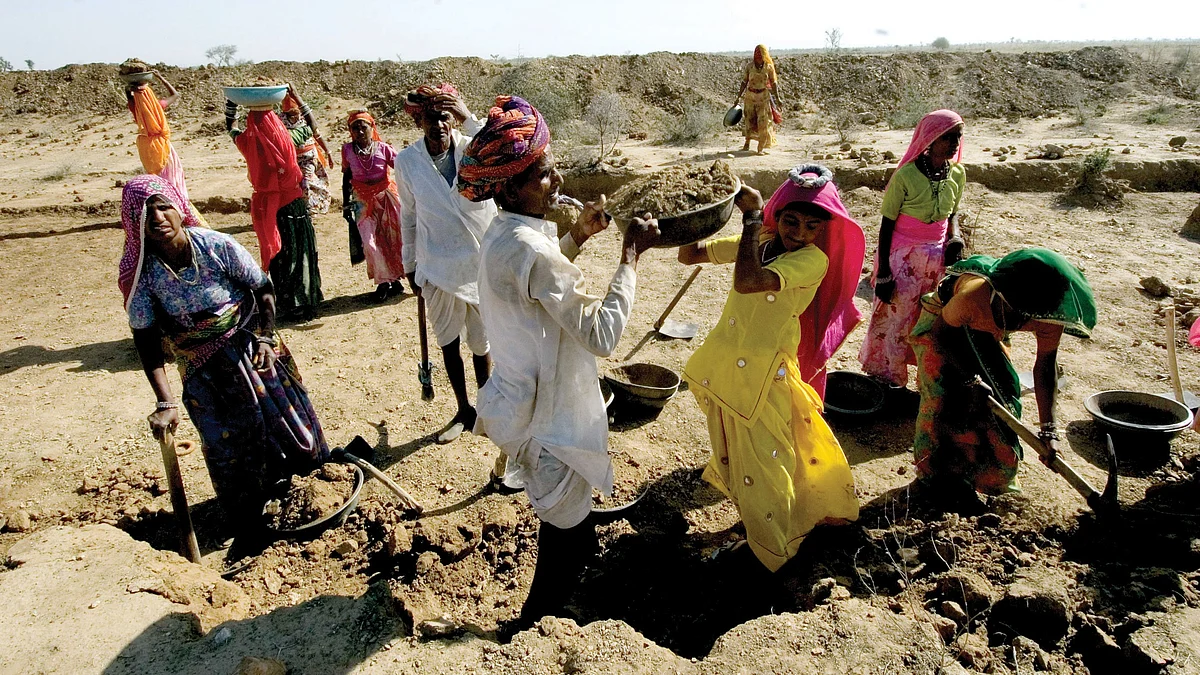


The Opposition was initially protesting the renaming of MGNREGA. Their question: why remove Gandhi’s name from a scheme the country has long known as the Mahatma Gandhi National Rural Employment Guarantee Act? Why scrub Gandhi out of it?
At first, even I felt a twinge of regret. The proposed new name—‘Viksit Bharat–Rozgar aur Aajeevika Guarantee Mission (Rural) Bill’—is clunky and reminiscent of an old habit of dreaming up an English acronym and then force-fitting Hindi words into it. But after reading the draft of the new law the government plans to bring in to replace MGNREGA, I thought it was just as well. What good would it serve to retain his name when the soul of the programme had been gouged out, when its foundational guarantees dismantled?
Let’s try and understand why MGNREGA was not just any old piece of legislation, why it was historic. Nearly sixty years after Independence, the Indian state took a tentative step towards fulfilling a core constitutional obligation. Articles 39(a) and 41 of the Directive Principles of State Policy enjoin the government to secure for every citizen an adequate means of livelihood (Art. 39) and the right to work (Art. 41). Nearly six decades after this was written into the Constitution, the UPA government finally passed the National Rural Employment Guarantee Act in Parliament in 2005, granting—for the first time—a legally recognisable right to the country’s poorest citizens.
This was not a full-fledged guarantee of employment, but its provisions set it apart from other government employment schemes. The law gave every rural resident the right to demand work from the state, leaving little wiggle room for official excuses, evasions and bureaucratic stonewalling. There were no eligibility criteria. Any rural resident could obtain a job card and claim work. There were no conditions attached to demanding employment. Whenever work was sought, the government was obliged to provide it within two weeks—or pay compensation.
Most uniquely, there was no budgetary cap for this scheme. As many people as wanted work could demand it, and the Union government was legally bound to find the money. Imperfect it may have been, but MGNREGA marked the first serious attempt to give legal shape to the right to work, and it was for this reason that the scheme drew the attention of the world.
In practice, the law fell short of its promise. Wages under MGNREGA were meagre and it was hobbled by administrative restrictions. Even so, the Manmohan Singh government expanded it. After the UPA lost in 2014 and he took over the reins of power, Prime Minister Narendra Modi openly mocked the law, saying he would preserve it as “a living monument to [the UPA’s] failures”. In its early years, the Modi government actively tried to kill the scheme.
Then came the Covid pandemic, and even the Modi government was forced to lean on MGNREGA. Despite government apathy, bureaucratic bad faith and entrenched local corruption, MGNREGA has been a lifeline for the poorest in rural India. Over the past fifteen years, it has generated nearly 4,000 crore person-days of wage employment. An estimated 9.5 crore works have been completed under the scheme, benefitting roughly five crore families every year. It provided a higher baseline for rural wages, and during national crises like Covid, or disasters such as droughts, MGNREGA saved millions from hunger and prevented mass migration.
But the Modi government has now made up its mind to bury the programme. Mindful that scrapping it altogether would have political repercussions, the official line is that the programme is being ‘restructured’. To sweeten the deception, the government claims that employment will now be guaranteed for 125 days instead of 100. But the truth is that the new Bill tabled in Parliament effectively abolishes the very idea of an employment guarantee—and a universal right to work is set to be replaced by a discretionary dole of daily wages for select beneficiaries.
According to the government’s draft, every crucial provision of the scheme is being reversed. The Centre will now decide in which states—and in which regions in those states—employment opportunities will be offered. The Union government will impose spending caps for each state. State governments will decide which two months of the farm labour season the scheme will be suspended. Even the choice of works at the local level will be dictated from above.
Most dangerously, states are now being saddled with a much larger share of the financial burden. Earlier, the Centre bore 90 per cent of the cost; now it will pay only 60 per cent. In precisely those poor regions where employment guarantees are most desperately needed, impoverished state governments will not have the funds, and the Centre will wash its hands off the ‘problem’.
Of course, if elections are at stake, funds for employment guarantees will materialise where none earlier existed. In states ruled by the Opposition, the scheme will either not be implemented at all or be crippled by punishing conditions.
So yes, it is just as well that such a scheme won’t carry Mahatma Gandhi’s name. But those who value Gandhi’s ideas must now fight the Bill—not just inside Parliament but on the streets too, like the farmers did; they must carry the message to the people, who must find out how MGNREGA was killed, how their ‘right to work’ was snatched away.
Join our official telegram channel (@nationalherald) and stay updated with the latest headlines