


MGNREGA: the death of a lifeline for India’s jobless millions
For the millions who drew hope from the MGNREGA job guarantee, something they could demand by right, the loss is immeasurable


o The central government shall determine the state-wise normative allocation for each financial year, based on objective parameters as may be prescribed by the central government. Section 4 (5)
o Save as otherwise provided, the state government shall in such rural areas in the state as may be notified by the Central Government, provide to every household whose adult members volunteer to do unskilled manual work, not less than 125 days of guaranteed employment in a financial year in accordance with the scheme made under this Act. Section 5(1)
o Any expenditure incurred by a state in excess of its normative allocation shall be borne by the state government in such manner and by such procedure as may be prescribed by the central government. Section 4(6)
o For the purposes of this Act, the fund sharing pattern between the central government and the state government shall be… 60:40. This is apart from the North-Eastern States, Hill States & Union Territories where the central government share will be 90:10. Section 22(2)
Among the Modi government’s many dubious talents is a knack for repackaging old schemes as new initiatives. That’s right: old wine in new (misshapen) bottles. Except this time the old wine is being thrown out as well and replaced with a toxic new brew.
The newest victim of this government’s ‘rejig–rename–reclaim’ enterprise is the historic UPA-era ‘MGNREGA’ (Mahatma Gandhi National Rural Employment Guarantee Act), which came into force in 2005, when Manmohan Singh was India’s prime minister.
Why historic? Because MGNREGA gave independent India its first law <guaranteeing> employment in rural India and gave that guarantee the sanctity and legal force of a <right> to demand work. That 20-year-old law, a lifeline for hundreds of thousands of Indians ekeing out a precarious living in rural India, is set to be replaced by the Viksit Bharat–Guarantee for Rozgar and Ajeevika Mission (Gramin), or VBGRAMG or just ‘G-RAM-G’—the contraction that will no doubt be seen as the USP of the new scheme.
The new Bill is being advertised as vastly superior for offering 125 days of ‘guaranteed’ employment instead of 100 days (under MGNREGA). But this ‘guarantee’ now lives only in the name of the bill, not its provisions. If the government really wished to guarantee an additional 25 days of work or even, as the bill claims, to ensure ‘all round development’ of villages, it was not necessary to repeal MGNREGA.
Over the last few years, the government has routinely failed to provide more than 50–55 days of work in a year, despite the mandate of providing 100 days of work on demand. This, against a backdrop of increased demand for jobs and rising rural distress. Farmer suicides continue unabated in several parts of the country, rural wages remain stagnant while rural inflation has surged. The budget allocation for MGNREGA has been steadily cut: from Rs 1.1 lakh crore during the pandemic years (2020–21) to Rs 98,000 crore in 2022 and Rs 90,000 crore in 2023.
Under MGNREGA, the Union government bore 90 per cent of the expenditure. The new bill proposes to cut this to 60 per cent, offloading 40 per cent onto the states. This is clearly not because the Union government is short of money. Nor are the states suddenly flush with internally generated funds; in fact, impoverished states will fail to implement the scheme simply because they can’t bear the financial burden and the Centre has given itself the room to say: ‘sorry, not our problem’. Does that sound like a ‘guarantee’? Economist Arun Kumar notes that the Union government’s fiscal deficit, at 4.4 per cent, is under control. So, financial constraints do not justify the dilution of the Centre’s financial commitment to MGNREGA nor the repeal of the scheme.
Prosenjit Datta, former editor of <Business Today>, suggests the motives may be political. The architecture of the new Bill offers clues: it lets the Union government set the ‘normative’ budget for states, dictate how many days of guaranteed employment each state must provide and retain full control over implementation—shifting both burden and blame to the states. It also opens the door to direct doles, as in Bihar before elections, allowing the Centre to influence voters.
What’s to stop the government from weaponising G-RAM-G to punish Opposition-ruled states by denying or delaying allocations? The Union government did hold back funds under MGNREGA too, forcing the government of West Bengal to approach the Supreme Court for relief. But the new law will effectively shut the door on legal remedies as well.
*
Ever since the Modi government made Aadhaar mandatory to claim the benefits of government schemes, there have been countless complaints about patchy implementation of MGNREGA, about job-card holders not being able to claim their dues. The Aadhaar Payment Bridge System (APBS), being used to directly transfer wages to workers’ Aadhaar-linked bank accounts—a system made mandatory in January 2024, ostensibly for better targeting, faster payments and reduced leakages—has had the opposite effect.
In March 2025, Congress leader Sonia Gandhi accused the BJP-led Centre of systematically undermining the scheme. The minimum wage should be raised, she demanded, to Rs 400 per day and the number of guaranteed workdays increased from 100 to 150 days a year. MGNREGA wages, she pointed out, had not kept up with inflation, adding that the Aadhaar-based payment mode was exclusionary and the National Mobile Monitoring System flawed, leading to persistent delays in payments.
Between 10 October and 14 November 2025, the names of nearly 27 lakh workers were deleted from the MGNREGA database. This erasure coincided with the Union government’s push for e-KYC (electronic know your customer) verification for all rural workers. LibTech, a consortium of activists and academics, flagged the unusually high deletion rates, revealing that only 7 per cent of beneficiaries received 100 days of work. The MGNREGA management information system (MIS) cited 12 reasons for removing workers or job cards, including ‘duplicate applicant’, ‘fake applicant’ and ‘not willing to work’.
*
But the new bill is not simply an attempt to paper over the failures of MGNREGA’s digital architecture, it is designed to give the Union government total control while shifting the financial burden onto states.It allows the Centre to decide where and when the scheme will be implemented, and turns a rights-based, demand-driven programme into a centrally sponsored scheme.
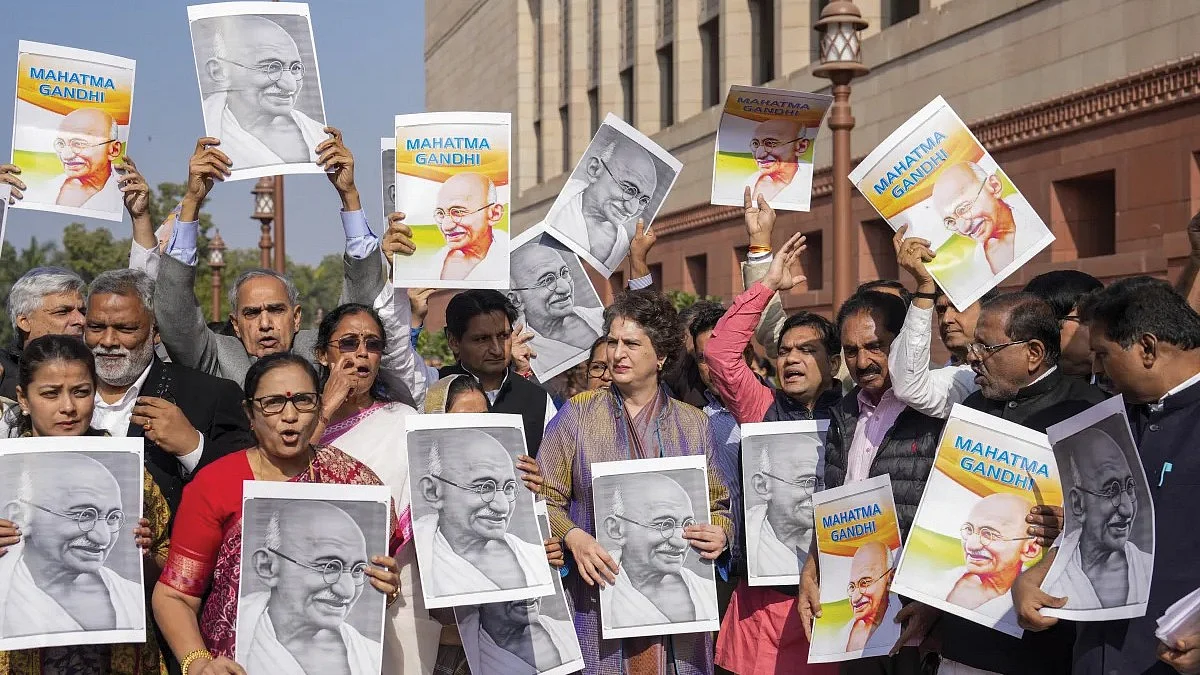
Opposing the bill in the Lok Sabha, Congress leader Priyanka Gandhi Vadra pointed out that the new legislation gave the Centre all the control while shrinking its responsibility. John Brittas, Rajya Sabha MP from Kerala, said the new bill doesn’t just shift the cost burden onto states, it undermines federalism; replaces gram sabha-led planning with PM Gati Shakti, GIS tools and centralised templates, and removes mandatory reservations (for women, SCs, STs, OBCs and minorities) in the Central Employment Guarantee Council.
For the millions of Indians who drew hope from the MGNREGA job guarantee, something they could demand by right, the loss is immeasurable, but what does this government care?
Join our official telegram channel (@nationalherald) and stay updated with the latest headlines