


Milk or ‘poison’ in the river: Religious extremism and assault on ecology
‘Offering’ of 11,000 litres of milk to the Narmada raises social and ethical questions, exposes threat to river's fragile ecosystem
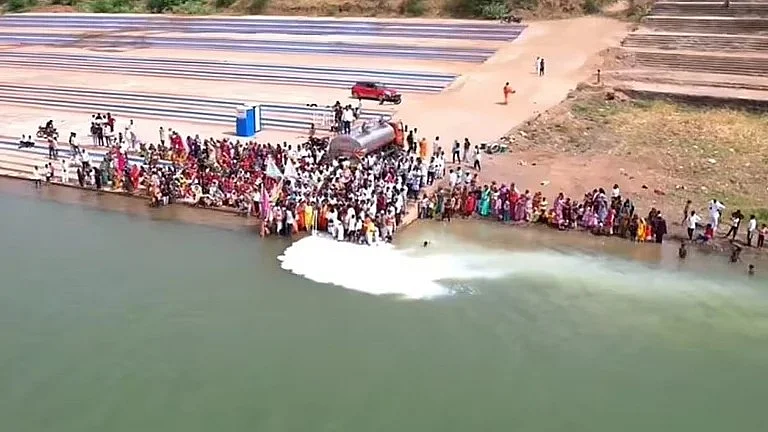


The Narmada — often hailed as the lifeline of central India — is currently fighting for its sanctity and survival. A nationwide debate has erupted following the dumping of tankers carrying 11,000 litres of milk into the river as part of a religious consecration.
The 21-day religious ceremony in Madhya Pradesh's Sehore district — barely 40 km from state capital Bhopal — saw huge quantities of havan samagri and coconuts being offered to the ‘holy’ fire by the thousands of devotees who attended it.
As per Hindu mythology, the Satdev area is believed to be the tapobhumi (land of penance) of the sapt rishis (seven sages), where Lord Shiva is said to have manifested in the form of Pataleshwar Mahadev. Consequently, large-scale rituals are frequently organised here.
The Narmada — which originates in Amarkantak — is already facing challenges due to rampant sand mining, the destruction of the dense forests lining its banks, and the discharge of chemical waste from industrial factories situated along its course. The environmental impact on the river is devastating and far-reaching. The latest incident is akin to introducing a 'biological poison' into the river. It also
Milk is a complex organic substance containing substantial quantities of proteins, fats and sugars (lactose). When thousands of litres are released into a river, it causes an unprecedented surge in Biological Oxygen Demand (BOD). As the bacteria present in the water begin to decompose this massive organic load, they rapidly consume the dissolved oxygen within the water. The sudden depletion of oxygen in turn creates a state of hypoxia for the river's aquatic life, causing fish and other microorganisms to suffocate and die within hours.
Narmada’s ecosystem is renowned for its unique biodiversity and includes several endangered species. The decomposition of milk disrupts the water's pH balance, causing the water to become increasingly acidic. This acidity can permanently disrupt the reproductive cycles of aquatic organisms. Furthermore, the fats present in the milk form an impermeable film or layer on the water's surface, thereby blocking the natural exchange of oxygen between the atmosphere and the water.
Milk contains nutrients such as phosphorus and nitrogen. These elements trigger an abnormal proliferation of algae within the river — a phenomenon known as an 'algal bloom'. This algal growth blankets the river's surface, preventing sunlight from penetrating below.
Deprived of light, submerged aquatic plants are unable to perform photosynthesis, leading to a complete disruption of the aquatic ecosystem's natural cycle. The presence of milk can lead to an increase in the population of pathogens (disease-causing microbes) in the water.
Beyond the environmental hara-kiri, such wastage — India ranks low on the Global Hunger Index and millions of children grapple with malnutrition — amounts to a social crime.
It is essential to understand that rivers possess an inherent capacity for self-purification; however, when they are inundated with massive quantities of substances they cannot naturally process, they begin to 'die'. To safeguard aquatic life, offering merely a few symbolic drops — or a small vessel — of water and a small amount of milk is a far more environmentally conscious alternative.
Diminished water flow and severe siltation due to large dams has already reduced Narmada’s capacity for 'self-purification'. The foul odour and harmful bacteria (such as E. coli) generated by the decomposing milk will not only degrade the quality of water but also precipitate a health crisis for the communities residing along the riverbanks.
There is absolutely no scriptural sanction or religious validity for the act of pouring 11,000 litres of milk — an amount substantial enough to alter the very colour of the river for kilometres.
Even from a religious perspective, could any divine power possibly condone such a colossal waste of resources? In Indian philosophy, anna (food) is revered, and ‘service to humanity’ is held as paramount. In ancient times, when resources were abundant and the population sparse, the traditions of abhishek (ritual bathing of deities) and offerings were largely symbolic in nature. However, in the present era — where rivers are already grappling with severe pollution and dwindling water levels — it has become imperative to harmonise religious faith with scientific understanding and humanitarian values.
Swami Vivekananda often asserted that feeding a hungry person constitutes the highest form of worship. Had those very 11,000 litres of milk been distributed among malnourished children in impoverished settlements or to orphanages, it would have constituted a far more genuine act of devotion.
Integrating faith with logic and science is the greatest imperative of present times. It is time the National Green Tribunal take suo motu cognisance of this matter.
Join our official telegram channel (@nationalherald) and stay updated with the latest headlines