


National Testing Agency officials sacked for NEET paper leak: Who are they?
On 22 July, the Rajya Sabha was told that in 2017, the NTA had just 25 staff, and by 2026, there were 39 posts with 15 vacant. Were the 47 sacked officials in the NEET scandal employed on contract?
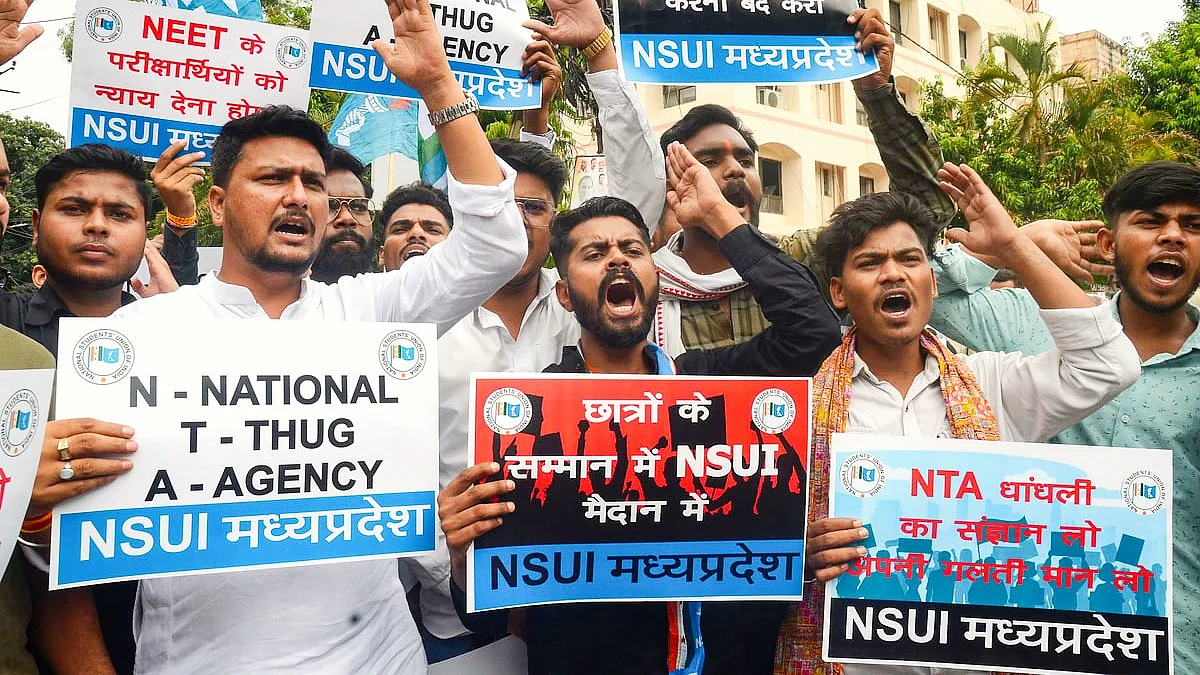


In a written reply to a question in the Rajya Sabha on 22 July, minister of state for education informed the House that the National Testing Agency had 39 sanctioned posts, 15 of which are on vacant. The NTA thus has only 24 employees, all of whom on deputation. The minister also informed that NTA also has 73 contractual and 124 outsourced personnel. The Supreme Court is at present seized of a bunch of petitions seeking the disbanding of the NTA in the wake of the recent NEET paper leak.
Two days later, newspapers reported quoting education ministry officials on Saturday, 25 July that 47 NTA officials have been terminated, with legal and criminal action to follow. So, when were they shown the door? Were they terminated between 22 and 24 July and was it done in a panic reaction by the government struggling to defuse the students’ agitation over NEET paper leaks across the country? Who exactly are these 47 officials? Are they permanent staff, deputationists, contractual employees, outsourced personnel, or a mix of these?
Significantly, the NTA, conducts over 20 national level examinations including Joint Entrance Examination (JEE) for admission to engineering colleges and NEET (National Eligibility Test) for admission to medical colleges. But practically all its work including the setting of question papers, encryption, selection of external printing presses and exam centres, transportation to printing presses, storage and distribution to examinees at examination centres and then the collection and transportation of answer sheets to evaluation centres are outsourced to technical partners and contractors.
The NTA which has been a controversial body from its inception in 2018 is registered under the Societies Registration Act and is not a statutory body like the UPSC or the CBSE. The government has never explained why it deemed it fit to structure the NTA as an NGO, restricting government control. The NTA’s accounts are not audited but as the ministry’s claim on sacking employees indicate, the arrangement merely serves to distance the government from responsibility even as it continues to control the ‘private’ society.
Since its inception in 2018, the NTA has conducted over 270 examinations covering more than 6.6 crore candidate registrations. For 2026, the ministry’s reply said the NTA has conducted 12 examinations so far, recording over 65 lakh candidate registrations. The NEET (UG) 2026 examination itself was held at 5,432 centres across 565 cities in 13 languages. The NTA’s structure and number of personnel seem inadequate to conduct such elaborate exercises; at the very least, the structure appears tailor-made for leakages.
NTA's income and expenditure accounts approved by its governing body, the ministry’s reply indicated that the agency's finances have grown significantly over the years. In 2019-20, the NTA reported an income of about Rs 504 crore and expenditure of about Rs 440 crore. The figures rose sharply in 2022-23, when the NTA reported Rs 901 crore in income and Rs 682 crore in expenditure. In 2023-24, the agency's income increased further to around Rs 1,117 crore, with expenditure reaching about Rs 1,041 crore.
The NTA was set up in 2017 as a specialist, self-sustaining and autonomous organisation under the aegis of the Union Education Ministry. Its director general and governing body are appointed by the Union government. However, it is registered as a society and is a separate legal entity, which raises questions about the government’s legal liability for the NTA’s actions. Its main mandate is to conduct efficient, transparent and international standard tests to assess the competency of candidates for admission, and recruitment purposes.
Besides major all-India examinations, such as the JEE for engineering college admissions, NEET-UG, and UGC-NET (both of which had previously been conducted by the Central Board for Secondary Education or CBSE), NTA also conducts entrance tests for Jawaharlal Nehru University and Delhi University. The National Education Policy of 2020 envisaged a broader role, recommending that the NTA conduct an entrance or aptitude test for all universities across the country.
Not much is known about NTA’s finances or functioning in the absence of any statutory audit by the CAG. There are doubts about how the NTA recruits personnel and how it awards contracts and outsources tasks. For the sake of transparency, NTA would do well to disclose the names of the officials sacked and assign reasons. If they were found complicit in the NET (UG) paper leak in May 2026 or earlier, what kind of an inquiry found them guilty and when?
Join our official telegram channel (@nationalherald) and stay updated with the latest headlines