


Corruption is not endemic to the judiciary
Partial truths can distort reality more effectively than outright lies, writes Shailendra Chauhan on NCERT’s now-withdrawn Class 8 textbook
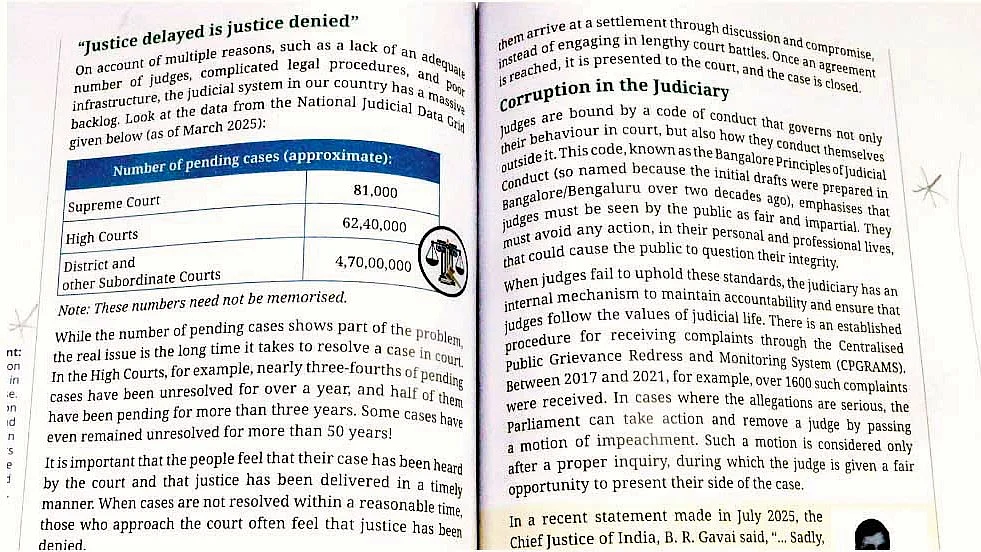


The National Council of Educational Research and Training (NCERT) has introduced a new chapter in Class 8 textbooks addressing corruption in the judiciary and the problem of pending cases. Students in Class 8 will read about how corruption within courts and the sheer volume of unresolved cases affect the delivery of justice. The revision has been made to the social science textbook, which now includes discussion of backlogged court cases and their consequences.
School education in India is not merely about transmitting information; it shapes civic awareness and democratic understanding. When a new chapter on a public institution is inserted into a textbook, its impact is not confined to the classroom. It influences how young citizens perceive the social and political order. NCERT’s decision to add a chapter on judicial corruption and pendency must be viewed within that wider frame.
At first glance, the move appears welcome. In a democracy, institutions must be understood critically. If students are told that courts take years to dispose of cases, or that transparency and accountability remain challenges within the justice system, they are better equipped to grasp democracy’s complexities. Yet a question naturally follows: is this critical lens being applied evenly across institutions, or is the judiciary alone being placed under the spotlight?
In India’s constitutional scheme, the judiciary is a foundational pillar. It safeguards rights and interprets the Constitution. It is also true that courts face an enormous backlog. Millions of cases remain pending for years, delaying justice. “Justice delayed is justice denied” is not an empty phrase. If textbooks acknowledge this reality, they take a step toward familiarising students with the workings — and limitations — of the justice system.
But democratic education requires balance. To frame pendency solely as a judicial failure would be incomplete. A significant cause of case overload lies in administrative inefficiency, poor governance and policy complexity. Laws are often drafted in ways that generate disputes; policies trigger litigation that eventually lands in court. If textbooks mention court backlogs but omit their broader social and political causes, students do not get the full picture.
The same applies to corruption. It is not confined to the judiciary. Corruption in India is structural, cutting across politics, bureaucracy and multiple public institutions. If the education system genuinely seeks to acquaint students with democratic realities, it must situate corruption within this wider ecosystem. To single out the judiciary risks narrowing a systemic issue into an isolated fault.
The silence around corruption
One of gravest challenges for Indian democracy is political corruption. The role of money power in elections, misuse of office, patronage networks — these have profoundly affected public life. Yet school textbooks devote little to no space to these themes.
Campaign finance, party funding, conflicts of interest in policymaking — students should encounter these subjects. Democracy is not merely a set of ideals; it is also an arena of contestation over power and resources. When discussions of political corruption are absent from curriculums, students may not grasp how the concentration of power and wealth breeds systemic distortions.
The issue is not simply factual omission but framing. Textbooks often present politics in idealised terms. In practice, politics is shaped by competing interests, negotiations and struggles. Without understanding this complexity, democratic education remains thin.
Many citizens encounter the State at the level of government offices — where bribery, delays, arbitrary interpretation of rules and weak accountability are common. Administrative corruption is not simply individual moral failure. It frequently arises from institutional design: opaque procedures, complex regulations, inadequate oversight and political patronage combine to make corruption durable. Yet school curriculums rarely examine these structural dimensions.
If students are to understand democratic governance, they must see corruption not only as personal wrongdoing but also as the outcome of institutional arrangements.
****
School textbooks do more than inform; they construct an intellectual frame. The examples they highlight and the silences they maintain shape students’ political imagination.
If a textbook foregrounds corruption in the judiciary while remaining quiet about political and administrative corruption, it presents a partial truth. Partial truths can distort reality more effectively than outright falsehoods. Democratic education should enable students to evaluate all institutions — their roles, limitations and vulnerabilities.
No form of power — judicial, political or administrative — remains healthy without transparency and accountability. But critique should not be selective. It’s important to recognise that textbooks guide perception. If one institution is presented as flawed while others escape scrutiny, you create a false reality.
The new chapter could, of course, help students understand how courts function, why delays occur, and what reforms may be needed. Taught within a larger context that situates the judiciary alongside other arms of governance, it will create democratic literacy.
The aim of education is not to glorify or demonise institutions but to cultivate knowledge and understanding. Curricular changes of this kind must be carefully evaluated as interventions that may help create a democratic consciousness.
Join our official telegram channel (@nationalherald) and stay updated with the latest headlines