


One scam, many schemes: What CAG reports reveal about systemic data fraud
Findings in the CAG report tabled in Parliament mirror anomalies earlier flagged by Rahul Gandhi in the voter list
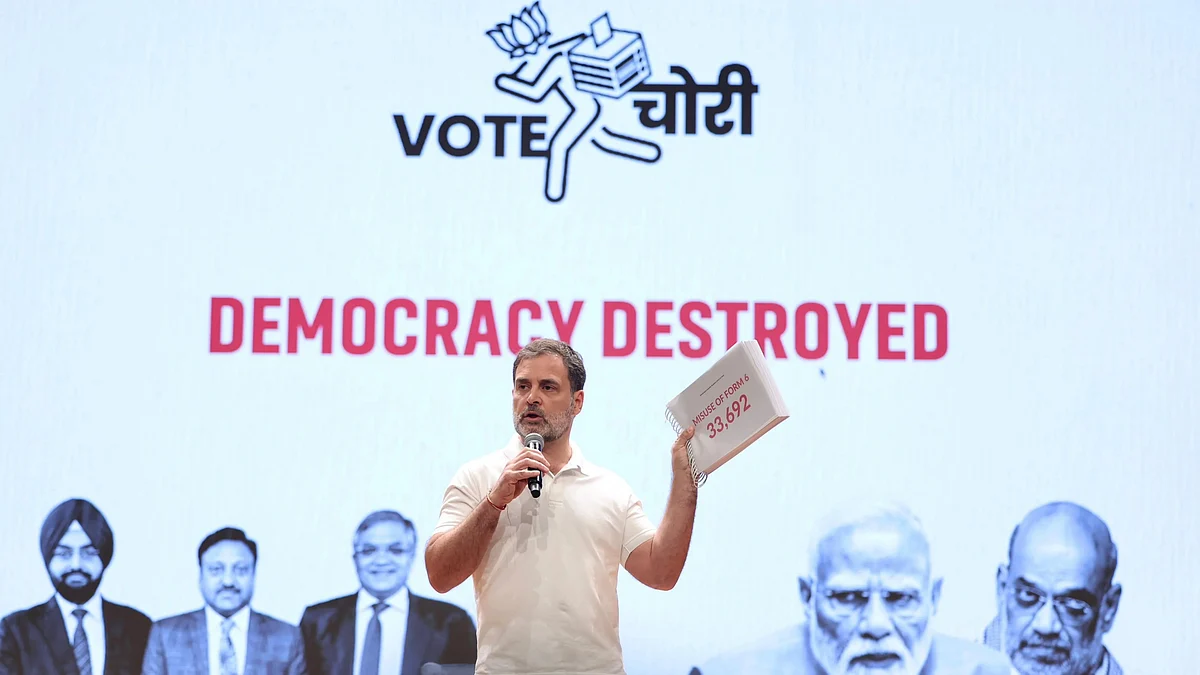


When Rahul Gandhi addressed a press conference in the first week of November, alleging large-scale manipulation of votes in the Haryana Assembly elections, it was widely seen as a serious indictment of the Election Commission. At the time, however, few suspected that similar patterns of irregularities were embedded across multiple government departments.
That suspicion gained substance on Saturday when The Indian Express reported on major lapses in the implementation of the Pradhan Mantri Kaushal Vikas Yojana (PMKVY). The findings were not the result of the newspaper’s own investigation but were drawn from a Comptroller and Auditor General (CAG) report tabled in Parliament two days earlier. The report echoed many of the anomalies Rahul Gandhi had highlighted weeks ago in voter list.
In his November press conference, Gandhi had pointed out that a single photograph—belonging to a Brazilian model—was used for 223 different voters in Haryana’s electoral rolls. PMKVY may not have gone so far as importing foreign faces, but it appears to have embraced the same practice of repetition: identical photographs were found attached to multiple beneficiaries.
Just as the Election Commission had entered “house number 00” as the address for thousands of voters, PMKVY records show glaringly fabricated bank details. In numerous cases, beneficiaries’ bank account numbers were listed as “11111111111” or a string such as “1234567…”. Some entries contained just a single digit. Altogether, 12,122 account numbers were recorded against 52,381 beneficiaries.
According to the CAG, 94.53 per cent of beneficiaries under PMKVY 2.0 and 3.0 had no valid bank account details on record—either zero was entered or the field was marked “N/A”. This raises serious questions about the disbursement of funds under a scheme that promises payments ranging from Rs 2,200 to Rs 12,000 per trainee, with an average payout of Rs 8,000.
With a total budget of Rs 14,450 crore, PMKVY aimed to skill 1.31 crore youth. While certificates have been issued to 1.1 crore individuals, the financial component tells a different story. The CAG found that 34 lakh beneficiaries are yet to receive any money.
Efforts to verify payments only deepened concerns. When the CAG emailed beneficiaries, 36.51 per cent of the messages bounced back as undeliverable, indicating incorrect or fake email IDs. In many instances, the same email address was linked to multiple beneficiaries, or the address of a training partner was used in place of the trainee’s own.
The audit also revealed that funds were released in the names of trainees at centres that had already shut down. The ministry was unable to provide proof that all beneficiaries received payments, and it could not furnish data on how many trained candidates were actually placed in jobs.
PMKVY is not an isolated case. The CAG has flagged comparable irregularities across several flagship schemes. In Ayushman Bharat and the Pradhan Mantri Jan Arogya Yojana, large sums were released in the names of deceased patients.
The report also noted that 7,49,820 beneficiaries had incorrect mobile numbers, with entries such as “9999999999” frequently used. Errors ranged from misspelled names to impossible dates of birth.
Similar data manipulation and record-keeping failures were found in schemes like Saubhagya, the Deen Dayal Upadhyaya Gram Jyoti Yojana, and the Pradhan Mantri Awas Yojana.
At his November press conference, Rahul Gandhi had pointed out that the Election Commission possesses de-duplication software capable of detecting repeated photographs, addresses, or EPIC numbers—but chooses not to use it. Whether the Ministry of Skill Development has such tools is unclear.
What is evident, however, is that across departments, the same patterns of duplication and distortion keep reappearing. The question is no longer whether these are coincidences, but whether they all originate from a common source.
Join our official telegram channel (@nationalherald) and stay updated with the latest headlines