


Putin begins 27-hour India visit as Modi sets stage for key summit talks
Russian president receives airport welcome; defence, trade imbalance and energy ties on agenda ahead of 23rd India–Russia summit
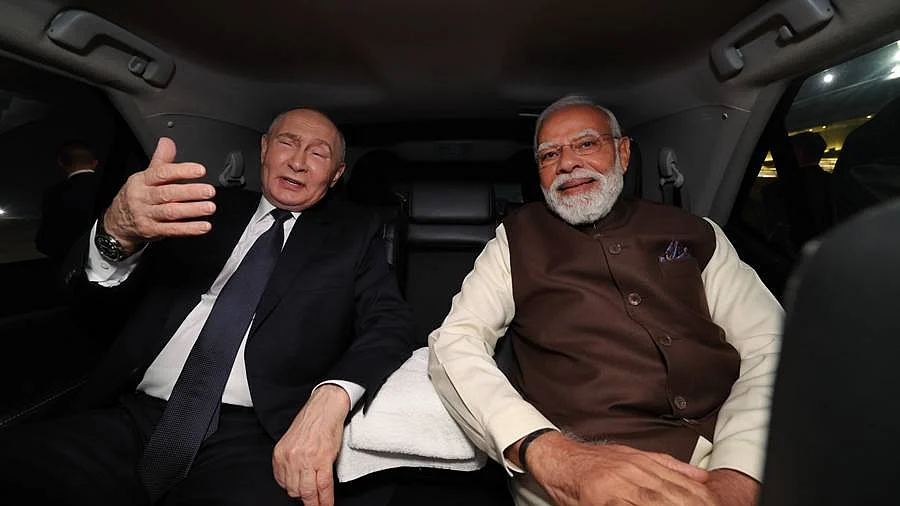


Russian President Vladimir Putin began a nearly 27-hour visit to India on Thursday night, marking his first trip to New Delhi in four years and signalling renewed momentum in bilateral ties that have spanned close to eight decades.
Prime Minister Narendra Modi received Putin with a warm welcome at Palam airport. The two leaders then travelled together in the same vehicle— reprising a similar gesture from their September meeting in Tianjin during the SCO (Shanghai Cooperation Organisation) summit—before heading to a private dinner hosted by Modi.
Officials said the informal interaction was expected to set the tone for Friday’s 23rd India–Russia annual summit.
The summit comes at a time of turbulence in India–US relations, including recent American tariffs of up to 50 per cent on Indian goods and a 25 per cent levy linked to New Delhi’s procurement of Russian crude oil. Western governments are expected to closely observe the engagements between Modi and Putin.
On Friday morning, Putin will receive a ceremonial welcome at Rashtrapati Bhavan, visit Rajghat, and hold delegation-level talks at Hyderabad House, where Modi will host a working lunch for the visiting leader.
The Russian President is also scheduled to launch a new India channel of the Russian state broadcaster and attend a state banquet hosted by President Droupadi Murmu before departing New Delhi around 9 pm.
Senior officials said India is expected to raise concerns over the growing bilateral trade imbalance. India’s annual imports from Russia stand at roughly $65 billion, driven largely by crude oil purchases, while exports to Russia amount to about $5 billion.
The two sides are exploring mechanisms to expand Indian shipments in pharmaceuticals, agriculture, food products and consumer goods. Cooperation in the fertiliser sector is also under discussion, with Russia supplying three to four million tonnes annually.
External Affairs Ministry officials said the impact of US sanctions on two Russian oil firms is likely to feature in the meeting, as India’s intake of Russian crude has reduced in recent weeks.
Kremlin spokesperson Dmitry Peskov had earlier remarked that purchases may decline “for a brief period”, but maintained that Moscow is taking measures to stabilise supplies.
The summit is also expected to review defence cooperation. India has sought additional S-400 missile system units — five of which were contracted in a $5-billion deal signed in 2018 despite the risk of US sanctions under the CAATSA (Countering America’s Adversaries Through Sanctions Act).
Defence ministers of the two countries met on Thursday to discuss ongoing projects and future procurement.
Peskov said discussions may also include Russia’s Su-57 fifth-generation fighter aircraft, though India is evaluating multiple options including the Rafale (Dassault Aviation), F-21 (Lockheed Martin), F/A-18 (Boeing) and Eurofighter Typhoon.
Energy cooperation, including additional discounts on Russian crude, is likely to be a key focus, officials said. They added that Russia has signalled willingness to expand long-term arrangements in the sector.
India and Russia are also expected to discuss a proposed free trade agreement with the Eurasian Economic Union, with both sides indicating a desire to move toward a conclusion.
On Ukraine, officials reiterated India’s position that the conflict “cannot be resolved on the battlefield” and that dialogue remains the only viable path. Putin is expected to brief Modi on recent US diplomatic initiatives related to the war.
This is the 23rd edition of the annual summit mechanism instituted between the two countries. The last in-person summit in New Delhi took place in 2021; Modi visited Moscow for the 2023 summit. Russian engagement remains a central pillar of India’s foreign policy, officials noted.
With PTI inputs
Follow us on: Facebook, Twitter, Google News, Instagram
Join our official telegram channel (@nationalherald) and stay updated with the latest headlines