


Surjewala demands drought declaration in Saurashtra, loan waiver for farmers
Congress cites severe rainfall deficits and seeks crop relief, loan waivers and higher compensation for farmers affected by power lines
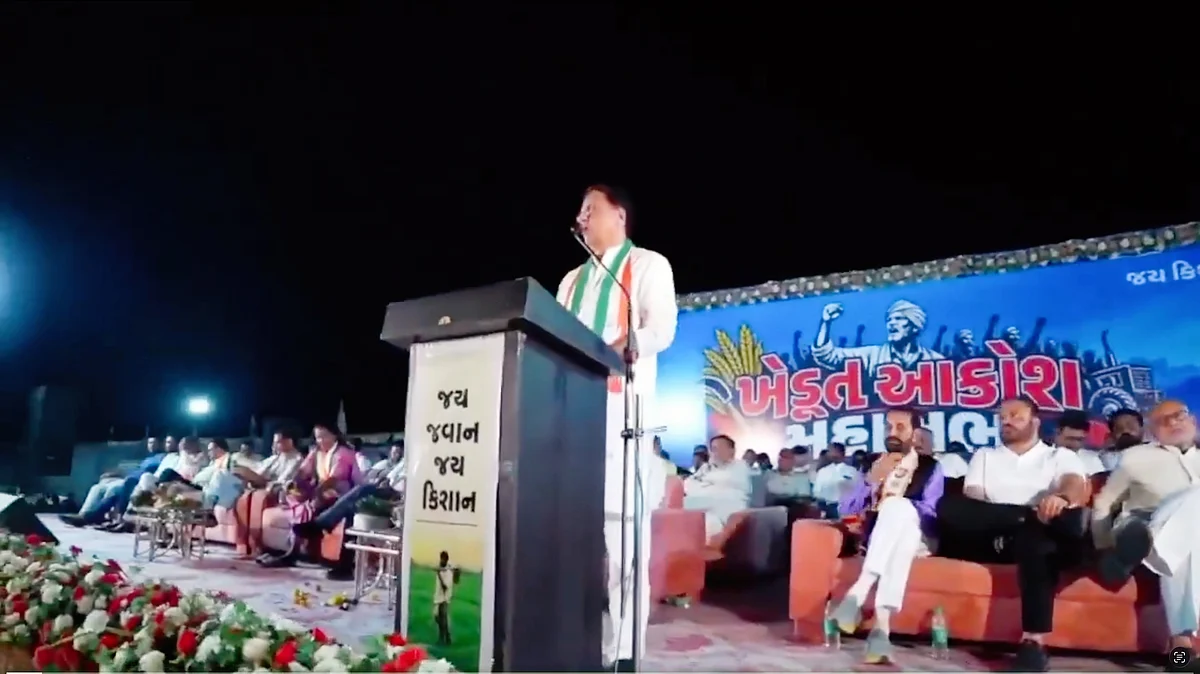


Randeep Surjewala seeks a drought declaration, crop loan relief and a special crop survey across Saurashtra.
Congress demands higher compensation and annual payments for farmers whose land is affected by power transmission lines.
Surjewala links the Opposition’s ‘vote chori’ allegations to democratic rights and constitutional safeguards.
Congress leader and Gujarat in-charge Randeep Surjewala on Thursday, 22 October demanded that the BJP government in Gujarat declare a drought in Saurashtra and other affected regions, waive crop loans and increase compensation for farmers whose land has been affected by power transmission lines.
Addressing a press conference in Rajkot, the Rajya Sabha member also said the alleged ‘vote chori’ (theft of votes) was not merely a BJP-versus-Congress issue but a question concerning the country’s democratic foundations.
Surjewala said several districts in Saurashtra had received significantly less rainfall this year, leaving farmers facing heavy losses to their cotton and groundnut crops. "There is a severe drought situation in entire Gujarat and in Saurashtra in particular," he said, claiming that Devbhumi Dwarka had received 84 per cent less rainfall than normal, while Porbandar and Jamnagar had recorded deficits of 67 per cent and 50 per cent, respectively.
The BJP government had recently informed the state legislative Assembly that it would not declare a drought or provide relief to farmers, industries and the general public, he said.
Highlighting water scarcity in Dwarka, Surjewala claimed that drinking water was being supplied for barely half-an-hour over a 72-hour period. He warned that Rajkot’s water reserves could run out within 48 hours unless more water was released from the Narmada project.
The Bhadar dam had only 20 per cent of its water remaining, while other reservoirs in the region were also reporting low storage levels, he said.
Surjewala demanded a special crop survey across Saurashtra to assess agricultural losses and determine compensation. He also sought a waiver or rescheduling of crop loans, fresh credit for the next cropping cycle and financial assistance to buy seeds and fertilisers.
The relief measures, he said, should be implemented within 30 days.
Referring to cotton and groundnut farmers, Surjewala questioned the Centre’s approach to the minimum support price (MSP), alleging that it was not accepting recommendations made by the Gujarat government.
He also flagged the difficulties faced by small and medium-sized industries, particularly the ceramic sector in Morbi, saying businesses were in crisis and employment opportunities for young people in Rajkot and the wider Saurashtra region were shrinking.
Higher compensation for land under transmission lines
On power transmission lines, Surjewala said the Congress supported Gujarat’s ambition to become a major solar power hub but opposed a system in which companies benefited at the expense of farmers whose land was affected.
Referring to a transmission line running from Khavda in Kutch to Halvad in Morbi, he alleged that farmers were receiving inadequate compensation for land used for tower installations and land beneath transmission lines.
He demanded compensation equivalent to 400 per cent of the land’s value for areas used to install towers and 100 per cent of the value for land beneath transmission lines.
He also sought an annual payment of Rs 30,000 to affected farmers for 25 years, arguing that restrictions on land beneath transmission lines could prevent construction and other activities, reducing its economic value.
Citing an example from Haryana during a Congress government, Surjewala said farmers had been entitled to annual payments for a specified period in addition to compensation for acquired land. Such payments, he said, recognised the long-term impact of land acquisition on farmers and their families.
With PTI inputs