


The forest has been reclaimed…
...but two decades after the end of Veerappan’s reign of terror, it’s still threatened. The story of Sathyamangalam


In the deep valleys around Talavadi and Talamalai, along the winding roads of Dhimbam and across the difficult country stretching towards the Moyar, the forest guards of Sathyamangalam still remember the days when entering the jungle meant entering Veerappan’s world.
Koose Munisamy Veerappan was not merely a fugitive in these forests. For more than three decades, he built a parallel empire of guns, sandalwood, ivory and informers; a reign of terror across the forests of Tamil Nadu and Karnataka.
The human and ecological cost was enormous — 180 people, including police personnel, forest officials and civilians, murdered; 2,000 elephants killed for an estimated 40,000 kg of ivory; sandalwood smuggled to the tune of Rs 100 crore. Among the gang’s 45 kidnappings was Kannada film star Rajkumar, who was held for 108 days in the year 2000.
When Veerappan and three associates were killed in a Tamil Nadu Special Task Force operation near Papparapatti on 18 October 2004, Sathyamangalam heaved a sigh of relief. With the guns silenced and the state able to reclaim the forest, a landscape that had been battered by organised hunting and illegal extraction had a chance to recover.
That recovery has been remarkable.
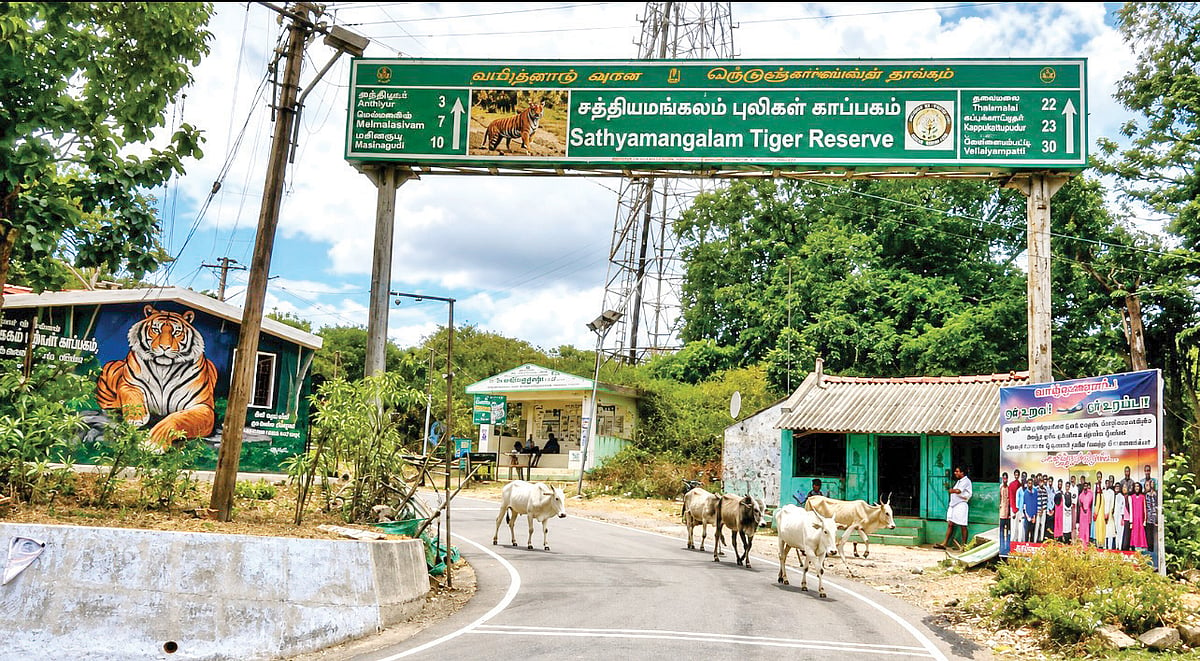
Sathyamangalam became a wildlife sanctuary in 2008 and a tiger reserve in 2013. Spread across about 1,408 sq. km, the reserve is one of the most important wildlife corridors in south India, connecting the Western and Eastern Ghats and linking the Nilgiris with the Biligiriranga landscape and forests further east.
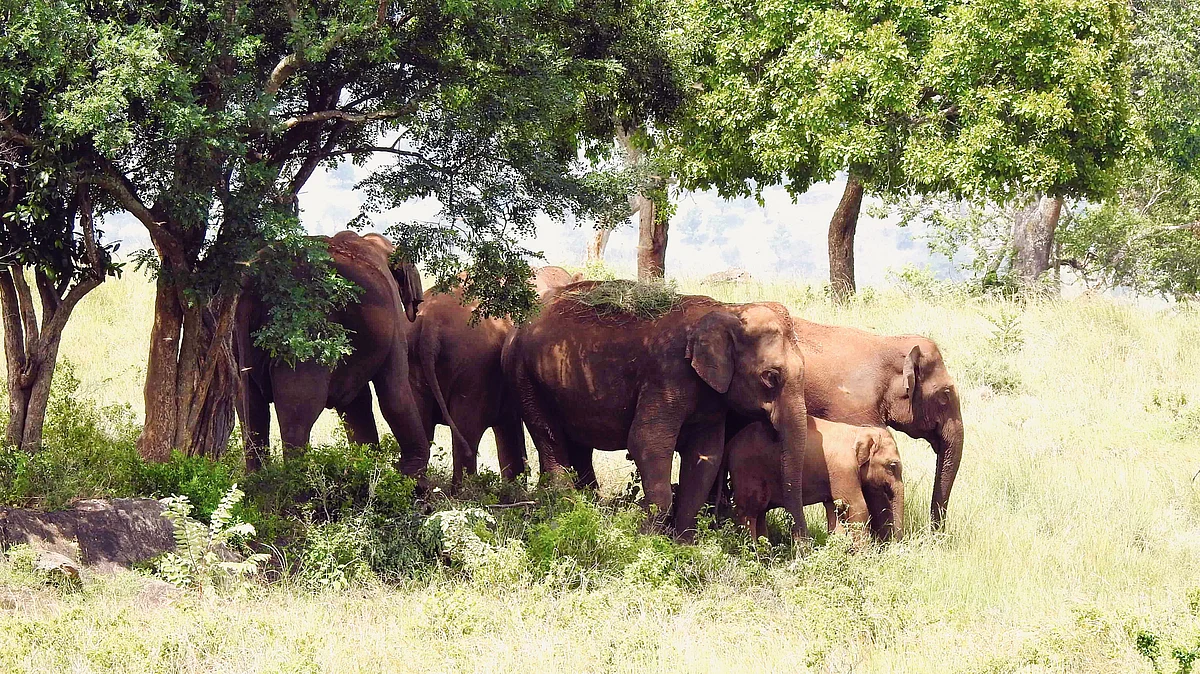
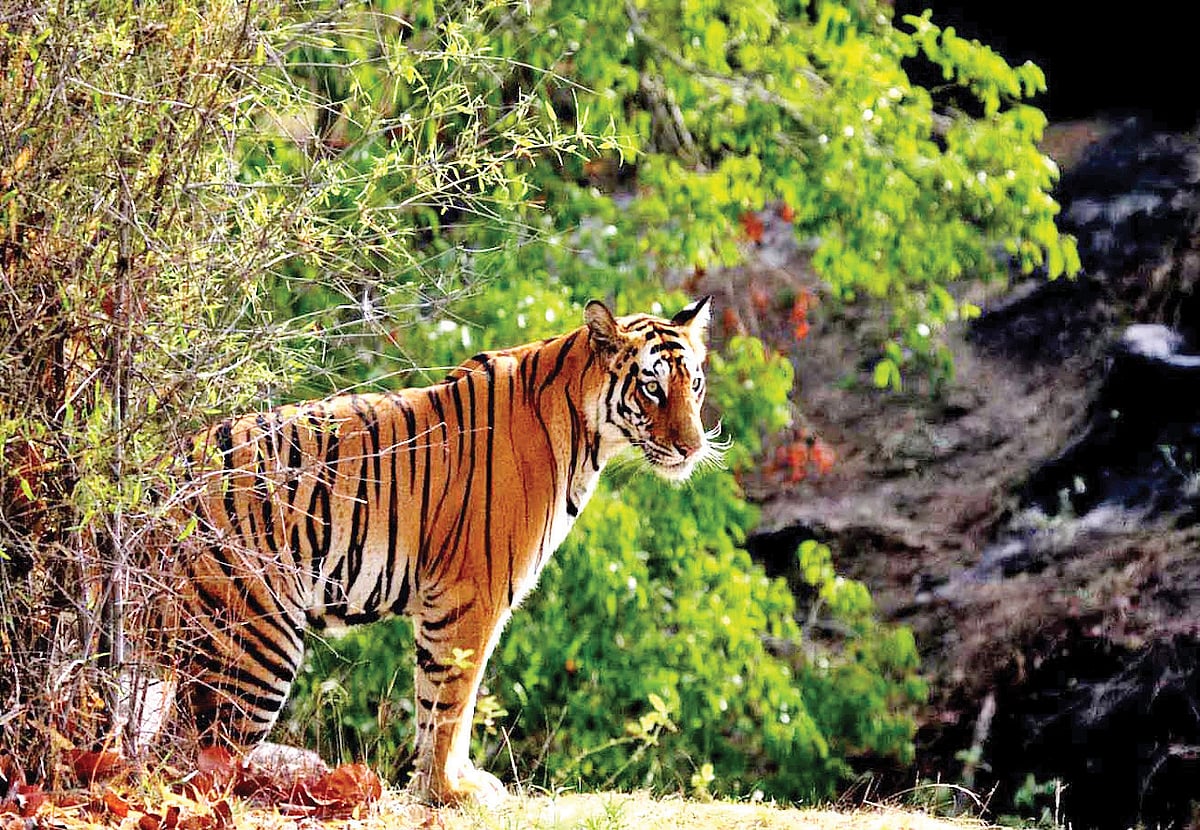
The latest camera-trap assessment puts the tiger population at 112, against 18 in 2010. The elephant population is estimated at around 651, while 54 anti-poaching camps now support regular protection through foot patrols, watchers, cameras and intelligence gathering.
Tigers cannot flourish in such numbers without adequate prey, water, cover and space. Their return is an indicator of a broader improvement.
Also Read: One reserve forest, three governments
“Animals do not recognise the boundaries dividing Tamil Nadu from Karnataka, or one forest division from another. A tiger reserve is invaluable not only for its animals but for the larger forest system it keeps connected. This is one reason why the recovery of Sathyamangalam matters,” says K. Rajkumar, chief conservator of forests and field director, Sathyamangalam Tiger Reserve.
There is another side often overlooked in the celebration of Sathyamangalam’s wildlife recovery: people. People live in and around the forest, including tribal communities whose relationship with the landscape predates the reserve, which includes parts of three development blocks (Sathy, Bhavanisagar and Talavadi) with numerous revenue villages and forest settlements.
The tribal communities include Soligas, Irulas, Kurumbas and Ooralis. Current forest department records identify 402 tribal families and 1,807 people in five major settlements, while older management records show a much larger network of tribal and non-tribal settlements in the core and buffer landscape.
For these communities, the forest is home. They cultivate small patches of land, collect honey and other non-timber forest produce, graze livestock and maintain cultural and spiritual links with the landscape. Their knowledge of forest paths, water sources, plants and animal movements has been built over generations.
During the Veerappan years, they were frequently viewed with suspicion. Because the gang operated in terrain known intimately to local forest dwellers, allegations of tribals acting as informers, guides, or abettors was part of official and popular lore.
Today, tribal communities are part of the forest protection system. The reserve has 28 tribal village forest committees, alongside other village and joint forest management committees. Local people are involved in protection, habitat restoration, micro-planning, sustainable collection of non-timber forest produce and livelihood programmes. For those once viewed as ‘accomplices’ of a brigand, this is a significant transformation. Conservation cannot succeed indefinitely by treating indigenous people as outsiders.
****
Also Read: Mullaperiyar: Dam nuisance
The temptation to make money from wildlife, however, persists.
In the years after his death, ‘junior Veerappans’ emerged. They never acquired his muscle, but they knew the forest, its routes and the difficulties of policing a landscape spread across two states. Today, country-made guns, traps, snares and improvised explosives have replaced heavily armed gangs. Small animals and wild boar are hunted for meat, while elephants remain a target for poachers.
In 2024, an 18-year-old tusker was found dead near Thalavadi with its tusks removed. Forest officials said the elephant had been shot. A Karnataka resident was arrested for being in possession of the tusks. The incident was a cruel reminder that the ivory trade has not vanished simply because the man who made elephant poaching an organised crime is gone.
But Enemy No. 1 is no longer necessarily a man with a rifle.
Roads are a persistent threat. Highways have increased traffic through wildlife areas, creating barriers to animal movement. Elephants crossing roads are particularly vulnerable.
Electricity lines are lethal, as is electric fencing erected by farmers. Elephants moving through agricultural and forest-edge areas have been killed after coming into contact with poorly insulated or unauthorised lines.
Then there are the quarries. “Around Soosaiyapuram in Talavadi, abandoned stone quarries have become hiding places for leopards. The animals take shelter in the deep pits and rocky cavities and emerge to prey on livestock in nearby settlements,” says V.P. Gunasekharan of the tribal collective Pazhankudi Makkal Sanghom.
Granite and other stone deposits in the landscape around Sathyamangalam have commercial value, as does tourism.
“Tourism can become destructive when it grows faster than regulation. Resorts imply roads, vehicles, lights, waste, water extraction and human traffic. In 2025, authorities identified dozens of resorts and farmhouses operating in the eco-sensitive zone without permissions,” says Coimbatore-based conservation activist Mohammed Saleem, founder of the Environment Conservation Group.
For communities living along the forest edge, the recovery of wildlife has brought another kind of pressure.
“During the dry months, when water and fodder become scarce, elephants seek sugarcane, banana and other crops. Tigers and leopards prey on cattle. Farmers respond with fences, lights, noise... Every crop raid can deepen resentment against an animal that is protected by law but appears to directly threaten our livelihood,” points out tribal leader K. Mallappa.
Recent studies of the Sathyamangalam landscape have recorded crop damage, livestock losses and human casualties. The cycle is painfully predictable. An elephant enters a field, a farmer tries to drive it away, somebody gets injured or killed, and the animal is subsequently regarded as a dangerous intruder.
The forest department cannot protect wildlife by ignoring the people living alongside. Compensation, early warning systems, safer fencing, better management of elephant movement and genuine local participation will be as important as anti-poaching camps.
The reserve’s own conservation model is already moving in that direction. But old suspicions die hard. The discovery of a decomposed tiger carcass near Bejalatti village in the Talamalai range in August showed how the memory of Veerappan continues to shape perceptions. Missing claws and teeth prompted conservationists to demand a closer forensic examination.
Forest officials said the preliminary examination did not indicate poaching and suggested that the condition of the carcass could explain the missing teeth. Even if the animal ultimately proves to have died naturally, the disagreement is significant.
If human-animal coexistence is managed with fairness and respect for traditional knowledge, Sathyamangalam could demonstrate that wildlife recovery and community rights need not be opposing ideas. The tiger has returned because the forest was given a chance. The elephant has survived because protection improved. The next step is for the people who live in the forest to be given a role in protecting its future.
K.A. Shaji has chronicled rural distress, caste and tribal realities, environmental struggles and development fault lines. More by the author here
Join our official telegram channel (@nationalherald) and stay updated with the latest headlines