


SC ruling on pedestrians' rights puts spotlight on Delhi's crumbling footpaths
As the SC declares walking on designated footpaths a fundamental right, residents and experts say the Capital's encroached and damaged pavements leave little room for pedestrians
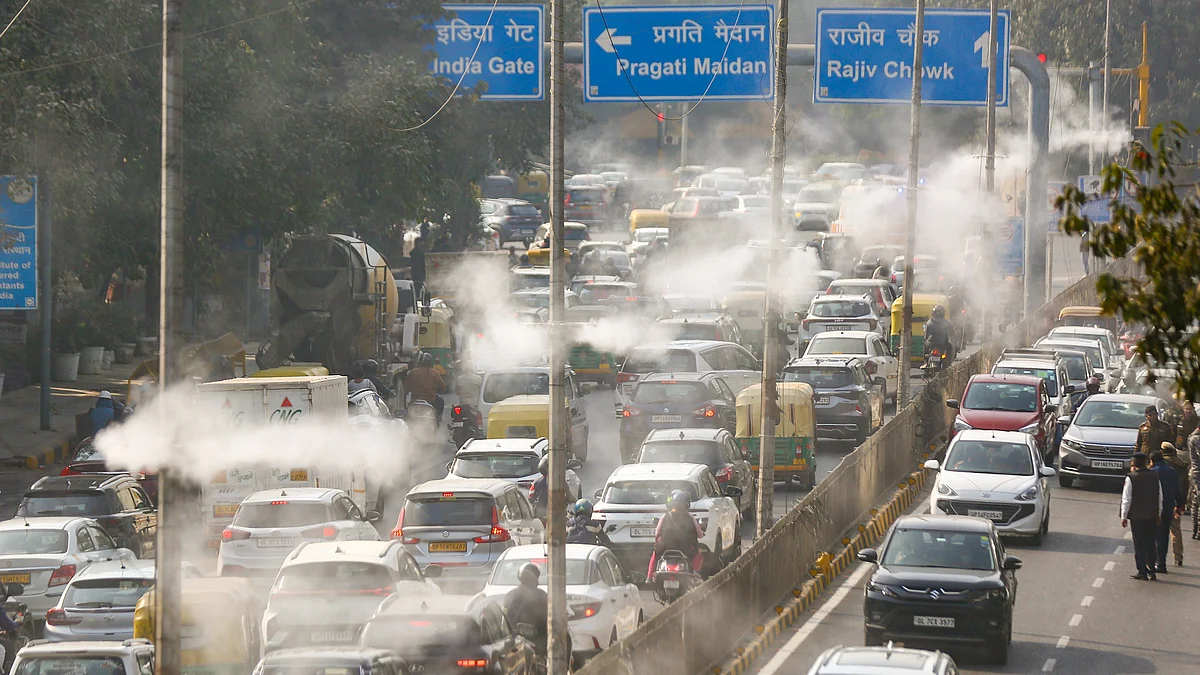


The Supreme Court's declaration that the right to walk on designated footpaths is a fundamental right has renewed focus on the poor state of pedestrian infrastructure in Delhi, where encroached, damaged and missing pavements routinely force people onto busy roads.
In a recent judgment delivered by a bench of Justices P.S. Narasimha and A.S. Chandurkar in a motor accident compensation case involving the death of a five-year-old boy, the apex court held that the right to walk on designated footpaths is protected under Article 19(1)(d), which guarantees freedom of movement, and Article 21, which guarantees the right to life.
The court observed that pedestrians have the first claim over footpaths and that their rights must take precedence over motor vehicles.
The ruling has also raised questions about the availability and condition of pedestrian infrastructure in the national capital, where pavements are frequently occupied by parked vehicles, damaged or absent altogether.
Experts call for enforcement
Senior advocate Ashok K. Singh said the judgment could strengthen enforcement against encroachments and reinforce the constitutional obligation of authorities to protect pedestrian spaces.
"This judgment is likely to create greater public awareness about the rights of pedestrians. It will also strengthen the process of removing encroachments and reinforce the idea that authorities are fulfilling their constitutional obligation to protect public spaces and ensure safe mobility for citizens," Singh told PTI Videos.
He alleged that footpaths under the jurisdiction of the Municipal Corporation of Delhi (MCD) and the New Delhi Municipal Council (NDMC) were frequently occupied by parked vehicles.
"In Delhi, you will find that both the MCD and NDMC have effectively turned footpaths into parking spaces. Vehicles are lined up along these footpaths, leaving little or no room for pedestrians to walk," he said.
Official data show that between January and March this year, Delhi Traffic Police issued 4,30,202 on-the-spot challans for improper or obstructive parking, making it the city's most common traffic violation.
Singh also alleged that some authorised parking arrangements allowed vehicles to occupy footpaths.
Residents describe daily struggle
Residents said navigating Delhi's roads as pedestrians had become increasingly difficult.
"There is a great deal of inconvenience. The government had earlier spoken about taking action against this issue, but the problem has only become more visible over time. There is simply no space left for people to walk," said Delhi resident Roshan Kumar.
He recalled narrowly avoiding an accident while walking with his child because of encroached pavements.
"There is barely any room for pedestrians, and the entire space has been encroached upon. It is difficult for people to challenge those responsible or even know whom to approach," he said.
Another resident, Sanjay Kumar, said footpaths in many areas had effectively disappeared beneath parked vehicles.
"These footpath parking arrangements themselves are problematic. As you can see, a large number of vehicles are parked here, even though there is no legitimate reason for them to occupy the footpath," he said.
Research highlights infrastructure gaps
Academic studies have also highlighted the poor state of Delhi's pedestrian infrastructure.
A study by the Transportation Research and Injury Prevention Centre (TRIPP) at IIT Delhi, conducted in collaboration with University College London, found that nearly 44 per cent of Delhi's roads do not have footpaths.
The study, based on surveys of 426 pedestrians across eight wards in south Delhi in 2022, found that most aspects of the city's pedestrian environment were perceived as unsafe. These included high-speed traffic, inadequate crossings near bus stops, vehicles parked on footpaths, poor lighting, lack of CCTV cameras and limited police presence.
Professor Geetam Tiwari of IIT Delhi, one of the study's authors, said many footpaths were either unusable or had disappeared altogether.
"Footpaths are either missing or completely unusable in many areas. The surface is uneven, the height is wrong, and in some stretches, pedestrian space has been removed altogether during roadworks," she said.
The study found that street vendors, police presence and CCTV cameras contributed to pedestrians' sense of safety, while poorly maintained or obstructed footpaths reduced it.
Researchers also found that many pedestrians avoided foot-overbridges because they were inconvenient, particularly for elderly people and those carrying goods.
"Foot-overbridges are not a solution for most people. Even globally, pedestrians tend to avoid them, as they are tiring and inconvenient, especially for older people," Tiwari said.
She added that bus stops were often poorly integrated with pedestrian crossings, prompting many people to cross roads at unsafe locations.
'Captive pedestrians'
Lead author Neba C. Tony highlighted the challenges faced by what the study described as "captive pedestrians"—people who walk because they cannot afford private or public transport.
These pedestrians often choose shorter but riskier routes, exposing themselves to greater danger from traffic and pollution.
"The built environment in Delhi is generally hostile to pedestrians," Tony said.
The study also found that women felt less safe than men, particularly in poorly lit areas and locations with parked vehicles or inadequate pedestrian infrastructure.
The consequences are reflected in road safety data. According to Delhi Police, 649 pedestrians were killed and 1,738 injured in road accidents in 2025. Private cars were responsible for the highest number of pedestrian fatalities, followed by two-wheelers and heavy vehicles.
The IIT Delhi study also noted that pedestrians accounted for 43 per cent of the 1,461 fatal road crashes recorded in Delhi in 2022.
Join our official telegram channel (@nationalherald) and stay updated with the latest headlines