


SC: you cannot block roads in name of faith; religious freedom is not absolute
Hearing Sabarimala-linked petitions, the Supreme Court says the State can regulate religious practices if they affect secular life and public order
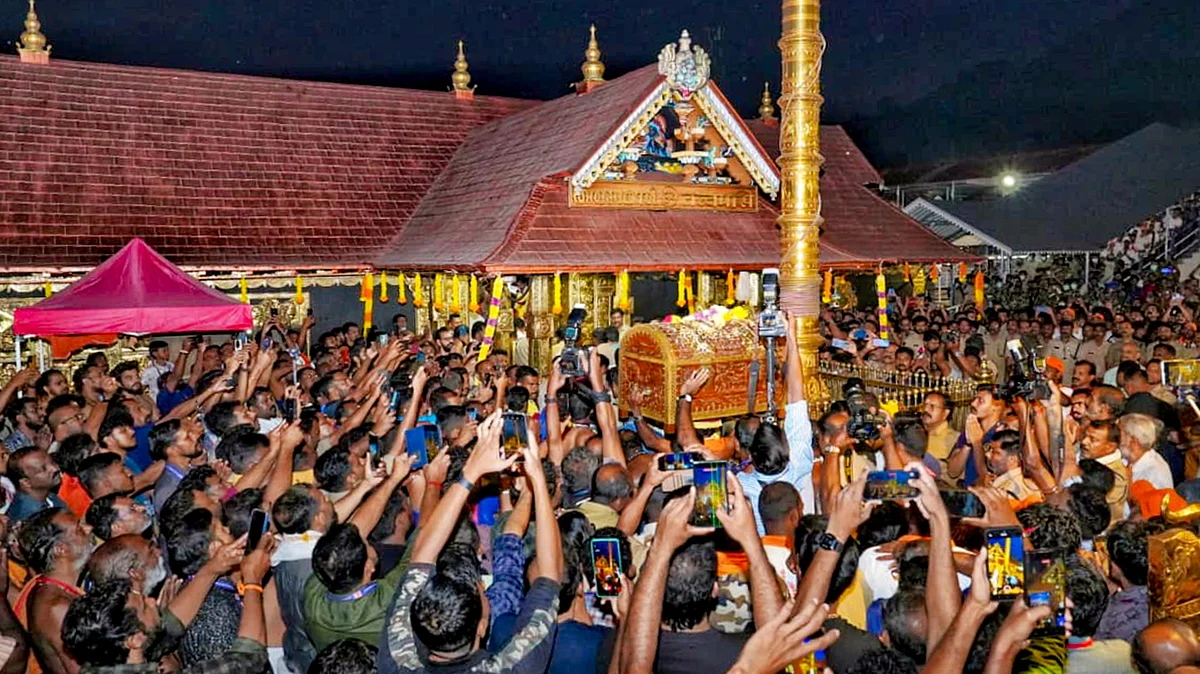


The Supreme Court on Tuesday, 28 April, underlined that while religious denominations enjoy autonomy in matters of worship, such freedom is not absolute and cannot disrupt public life.
Hearing a batch of petitions on gender discrimination in religious spaces—including issues arising from the Sabarimala temple case—a nine-judge Constitution bench said the State is empowered to step in where religious practices spill over into secular domains.
The bench, led by Chief Justice of India Surya Kant, was examining the scope of religious freedom under Articles 25 and 26 of the Constitution, and the extent to which the State can regulate practices linked to faith.
Other members of the bench include Justices B.V. Nagarathna, M.M. Sundresh, Ahsanuddin Amanullah, Aravind Kumar, Augustine George Masih, Prasanna B. Varale, R. Mahadevan and Joymalya Bagchi.
During the hearing, Justice Nagarathna drew a clear distinction between protected religious practices and activities that affect the public at large.
“Suppose there is a temple, they want to have an annual festival, like you have the annual cart or chariot festival. You cannot block all the roads around the temple. That has nothing to do with religion. You do your religious activity, but not by blocking the roads. The State can always step in to regulate,” she said.
She emphasised that courts cannot adjudicate on the manner of worship followed by a denomination. “Suppose they say they have a particular way of worship. That is the autonomy which is given in the manner of worship. Court cannot sit in judgment and say, no this cannot be done. But if a secular activity is also affected, then the State can step in to regulate,” Justice Nagarathna added.
The observations came in response to submissions by advocate Akshay Nagarajan, appearing for the Hindu Dharma Acharya Sabha, who argued that Article 25 protects not just belief but also the outward expression of faith, including rituals and ceremonies.
Article 25 guarantees freedom of conscience and the right to freely profess, practise and propagate religion, but clause (2) (a) allows the State to regulate secular activities associated with religious practice. Article 26, meanwhile, grants religious denominations the right to manage their own affairs in matters of religion.
The bench also cautioned against an unregulated exercise of these rights. Justice Amanullah said the right to manage a religious institution cannot imply the absence of structure.
“There cannot be anarchy. Take a dargah or a temple. There will be elements associated with the institution, the manner of worship, the sequence in which things are done. Somebody has to regulate that,” he said.
“It cannot be that everyone says I will do whatever I want, or that the gates remain open at all times without any control… every institution must have norms and it cannot be individually determined by each person,” he added, stressing that regulation must remain within constitutional limits and cannot be discriminatory.
Senior advocate Nizam Pasha, appearing for a petitioner linked to the dargah of Hazrat Nizamuddin Dargah, argued that Sufi traditions constitute a distinct religious denomination with established practices and management structures.
The court also briefly pulled up an intervenor for straying beyond the issue. When advocate Ashwini Upadhyay raised broader civilisational arguments, Justice R Mahadevan remarked that such submissions were not relevant to the matter at hand.
The hearing will continue on Wednesday, as the Constitution bench seeks to delineate the balance between religious freedom and constitutional principles of equality and public order.
(With agency inputs)
Join our official telegram channel (@nationalherald) and stay updated with the latest headlines