


Sonam Wangchuk calls for dialogue, signals flexibility on demand for statehood
Released after 170 days detention under the NSA, climate activist advocates a win-win solution, rejects rumours of personal gain and focuses on Ladakh’s bigger cause
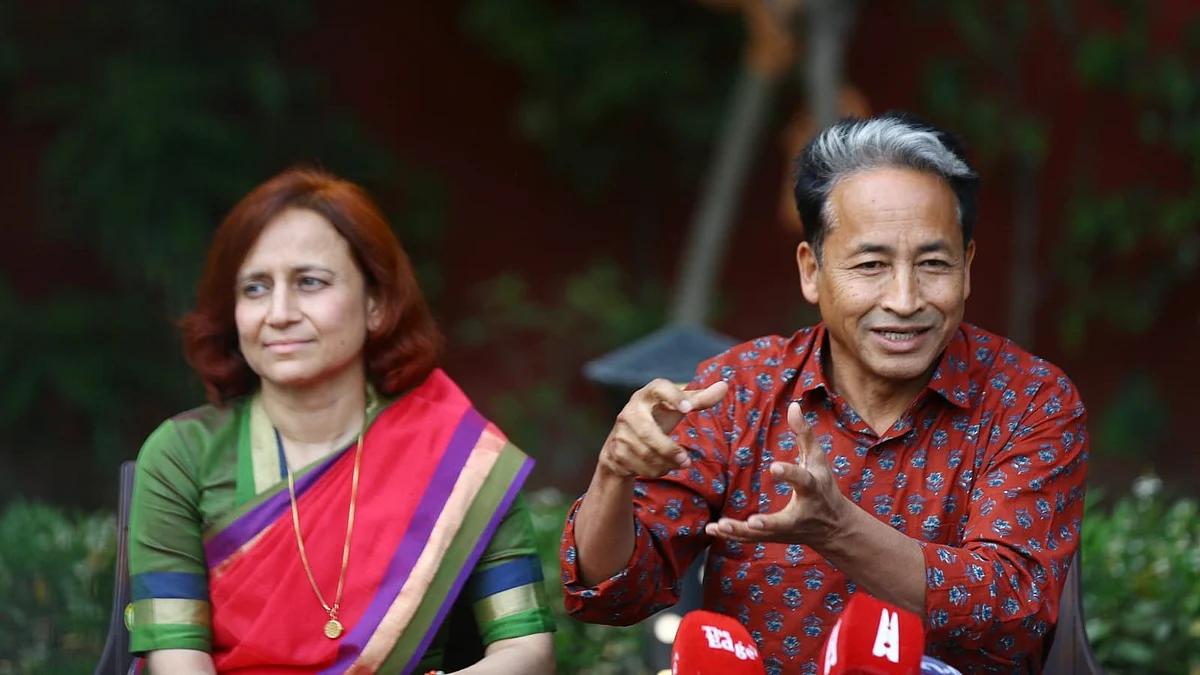


Three days after his release from Jodhpur jail, climate activist and educationist Sonam Wangchuk, who has been at the forefront of the movement demanding statehood for Ladakh, struck a conciliatory note on Tuesday, 17 March, while addressing the press in Delhi.
Wangchuk was arrested on 26 September last year and detained under the stringent National Security Act (NSA) after protests turned violent, leaving four people dead and dozens injured. He was released on 14 March after the Union ministry of home affairs revoked with “immediate effect” his 170-day detention.
Commenting on his release from jail, he said, “The advances from the government was possible due to our status in the court. I was well prepared to spend 12-months in jail.”
Addressing the press conference along with his wife Geetanjali Angmo, Wangchuk added: "We were sure of a victory in the court, but a win was not enough. I wanted a win-win."
Emphasising a “give-and-take” approach in dealing with the Centre, Wangchuk said, “Our main issues are Sixth Schedule status and statehood. If not both, then at least one. If the Centre wants something, we should also get something. It should not be a one-sided loss.” This signals some flexibility unlike the consistent stand of the Leh Apex Body and the Kargil Democratic Alliance, which have maintained that both demands are non-negotiable.
Welcoming what he described as an “extended hand” from the government to rebuild trust and initiate dialogue, Wangchuk said he was “greedy” for a resolution that benefits all sides.
“What use is my personal victory if the larger cause does not succeed?” he said, adding that Ladakh too would “win” if talks move forward constructively and the government “comes out looking better”.
Wangchuk also rejected suggestions of any deal with the government leading to his release. “Even if there was such an offer, I wouldn’t have accepted it. My agitation was never about me, but about the people of Ladakh,” he said, adding that he would be willing to be part of any high-powered committee representing Ladakh in negotiations with the Centre.
Recalling the time immediately after his arrest Wangchuk said he was “bundled and thrown into jail” with no communication with his family and legal team for almost ten days.
Striking a forward-looking tone, Wangchuk said he did not wish to dwell on past grievances. “What we went through was nothing short of a thriller. But we can now move on and look for a new beginning, where trust is rebuilt,” he said, reiterating that “talks are always about mutual accommodation”.
He added that he would return to Ladakh to consult stakeholders before deciding the next course of action. “I will go back and discuss with the LAB and the KDA,” he said.
Geetanjali Angmo, meanwhile, outlined a broader vision for the region, saying Ladakh should aspire to become a model of self-reliance, environmental sustainability and grassroots empowerment, working “with the government”.
Responding to allegations of being labelled anti-national, Wangchuk said, “If I were a ‘deshdrohi’, I wouldn’t have been released. People in Ladakh are deeply hurt by such branding.”
Also Read: The State versus Sonam Wangchuk
Join our official telegram channel (@nationalherald) and stay updated with the latest headlines