


SC says no blanket ban on pellet guns, opens scrutiny of Delhi protest firing
Top court says blanket ban requires challenge to police rules, but agrees to examine alleged misuse during Delhi youth protests
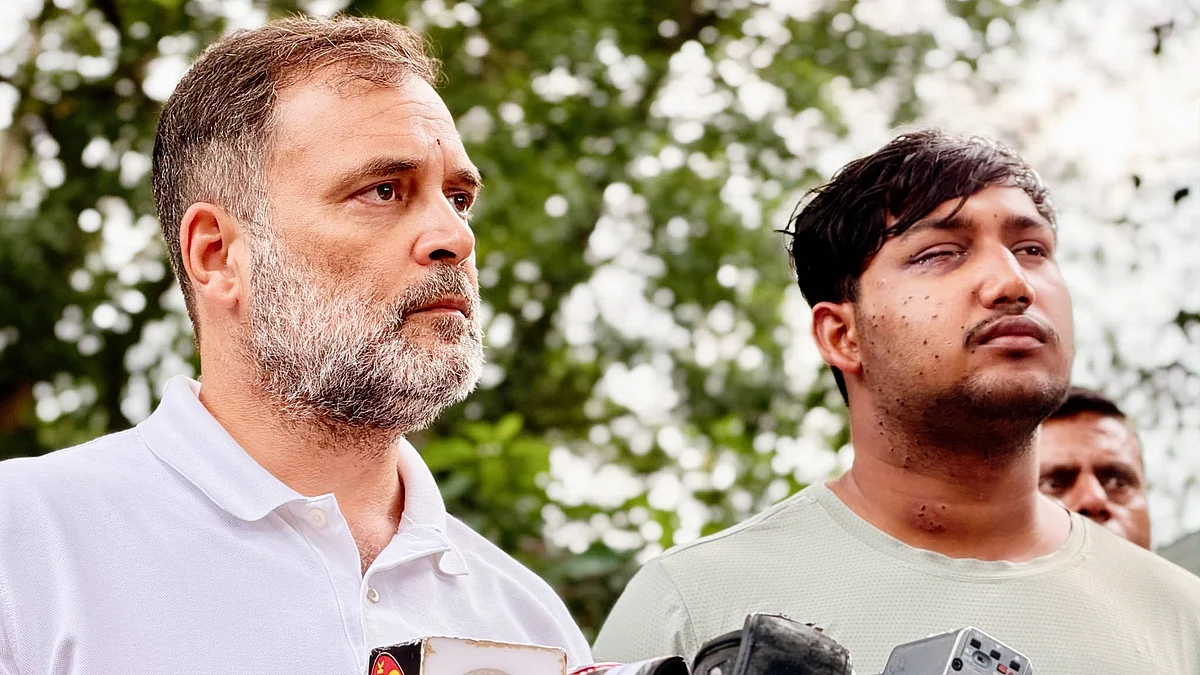


The Supreme Court on Thursday, 30 July refused to order a blanket ban on the use of pellet guns for crowd control, observing that security forces are permitted to use them in exceptional circumstances under existing police guidelines. At the same time, it agreed to examine allegations that metallic pellets were used disproportionately during the 20 July youth protests in Delhi calling for former education minister Dharmendra Pradhan's resignation over the NEET-UG paper leak case.
A bench comprising Chief Justice Surya Kant and Justices Joymalya Bagchi and V. Mohana directed the Centre to preserve the ammunition log of the Rapid Action Force (RAF) personnel deployed during the protests at Jantar Mantar, saying the material could be relevant to the ongoing proceedings.
The bench also issued notices to the Centre and the inspector-general of police, RAF, on a petition filed by former central information commissioner and retired IPS officer Yashovardhan Azad, along with two injured protesters, Prashant Kumar and Sheikh Irshad Mansoori.
The petition seeks a nationwide ban on the use of wholly or partly metallic pellet ammunition for dispersing civilian assemblies, contending that such weapons are incompatible with constitutional safeguards governing the use of force.
Questioning the plea's prayer for a complete prohibition, the bench observed that the Bureau of Police Research and Development (BPRD) advisory permits the use of pellet guns in exceptional situations.
"Prayers are not to use pellet guns. In exceptional cases, police regulations permit the use of pellet guns. If you are interested in phasing out pellet guns, you will have to challenge that very provision as ultra vires to Article 21," justice Bagchi observed.
The court said while it could not prohibit the use of pellet guns as long as the existing framework remained in force, it was open to examining whether they had been used lawfully in a specific incident.
Appearing for the petitioners, senior advocate Vrinda Grover argued that metallic pellets had been recovered from the bodies of the injured protesters and clarified that the challenge was confined to the use of metallic pellets rather than pellet guns in general.
"I am not saying pellet guns should not be in the armoury of the RAF or not. Here it is different. They have used metallic pellets," she submitted.
Grover also argued that she could not locate any Delhi Police standing order authorising the use of pellet guns and urged the Union government to place any such instructions on record.
"There is no standing order of the Delhi Police which permits the use of pellets. That is why my difficulty arises, and I have to rely on BPRD. If there is such a standing order, the Union may place it on record. I am sure the Union and the Delhi Police do not wish to fire pellets on innocent youngsters," she said.
Solicitor-general Tushar Mehta assured the court that the government would assist the proceedings and preserve all material necessary for the investigation.
The bench also directed the Delhi government to ensure the best possible medical treatment for Kumar, Mansoori and others who allegedly suffered pellet injuries during the protests.
The petition arises from the 'Sansad (Parliament) Chalo' march organised by the Cockroach Janata Party (CJP) on 20 July against the NEET-UG 2026 paper leak, which led to the cancellation of the first round of exams and a re-test in May. Protesters have accused the police and the RAF of using excessive force, including tear gas, lathi-charge and metallic pellet ammunition, without adequate warning. The Supreme Court had earlier directed the authorities to preserve CCTV footage, drone recordings, body camera footage and wireless logs relating to the police action.
During Thursday's hearing, the bench observed that even bona fide protests could sometimes turn violent because of the presence of anti-social elements, requiring law enforcement agencies to adopt a "graded response" depending on the situation.
The petition contends that pellet guns, despite being described as 'less-lethal' weapons, disperse hundreds of projectiles over a wide area, making precise targeting impossible and posing a serious risk of permanent injuries, particularly to the eyes. It seeks compensation, medical treatment and rehabilitation for those allegedly injured, besides a nationwide prohibition on the use of metallic pellet ammunition for crowd control.
With PTI inputs
Join our official telegram channel (@nationalherald) and stay updated with the latest headlines