


Supreme Court to examine Bihar minister’s continuance beyond six months without election
Top court says the Bihar government must explain the constitutional basis for Deepak Prakash remaining a minister despite not being a member of either House of the state legislature
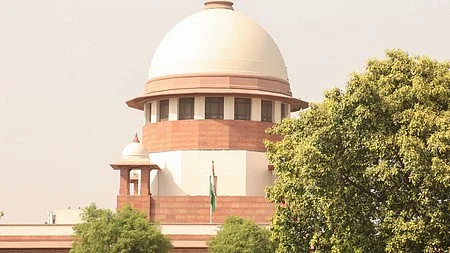


The Supreme Court on Thursday said it would examine the constitutional validity of Bihar Panchayati Raj Minister Deepak Prakash continuing in office beyond six months without being elected to either House of the state legislature.
The matter was mentioned before a Bench led by Chief Justice of India Surya Kant, where counsel for the petitioner argued that more than six months had elapsed since Prakash assumed office and that he continued to serve as a minister despite not being a member of either the Bihar Legislative Assembly or the Legislative Council.
Seeking an early hearing, the petitioner's counsel submitted that the constitutional time limit had already expired.
Appearing for the Bihar government, the state's counsel informed the court that the case was already listed for hearing on 27 August and left it to the Bench to decide whether the matter should be taken up sooner.
Observing that the case raised a pure question of constitutional law, Chief Justice Kant said the Bihar government would have to explain the legal basis for allowing a person who was not a legislator to continue as a minister beyond the six-month period permitted under the Constitution.
The court indicated that it would hear the matter on Tuesday.
The petition challenges Prakash's continuation as Panchayati Raj Minister after the formation of the new government in Bihar, despite his not having secured membership of either House of the legislature.
The public interest litigation, filed by social activist and whistleblower Rakesh Kumar Singh, questions the validity of Prakash's reappointment under Article 164(4) of the Constitution, which allows a non-legislator to serve as a minister for a maximum of six months, during which time the individual must be elected or nominated to the legislature.
According to the petition, Prakash was first sworn in as a minister on 20 November 2025, despite not being a legislator. After the resignation of then Chief Minister Nitish Kumar on 15 April, the Council of Ministers ceased to exist. Prakash was subsequently reappointed to the Cabinet on 7 May after Samrat Choudhary formed the new government, although he had still not become a member of either House.
The petitioner argues that the reappointment amounts to a colourable exercise of constitutional power designed to effectively extend the six-month limit prescribed under Article 164(4).
The plea relies on the Supreme Court's 2001 judgment in S.R. Chaudhuri v. State of Punjab, which held that the constitutional provision allowing a non-legislator to become a minister is a one-time exception and cannot be repeatedly invoked through reappointment, cabinet reshuffles or the formation of a new ministry.
The petition seeks a declaration that Prakash's reappointment is unconstitutional and also requests the issuance of a writ of quo warranto questioning the authority under which he continues to hold ministerial office.
With IANS inputs
Join our official telegram channel (@nationalherald) and stay updated with the latest headlines