


UGC rules row: Centre mulls review panel, months after Supreme Court stay
Modi government weighs changes to controversial equity regulations amid continuing legal and political scrutiny
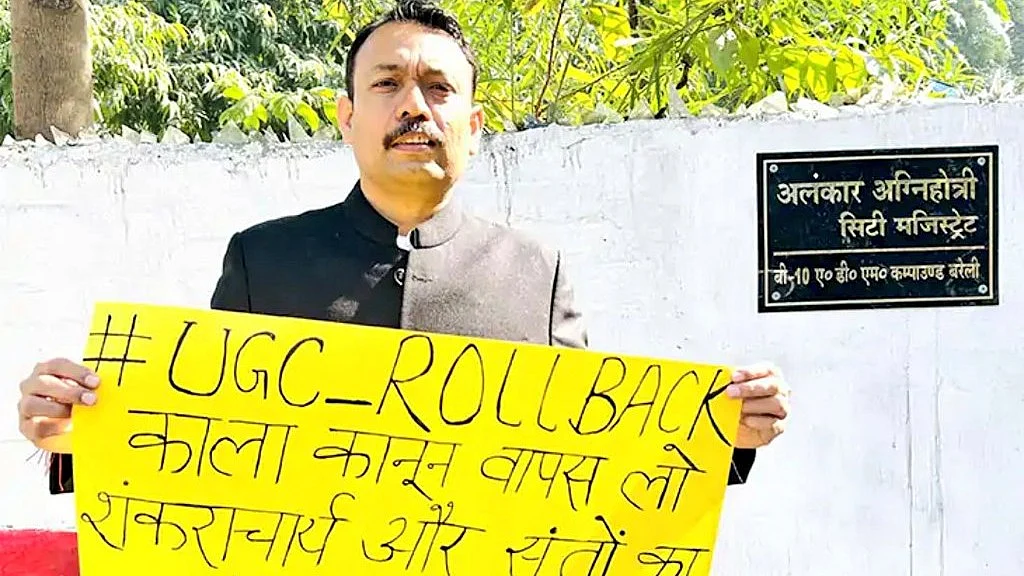


Centre considers committee to revisit UGC's controversial 2026 equity regulations.
Supreme Court flags ambiguity, possible misuse and gaps in safeguards.
BJP faces competing demands from general-category and reserved-category groups.
The Narendra Modi government is considering setting up a committee to review the controversial University Grants Commission (UGC) equity regulations, nearly 10 months after the Supreme Court stayed their implementation following a legal challenge over alleged discrimination against general-category students.
Solicitor-general Tushar Mehta informed a Supreme Court bench headed by Chief Justice of India Surya Kant on Thursday, 5 November, that the government was contemplating constituting a committee to examine the concerns surrounding the University Grants Commission (Promotion of Equity in Higher Education Institutions) Regulations, 2026.
The submission came after the bench suggested that the Centre revisit the provisions and ensure that the interests of every student were protected. The court granted the government four weeks before taking up the matter again.
The proposed committee could provide the Centre an opportunity to revisit the contentious provisions and work towards a revised framework without abandoning the stated objective of preventing caste discrimination in higher educational institutions.
The latest development is significant because the Centre had already informed the Supreme Court in August that it was reconsidering the regulations. The proposal to constitute a committee now suggests that the government is moving towards a more structured review, although its composition, mandate and terms of reference are yet to be announced.
The controversy has placed the BJP in a politically uncomfortable position. The regulations triggered protests among sections of the general-category electorate, including upper-caste groups that constitute an important part of the party's support base. At the same time, any dilution of the safeguards risks inviting criticism from Dalit, Adivasi and OBC communities that have long demanded stronger institutional protection against caste discrimination.
The Supreme Court's January intervention had provided the Centre considerable breathing space by keeping the new regulations in abeyance. The government is now faced with the task of finding a legally sustainable and politically acceptable way forward.
The 2026 regulations were notified on 13 January, replacing the UGC's 2012 framework on promoting equity in higher education institutions. They were the culmination of a prolonged legal battle that began with a 2019 petition filed by Radhika Vemula, mother of Hyderabad University research scholar Rohith Vemula, and Abeda Salim Tadvi, mother of medical student Payal Tadvi.
Both students died by suicide following allegations of caste-based discrimination in their respective institutions. Their mothers approached the Supreme Court seeking stronger mechanisms to prevent discrimination and ensure accountability within universities and colleges.
The new regulations sought to establish a more comprehensive institutional mechanism for addressing discrimination. They mandated equal opportunity centres, equity committees, dedicated helplines and monitoring mechanisms in higher educational institutions.
However, the final regulations triggered protests, with critics arguing that the provisions could discriminate against general-category students and leave them vulnerable to complaints without adequate safeguards.
At the heart of the controversy is Regulation 3(1)(c), which defines caste-based discrimination as unfair treatment on the basis of caste or tribe against members of the Scheduled Castes, Scheduled Tribes and Other Backward Classes.
Petitioners argued that the definition effectively excludes general-category students and faculty from specific protection against caste-based discrimination. They questioned why discrimination against one category of students should be treated differently from discrimination against another.
An important distinction, however, lies in Regulation 3(1)(e), which provides a broader definition of discrimination. It covers unfair, differential or biased treatment against any stakeholder on grounds including caste, religion, race, gender, place of birth and disability.
This apparent overlap between the two provisions became one of the central questions before the Supreme Court. The petitioners argued that the specific definition under Regulation 3(1)(c) was restrictive, while the broader provision under 3(1)(e) already covered discrimination against all stakeholders.
Another contentious aspect was the omission, in the final regulations, of a provision contained in the draft that proposed penalties or disciplinary action against those found guilty of filing false complaints. Critics argued that the removal of this safeguard could leave the framework open to misuse.
Opposition to the regulations was not confined to student demonstrations. In Uttar Pradesh, BJP Yuva Morcha office-bearer Raju Pandit resigned in protest, describing the rules as discriminatory towards upper-caste students. Several office-bearers of a Lucknow-based political unit also resigned, while sub-divisional magistrate Alankar Agnihotri quit his post over the controversy.
The regulations also exposed divisions within the wider social-justice debate. While general-category groups demanded their withdrawal, sections of Dalit and OBC organisations opposed the Supreme Court stay, arguing that it weakened safeguards against discrimination on university campuses.
The political Opposition, too, appeared cautious. Parties such as the Congress and Samajwadi Party, which have traditionally positioned themselves around social justice and caste representation, faced competing pressures over how to respond to a controversy that had generated strong reactions among different social groups.
Join our official telegram channel (@nationalherald) and stay updated with the latest headlines