


UT with dual power structure worst form of government: Omar Abdullah
Jammu and Kashmir Chief Minister pushes for restoration of full statehood, says elected government should have greater administrative control
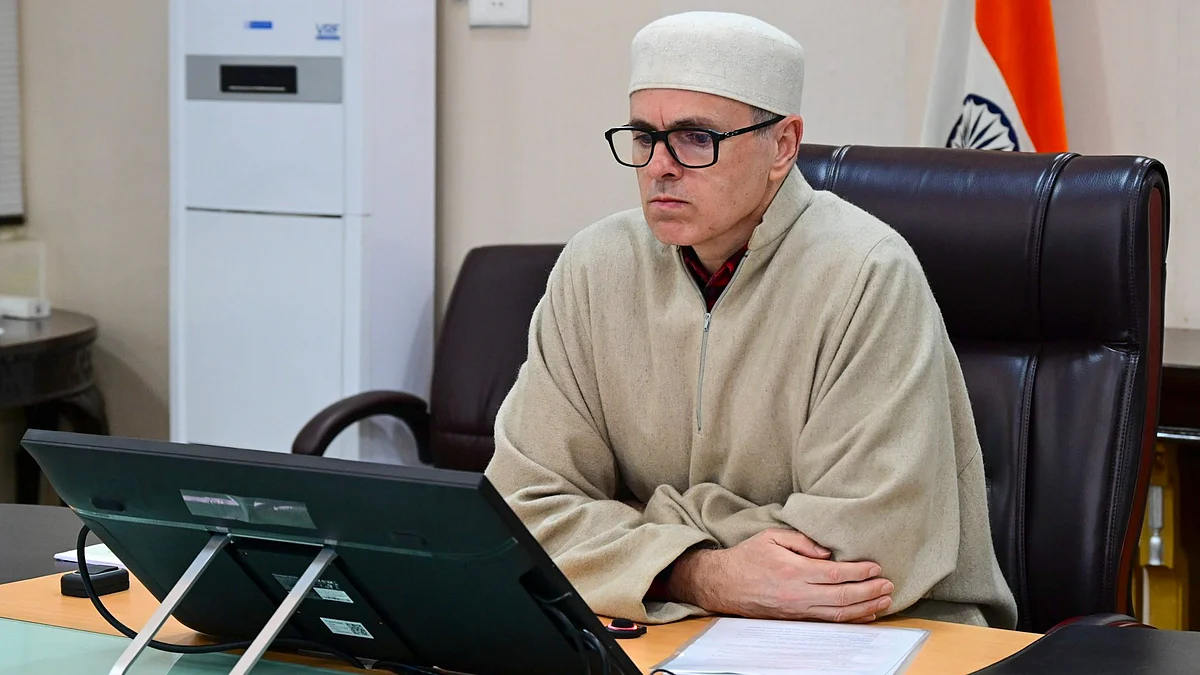


Jammu and Kashmir Chief Minister Omar Abdullah has described the present Union Territory governance model in Jammu and Kashmir as the “worst form of government”, arguing that the dual power structure between the elected administration and the Lieutenant Governor’s office has created administrative complications and weakened democratic accountability.
In an interview with PTI, Abdullah reiterated his demand for restoration of full statehood to Jammu and Kashmir and said significant progress had nevertheless been made in resolving differences with the Centre over rules governing administrative powers and transaction of business.
“I continue to maintain that view. I continue to believe that a system of Union Territory with an assembly is by far the worst form of government that you can come up with,” Abdullah said.
The chief minister questioned the rationale behind treating Jammu and Kashmir, which has a 90-member elected Assembly, on the same footing as smaller Union Territories such as Puducherry, which has a significantly smaller legislature.
“Can you not see the difference between a tiny one with 30 MLAs and one with 90 MLAs?” Abdullah asked while referring to the governance structure.
‘Recipe for disaster’
Abdullah said the coexistence of elected and unelected power centres was proving counterproductive, especially in areas linked to governance and crisis response.
Referring to the recent Pahalgam tragedy, he argued that keeping elected representatives away from law and order-related decision-making served little purpose and weakened accountability mechanisms.
The National Conference leader also said several institutions that previously functioned under the elected state government — including universities, the Sher-e-Kashmir Institute of Medical Sciences and the Power Development Corporation — should naturally remain under the elected administration even within the Union Territory framework.
He clarified that he was not questioning the Centre’s constitutional control over subjects such as police, law and order and central services under the UT arrangement.
Talks with Centre progressing
Despite criticism of the governance model, Abdullah said his administration and the Centre had made “significant progress” in narrowing differences over business rules and administrative functioning.
He revealed that a proposal regarding appointment of a new Advocate General had recently been forwarded to the relevant authorities.
On the issue of dismissal of government employees without judicial inquiry, Abdullah criticised the process as “arbitrary” and “opaque”, warning that many such dismissals may not survive judicial scrutiny in courts.
He noted that the practice began during the earlier BJP-PDP government and not under the current Lieutenant Governor administration.
“We will not be able to defend the dismissal of these employees in the courts,” Abdullah said, asserting that employees had not been given adequate opportunity to prove their innocence.
Welfare measures and Jammu-Kashmir ties
Abdullah also highlighted implementation of several election promises made by the National Conference government, including free electricity support for poorer households and free LPG cylinders for economically weaker sections.
He argued that electricity subsidies should primarily benefit Below Poverty Line families and suggested that wealthier consumers should eventually pay market-linked tariffs.
The chief minister additionally described the restoration of the traditional ‘Darbar Move’ — the biannual shifting of the capital between Jammu and Srinagar — as an important step towards reducing emotional and administrative distance between the two regions.
“The distance between Jammu and Kashmir has reduced to a great extent,” Abdullah said.
Remarks on Kashmiri Pandits, dynastic politics
On the issue of displaced Kashmiri Pandits, Abdullah said the community left the Valley after losing its sense of security and asserted that meaningful rehabilitation remained incomplete.
He questioned the BJP (Bharatiya Janata Party) over the continued existence of migrant camps in Jammu decades after the exodus of the early 1990s.
Abdullah also rejected suggestions that recent defeats of political heirs elsewhere reflected public rejection of dynastic politics.
“Belonging to a political family only opens a door. What keeps it open is your own performance,” he said.
He further dismissed speculation about an imminent cabinet reshuffle in Jammu and Kashmir, calling such reports “absolute lies”.
Join our official telegram channel (@nationalherald) and stay updated with the latest headlines