


ECI finds more ways to cull voters
Since when is the number of children an eligibility criterion for voters? Nandlal Sharma on the madness in the method
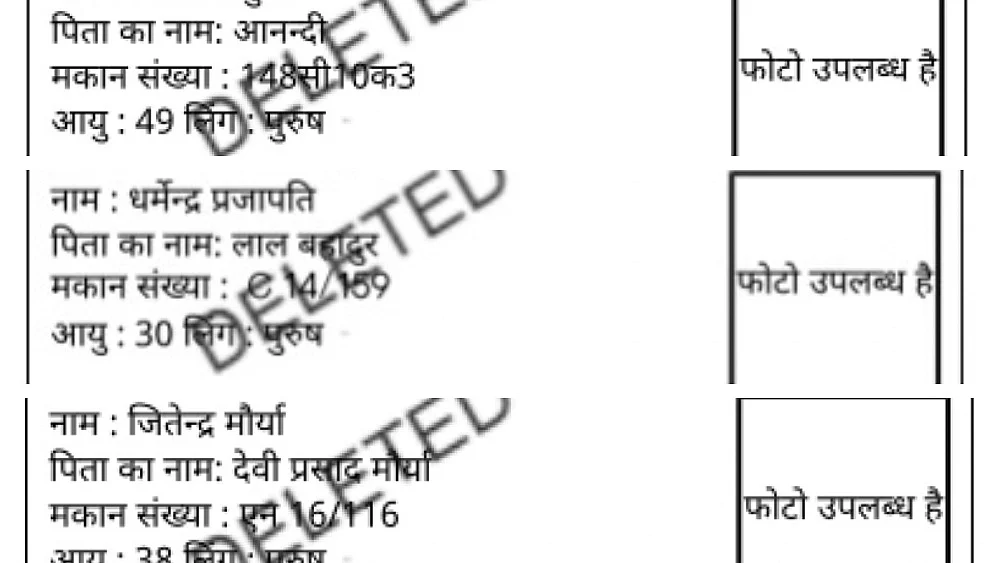


Can an Indian citizen lose voting rights for having ‘six or more’ children? Apparently, yes, as Sonu Giri (35), a voter from Varanasi Cantonment discovered. Soon after the publication of the draft voter list on 6 January, the Election Commission of India (ECI) sent Sonu a notice asking him to respond to allegations that he had ‘six or more’ children. When the final voter list was released, Sonu Giri’s name had been deleted.
He is not the only one. National Herald studied voter lists from 20 booths across four polling stations — Hamidia Madrasa, Bajardiha (177); Goenka Sanskrit Mahavidyalaya, Assi Sangam (345); Markazi Madrasa Ansarul Uloom, Kazipura Khurd (15); and Kanya Primary and Upper Primary School, Shankuldhara (228) in the Varanasi Cantonment Assembly constituency and found large number of deletions on similar grounds.
Girijesh Kumar, 49, (Assi Sangam) received a notice citing ‘an age difference of less than 40 with grandparents’ and ‘having six or more children’.
Jitendra Maurya, 38, (Shankuldhara) received a notice citing ‘name discrepancy’ and ‘having six or more children’.
In the final list, Sonu, Girijesh, Jitendra and many other deleted voters were categorised as ‘Q’ — ‘disqualified’. Other deleted voters were coded: ‘E’ (expired), ‘S’ (shifted), ‘R’ (repeated/duplicated), ‘M’ (missing).
At Sonu Giri’s booth (Hamidia Madrasa), the EC deleted 150 names — 61 men and 89 women. Reasons included ‘non-mapping with the final SIR’ (91 voters) and ‘having six or more children’ (27).
At Goenka Sanskrit Mahavidyalaya, 187 voters — including 78 women — were deleted. The main reasons were ‘not mapped’ (102 voters), ‘grandparent age difference under 40 years’ (40) and ‘having six or more children’ (20).
At Kazipura Khurd, 114 voters (58 men and 56 women) were deleted, with 103 removed because they ‘could not be mapped with the final SIR’. At Kanya Primary and Upper Primary Girls’ School, 57 were deleted.
****
On 28 June 2025, the ECI declared that under Article 326 of the Constitution, ‘only Indian citizens above the age of 18 and ordinarily resident in an assembly constituency are eligible to become voters’.
Looking at the Special Intensive Revision (SIR) conducted in Uttar Pradesh, it seems like the EC has altered the very criteria for voter eligibility. Deleting voters for ‘having six or more children’ begs the question: how did the Commission determine how many children a voter has? Enumeration forms did not ask for the number of children, just Aadhaar, EPIC and mobile numbers, as well as the names of the voter’s father/ guardian, mother, spouse.
A primary school teacher who served as a Booth Level Officer (BLO) during the SIR in Meerut South said she had seen cases where voters were deleted due to an age gap of less than 15 years with their parents. However, she denied knowledge of deletions linked to number of children.
Dr Noor Mohammad, who served as Uttar Pradesh’s chief election officer (CEO) for nine years, is outraged. “India follows universal adult franchise. Data provided during enumeration cannot be rejected merely on the basis of ‘logical discrepancies’. The only consideration for determining eligibility is the minimum age requirement.” The number of children or any other discrepancy is immaterial. “This simply cannot be done,” he says.
“This kind of profiling on a criterion which [the EC] just invented is undesirable,” senior advocate Shyam Divan argued in the Supreme Court on 19 January. “Where is the statutory sanction? What has the electoral roll got to do with progeny? Can it even be a relevant consideration for the EC?”
The ECI argued that voter records in West Bengal and Tamil Nadu showed unusually high numbers of electors with an abnormally high number of children: 4.59 lakh with more than five children, 2.06 lakh with more than six and 8,682 with more than 10. According to The Print, the ECI even claimed to have found electors with over 100 children!
Dr Mohammad finds the entire process suspicious and says it should be conducted again.
“Earlier, Form 6 only asked for the voter’s age; anyone above 18 could be registered. In many cases, records were not available, so a declaration by the head of the family, or the village head, was considered sufficient. If an objection arose, an investigation was conducted. In case of a dispute, a doctor’s opinion was sought. I know of a case involving two siblings whose age difference was recorded as just three months,” he shares. The teacher who recorded the dates of birth was clearly distracted.
Regarding the age difference with parents or grandparents, he says, “Showing a 15-year age gap with the father is, in itself, absurd. Has the Election Commission assumed that child marriages no longer happen? In most cases, even the ages of fathers and grandfathers aren’t accurately recorded.”
At a presser on 10 April, CEO of UP Navdeep Rinwa claimed no deletions had occurred without due process: “If a name appeared in the draft list but is missing from the final list, it means either Form 7 was filed against that voter, or the ERO decided, after hearing the notice, to exclude them.”
He said 1.04 crore voters had been dropped because of their failure to map their legacy, and 2.22 crore voters were flagged for ‘logical discrepancies’. Notices were sent from 14 January onwards and hearings completed by 27 March.
Before the SIR, the number of voters in UP stood at 15.44 crore. In the draft list, this fell to 12.55 crore. In the final voter list, the number stood at 13.39 crore.
Rinwa said after 6 January, 815,999 names were deleted. Of these, 350,436 voters failed to respond satisfactorily to notices, 328,350 were absent or had permanently shifted, 79,076 were registered elsewhere, and 55,865 had died. Another 2,269 were deleted for not being Indian citizens or for being under 18.
In effect, the SIR has disenfranchised 2.05 crore voters in UP.
Unlike in West Bengal, where judicial officers were drafted to adjudicate logical discrepancies and an appellate tribunal is still wading through 27 lakh appeals, there is no clarity on the fate of UP’s deleted voters. Rinwa has said affected voters could appeal exclusions under the Representation of the People Act, 1950.
We aren’t holding our breath.
Join our official telegram channel (@nationalherald) and stay updated with the latest headlines