


After Maoism, the mines
Mineral-rich forests of central and east India — Gadchiroli, Bastar, Singbhum, Latehar, Koderma etc — await their plunder, writes Jaideep Hardikar
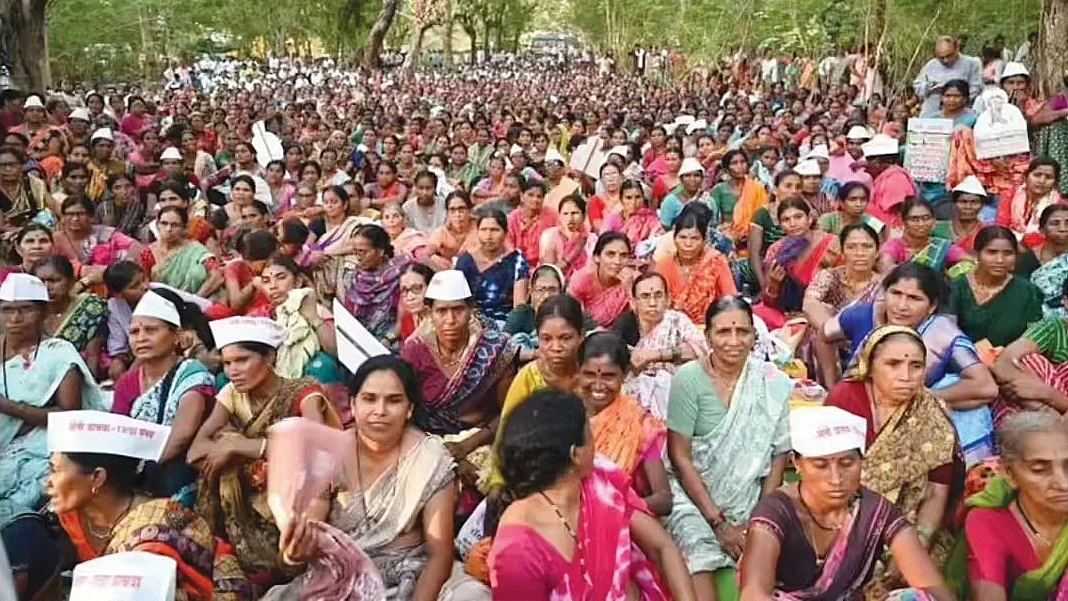


The guns have fallen silent in Gadchiroli with the end of Maoism. But a new battle is emerging over forests, land and the future of India’s minerals frontier.
For three days this month, thousands of tribal farmers sat in protest near Chamorshi in Maharashtra’s Gadchiroli district. Their demand: stop acquiring our land.
On 12 May, the state government approved the acquisition of more than 311 hectares in four villages for a proposed airport, and sanctioned about Rs 77 crore as compensation to villagers. Meanwhile, the Maharashtra Industrial Development Corporation (MIDC) is moving ahead with plans to acquire nearly 3,000 hectares across 14 villages in Chamorshi tehsil for a proposed Rs 1 lakh crore steel plant of the JSW Group.
Beyond the recent announcements of scattered land acquisition lies a far bigger plan involving thousands of hectares of forest and agricultural land in this unspoilt southeastern corner of the state for mining infrastructure, steel manufacturing and other industrial projects.
Faced with growing resistance, the government has temporarily suspended some of the planned acquisition, but protesters know from experience that the pause won’t last.
The current, spontaneous agitation is not simply about compensation, though. It is about the future of this pristine forest district (nearly three-quarters of Gadchiroli is under forest cover), which has become the site of a gigantic resource-extraction enterprise.
Earlier this year, in the budget sessionof the state legislature, Maharashtra chief minister Devendra Fadnavis announced that Gadchiroli would be transformed into a steel hub, promising over Rs 2.6 lakh crore worth of investments and the creation of 70,000 jobs. The district, long associated with Maoist insurgency, is being recast as the state’s next big industrial hub.
It doesn’t seem to matter that this grand ambition will destroy thousands of acres of pristine forests, perennial rivers and forest-based livelihoods. The iron ore deposits that lie under these forests will fuel steel plants, logistics corridors and a new manufacturing economy. Corporates close to this regime have long been eyeing these deposits.
A look at the ongoing road works reveals that the government wants to connect the ports on the east coast to those on the west. The BJP+ governments in the state and at the Centre present this as a story of development finally reaching one of Maharashtra’s most neglected regions. But local residents, tribal rights activists and environmentalists foresee devastating consequences for their ecology, economy and cultural habitat.
****
Gadchiroli is not unique. Variations of the same story are playing out across central India. In Bastar, in the mineral-rich districts of western Odisha, and in the forested areas stretching across Chhattisgarh, Jharkhand and Maharashtra, the decline of Maoist influence is rapidly opening up large swathes of land for mining and other industrial projects.
For decades, security concerns and political instability cut off corporate access to the rich mineral deposits in these parts. But now that insurgency has been quelled and those Maoist barriers are breaking down, the pent-up appetite for mineral extraction is in full view.
Gadchiroli may be the clearest example of this transition.
It is one of the most densely forested districts of Maharashtra, with nearly 76 per cent of its area under forest cover. Beneath these forests lie substantial deposits of iron ore, particularly around the sacred hills of Surjagarh in central Gadchiroli. Mining in the area was discussed for years but remained constrained by a combination of local opposition, legal disputes and Maoist activity.
Today, vast stretches of this once-remote landscape witness a fever of mining activity, truck traffic, security deployments, new and expanding infrastructure and a marked inflow of non-tribal migrants into what used to be a quiet tribal landscape.
As the state pushes ahead with plans to turn Gadchiroli into a steel hub, many villagers see Surjagarh as a preview of what awaits the district’s remaining forests.
Tens of mining permits are in the queue for clearance. The state’s vision is quite straightforward. Iron ore will be extracted from the forests while steel and related industries will be set up outside the forests. Roads, rail links, the proposed airport, industrial estates and logistics infrastructure will connect the mines to processing centres and markets.
Officials argue that the new manufacturing infrastructure will generate employment, increase local incomes and integrate Gadchiroli into the broader economy. But this vision elides the crises that will ensue from the appropriation of land.
The annexation will likely employ the subterfuge of classifying some of these forest lands as wastelands, arbitrarily curtailing or denying community forest rights. That these acquisitions will flout the democratic consent and framework of the Panchayats (Extension to Scheduled Areas), Act, 1996, is no kind of deterrent for the current dispensation.
Environment groups have repeatedly warned that mining in and around Surjagarh threatens a crucial wildlife landscape connecting the forests of Maharashtra and Chhattisgarh. The Tadoba-Indravati corridor, which enables tiger movement between protected areas, passes through parts of this region. Even the National Tiger Conservation Authority (NTCA) has raised questions about the approvals, but to no avail. All red flags have gone unheeded.
****
Gadchiroli is an ecologically sensitive and socially vulnerable district. Emerging from the shadows of four decades of armed conflict that claimed thousands of lives, it needs a cooling period. But the headlong rush to reclaim its land for ‘development’ will make no allowance for these niceties.
What happens to the tribal populations it will permanently displace? What of the tiger corridor it will fragment and likely ruin? Can it ever be restored?
The irony is particularly striking in Gadchiroli because many of the forests now targeted for extraction have survived precisely because local tribal communities protected them. For years, villages in the district have been celebrated for community forest rights, for their gram-sabha-led forest management and innovative local governance. These experiments demonstrated that forests can be conserved even while supporting livelihoods. But these landscapes are no longer being seen as ecological assets that also sustain other ways of life but as mineral treasures awaiting plunder.
The proposed Shaktipeeth Expressway, from the tribal hinterland of Gadchiroli to Goa, illustrates the scale of this transformation. Its votaries in government and outside view it as a vital infrastructure project that will link regions and facilitate economic growth. But that spiel aside, it is a conveyor belt for minerals, industrial goods and capital. It is being designed as an artery of India’s great extractive economy, stretching from the forests of central India to ports and export markets.
The story unfolding in Gadchiroli is much larger than Gadchiroli itself. For years, the district symbolised a conflict between the Indian state and Maoist insurgents. That conflict may finally be fading away, but the contest over competing visions of land, forests and the future is still alive. The guns may have fallen silent, but the struggle over who controls the forests has perhaps only just begun.
Jaideep Hardikar is a senior Nagpur-based journalist and author of Ramrao: The Story of India’s Farm Crisis. Read more by him here
Join our official telegram channel (@nationalherald) and stay updated with the latest headlines