


Is the ‘golden gate’ closing on India?
What makes Chabahar’s unravelling so consequential is New Delhi’s prior insistence on the port being a national necessity
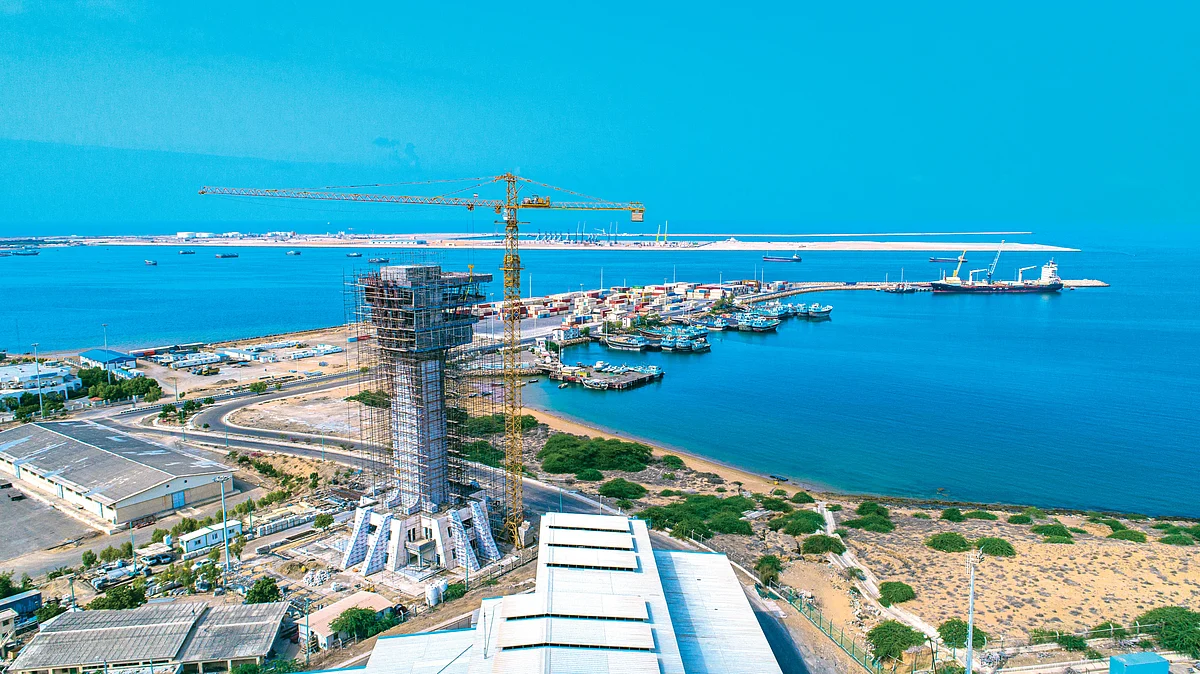


For two decades, Chabahar was never just another foreign infrastructure stake for India. It was the rare project where geography, strategy and commerce aligned so neatly that even chronic delays and diplomatic headwinds could not dilute the logic.
A deep-water port on Iran’s southeastern coast, outside the Strait of Hormuz, Chabahar offered India a way to bypass Pakistan’s longstanding efforts to block direct access to Afghanistan and Central Asia. It was also India’s subtle, civilian and commercially defensible response to China’s increasingly muscular footprint next door at Gwadar in Pakistan.
Chabahar was never intended as a mirror-image of Gwadar. Managed by a Chinese operator since 2013, Gwadar anchors the China-Pakistan Economic Corridor and fits within Beijing’s broader Belt and Road Initiative.
Chabahar, by contrast, was India’s attempt to build a parallel corridor that did not run through disputed territories or come bundled with the strategic obligations that follow Chinese financing. It sent a signal to Central Asia and to Russia that India could be a serious connectivity player, not merely a market at the end of someone else’s supply chain.
Chabahar’s geography matters for another reason that is rarely stated. It sits on the Gulf of Oman, at the mouth of one of the world’s most sensitive maritime arteries. In any crisis that rattles the Persian Gulf, the Strait of Hormuz becomes the pressure point for global economic security because roughly a fifth of global petroleum consumption transits that narrow passage. That is why the port’s current limbo is more than a logistical inconvenience — it is a strategic setback.
Sanctions announced by America were the immediate catalyst, sharpened by an overt tariff threat from President Donald Trump. On 12 January, Trump warned that any country doing business with Iran could face an additional 25 per cent tariff on all trade with the United States. For India, already balancing trade negotiations, and wider strategic cooperation with Washington, this is not a theoretical risk. It is a direct demand to choose.
But what makes Chabahar’s unravelling so consequential is that New Delhi has long insisted the port was not a luxury but a national necessity. Pakistan’s denial of overland access turned India’s extended neighbourhood strategy into a map with missing connections that Chabahar aimed to redraw.
It anchored India’s role in the International North South Transport Corridor, linking Indian ports to Iran, Central Asia, Russia and Europe while offering landlocked Central Asian states a rare route to the Indian Ocean that reduced dependence on China.
Such strategic imagination required something the Modi government does not always sustain abroad — patience backed by operational continuity. The 10-year operating contract signed in May 2024 was supposed to be the turning point. Yet the last few months suggest the project has slipped from ‘strategic necessity’ into ‘sanctions exposure’.
In September 2025, Washington moved to revoke the sanctions carve-out that had previously insulated Chabahar-related activity. A US State Department release tied to ‘maximum pressure’ measures specified an effective timeline, underlining that Chabahar would lose its special status. India then obtained a conditional six-month waiver beginning late October 2025, reportedly valid until 26 April 2026, which is more a temporary reprieve than a vote of confidence.
And then came India’s decision to ‘liquidate’ its financial exposure by reportedly transferring approximately $120 million to Iran, effectively completing its committed investment while relinquishing operational responsibilities. There were also reports of directors linked to India Ports Global resigning and the company’s website being taken down.
This is where official denials start sounding like wordplay. A government can insist it has not ‘withdrawn’ while ensuring, in practice, that it no longer carries financial, managerial or operational risk and responsibilities.
Chabahar’s importance was always disproportionate to its immediate trade volumes. Its real value lay in its leverage over Pakistan and in the wider competition shaping Eurasian connectivity. India did not need Chabahar to outcompete Dubai or Singapore. It needed it to remain present — physically and politically — in a region where absence is quickly filled.
If Chabahar stalls, the winners are obvious.
Pakistan regains the satisfaction of strategic denial. It has long used geography as a veto. Chabahar reduced that veto, at least partially, by making the Afghanistan-India link less hostage to Pakistan’s policy. Without an India-operated Chabahar that can be reliably used for trade and humanitarian shipments, India’s options are narrowing again. It has to either accept Pakistan’s gatekeeping or rely on more circuitous, expensive, less controllable routes.
China, meanwhile, gains a narrative victory. Beijing has spent a decade presenting itself as the only power that can build connectivity at scale — ports, roads, railways, pipelines — without getting tangled in Western sanction regimes or domestic political cycles. India’s perceived retreat reinforces that story. It tells partners in Central Asia and West Asia that India’s signature projects are contingent, impressive on paper, fragile under pressure.
What makes the current moment more damaging is the pattern it reveals. Chabahar is not an isolated retreat. Since 2022, India has reportedly lost operational control of its only full-fledged overseas air facility at Ayni in Tajikistan, a base it had developed and co-administered for nearly two decades before quietly winding down and exiting. Together, they shrink India’s strategic depth across the Iran-Afghanistan-Central Asia arc precisely when China and Pakistan are tightening theirs.
The deeper problem is what this says about India’s strategic autonomy. Autonomy is not measured by speeches about multipolarity but by the proven capacity to sustain long-term commitments when costs rise. Here, the cost is not only financial. It is the willingness to absorb friction with Washington, or at least negotiate exceptions with enough confidence and creativity for a flagship project not to end up in a six-month hospice ward.
The government may argue that India cannot jeopardise a far larger economic relationship with the US for a single port. That is not wrong. The real failure lies in allowing Chabahar to remain perpetually sanction-vulnerable, with too little multi-lateralisation, too little insulation through broader stakeholder coalitions and too much reliance on a US waiver that could be revoked by the stroke of a pen.
There were always ways to distribute risk. India could have tried deeper coordination with Europe on connectivity to Central Asia; stronger institutional embedding of Chabahar within a wider framework of humanitarian exemptions; even a more candid domestic conversation about what India was willing to pay, politically, to sustain access to Eurasia.
Instead, the government appears to have opted for the least costly short-term path — wind down quietly, issue formal denials and hope time restores room for manoeuvre.
But geopolitics rarely refunds lost time. More than concrete and cranes, a port is presence. When presence recedes, someone else steps forward, often with money, security personnel and a ready-made corridor plan.
Chabahar was India’s ‘golden gate’ to a strategically vital but elusive region. If that gate is closing, it will not simply be an administrative setback. It will be a strategic concession, one that China and Pakistan will capitalise on. And one that India will spend years trying to reclaim in an increasingly harsh connectivity landscape.
Ashok Swain is a professor of peace and conflict research at Uppsala University, Sweden. More by the author here.
Join our official telegram channel (@nationalherald) and stay updated with the latest headlines